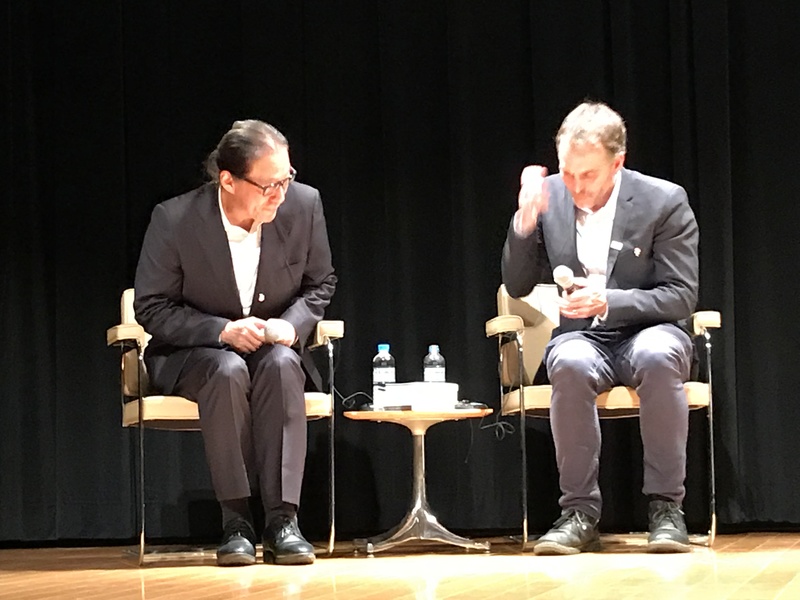
"A lot of my work is about the body," Alexander MacLeod said at the Canadian Embassy one evening in July.
MacLeod, an award-winning author of short stories, was there to give an overview of contemporary Canadian literature, speak about his own work in light of the human body and other themes, and engage in an onstage chat with Japanese author Durian Sukegawa.
Sukegawa, whose novel "An" ("Sweet Bean Paste") was turned into a movie, at one point reminisced about being taken to play bingo during a monthlong stay on the Canadian island of Newfoundland. MacLeod jokingly remarked that it sounded like "an archetypical Canadian experience."
During a more serious part of the presentation, MacLeod stressed the significance of short stories in Canadian literature, calling Alice Monroe -- who won the 2013 Nobel Prize in Literature for her short stories -- one of the nation's most important writers.
He also introduced a litany of "young [Canadian] writers you should pay attention to," including Eden Robinson, Leanne Simpson, Madeleine Thien, David Bezmogis and R.W. Gray, all of whom have published short story collections.
MacLeod's own collection, "Light Lifting," comprises seven stories in which readers can see the three elements that MacLeod listed to explain how stories work: contrast, connection and communication.
Reflecting MacLeod's interest in the body, his characters have very physical experiences, from bricklaying to making deliveries by bicycle to caring for a sick child to experiencing a wreck on the highway. The element of contrast is the easiest to see in bodily terms, as several of the stories sharply contrast the wonderful powers a body can hold and the terrible harms it can suffer.
In one of them, a woman finds herself in danger in a river at night. She is a strong, smooth swimmer who is confident that she could literally swim across the river from Canada to the United States, but in her moment of distress MacLeod gives us a flashback to a time when she nearly drowned at a beach as a child. The story whips her back and forth between pride at her hard-won skill in the water and dread at how deadly the water can be.
Sukegawa said that he was impressed by MacLeod's description of the near-drowning, and read part of it to the audience. "She reached out her arms, but there was nothing to hold onto and she felt like a person fumbling for the light switch in the middle of a dark room with a high ceiling and the walls moving further apart. It could go on forever. She knew this. The ocean could go on forever."
Another story in "Light Lifting" is about two friends who are Olympic-level runners. Their intense dedication to just one thing makes them different from most other people, and is part of a connection they find impossible to communicate to anyone else.
Sukegawa's novel "Sweet Bean Paste" is also about characters outside the mainstream, including one who was literally banished: a former leprosy patient who spent most of her life in an institution as a matter of government policy.
If one theme of MacLeod's stories is what it is like to inhabit a body, it could be said that one theme of Sukegawa's book is what it is like to be perceived as a body.
"When I read 'Sweet Bean Paste,' I was struck by the dignity of each character in their individual circumstances," MacLeod said.
"There are dark elements in the world. If fiction can't explore darkness in fair ways, then it's not doing what we need fiction to do," he said, while also noting light in the darkness. "Even as that [former patient's] life is running out, it has a moment of pure grace ... [The book shows that] in the hand of a great artist, that you can take darkness and make beauty out of it. And in my running story, those characters are so far away from normal that I was interested in the way that they became intimately connected to each other. Their relationship is intimate, and beautiful, and maybe a love story of a certain kind, but it never escapes the antisocial elements that are embedded in it."
Although his work has been deservedly praised, MacLeod did acknowledge one common complaint about his story about the two runners: "Everyone would like a happier ending."
Read more from The Japan News at https://japannews.yomiuri.co.jp/