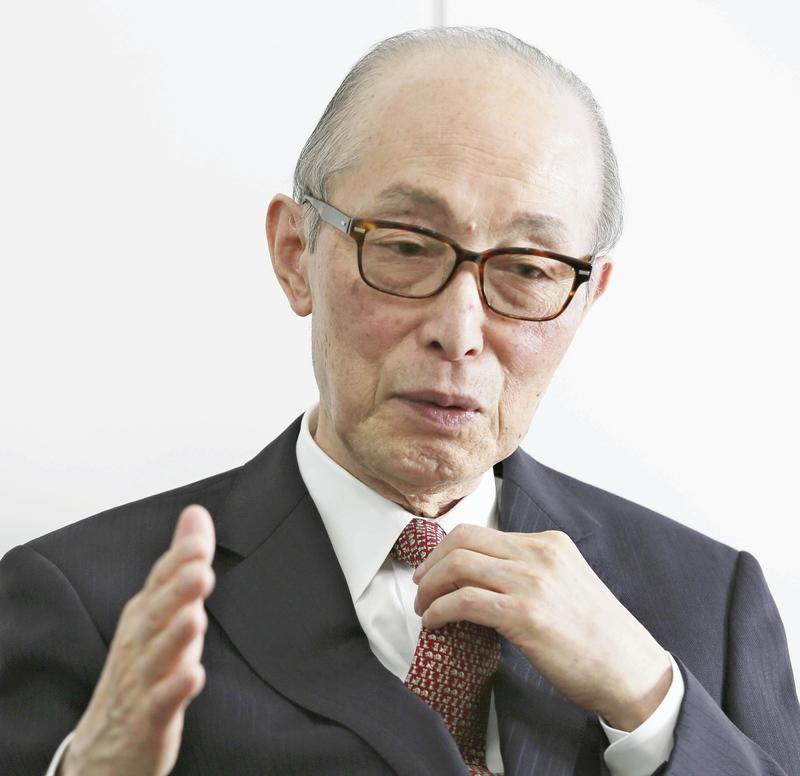
When the Heisei era began, the post-bubble Japanese economy entered a long period of stagnation. Trapped in a situation in which there were even whispers of a "financial crisis born in Japan," the public's opposition to "powerful banks" at the start of the Heisei era was strong. Positioned between the quietly approaching crisis and public opinion, what were the thoughts of those in charge of policy? The Yomiuri Shimbun posed the question to Yoshimasa Nishimura, the former director general of the Banking Bureau at the Finance Ministry.
Up to the early 1990s, there was an overflow of animosity toward banks, which had been at the height of their prosperity since the 1980s. This feeling was shared not only by the people, but also political and business circles, even the press. I once asked a powerful politician -- a policy expert and very rational -- in the ruling party about banks' disposal of bad loans. When he said that it was "their own fault," it made a particular impression.
In the summer of 1992, Prime Minister Kiichi Miyazawa, who early on sensed a financial crisis approaching, insisted on bracing for the crisis by using public funds. He said that it was advice from Yasushi Mieno, the governor of the Bank of Japan. As usual, however, the public paid no mind. The Federation of Economic Organizations and the Federation of Employers' Associations showed an icy attitude immediately. Using taxpayer money on banks that were unpopular even among the business community close to them, I figured the public would never have it.
Two years later, however, in the summer of 1994, when I became director general of the Banking Bureau, the situation had grown more strained. The management of financial institutions had taken a terrible beating by a series of sharp declines in land prices. I resolved that bankruptcy procedures and injections of public funds for several banks were unavoidable.
[The Finance Ministry, instead of using taxpayers' money to resolve bankruptcies, outlined its plan to fully protect deposits and clear an "exit" for bankrupt financial institutions. The first test came in December 1994, with the bankruptcy resolution of two credit unions, Tokyo Kyowa and Anzen (see below).]
At first, public opinion favored a resolution framework of having the Bank of Japan and other institutions put up financing to create bridge banks. But we were soon engulfed in a blaze of criticism.
Perhaps you remember the name EIE International? It was a real estate and development company that took out huge loans from the two credit unions and later went bankrupt. On top of the fact that the man who ran it was also chairman of the board for Tokyo Kyowa, there was much talk about his involvement in scandals through close relations with powerful politicians and excessive entertainment of Finance Ministry bureaucrats.
The public drew the conclusion that resolving the two credit unions was a "relief measure with politician involvement" and strongly opposed it. Just then, the Tokyo gubernatorial election took place. Yukio Aoshima, probably thinking this theme would be well received in the election, ran with the slogan "We won't accept the disposal of the two credit unions" and won. The resolution of Tokyo Kyowa and Anzen had transformed from a simple policy dispute to a problem mired in scandal and political strife.
[The resolution of the housing loan company problem (see below) the following year, 1995, drew a firestorm of public criticism.]
The housing loan company problem was regarded worldwide as a symbol of Japan's bad loan problem. Of course, it was not that everything would be fixed by resolving the companies. But the situation was that if we did not resolve them well, we would not be able to wipe away misgivings about fluctuations in the financial system.
A difficult problem was how to divide losses and responsibility regarding the enormous 6.4 trillion yen in losses held by housing loan companies. The main factor that deepened the confusion was the fact that the biggest lenders to housing loan companies, the agricultural and forestry financial institutions comprised of agricultural and other cooperatives, insisted that they would absolutely not take on anything above a fixed limit. Negotiation was terribly difficult, and in the end we acceded to them. As a result, we ended up using 685 billion yen in taxpayers' money to offset the loss.
I think the public's criticism was only natural. There was a sense of unfairness that the politically strong groups, like agricultural and forestry financial institutions, would profit. There was also opposition to banks and distrust of the Finance Ministry. Of course, there was also major opposition to the unprecedented injections of enormous amounts of tax money. There were not enough explanations, as well. No matter what it was, I feel a sense of responsibility that this successive turmoil sank trust in the administration.
[There is a view that the successive turmoil involving public funds led the ruling parties to hesitate to inject capital and deepened the crisis.]
On the other hand, I think something significant was born from the turmoil.
[The process of the bubble bursting brought relations between the criminal underworld and financial institutions to light, such as the shooting death of the Hanwa Bank vice president in summer 1993 and the shooting death of Sumitomo Bank's Nagoya branch manager in September 1994. There were a series of cases that suggested the criminal underworld's involvement.]
Until a certain time, there was a strong spirit that financial circles would "finish resolving the bubble on their own." But violent crimes continued and the number of likely unsolved cases rose. As time went by, they were assailed by the fear that money and human life would be sucked up by the underworld.
There was certainly the logic of a "close-knit financial community" comprised of financial institutions and the government. For example, the "inside government/inside industry scandals," such as embezzlement, were first investigated internally and then reported to the police afterward. This insular system took strong criticism.
At this time, they decided to break with the conventional wisdom of the financial world, which dealt with things below the surface, and to make everything public, so that criminal hands could not touch them although they could no longer escape. They made up their mind, regarding it as all that was left for them.
I started to actively communicate with the judicial administrations and the police. I got many people from legal circles to lend their help in resolving bad loans, one of them being attorney Kohei Nakabo, who as the first president of the Resolution and Collection Corp. made efforts at collecting bad debt.
[Nishimura resigned as director general of the Banking Bureau in summer 1996. The following year, 1997, Yamaichi Securities and the Hokkaido Takushoku Bank went bust. Confusion spread in 1998, with the temporary nationalization of the Long-Term Credit Bank of Japan (LTCB) and the Nippon Credit Bank (NCB), and the government was pressed into taking action such as injecting huge amounts of capital in major banks.]
I think back to the days being dogged by the housing loan companies issue and what it was all for. It was certainly the "doorway" to tremendous change, but I do have regrets over whether it could have been managed a bit better.
Kaoru Yosano, who served in such posts as finance minister, has left behind words that illustrate this point.
"A national trait of the Japanese is that they cannot understand something unless they experience it. [Loss] turns into uproars like the housing loan companies at the abstract stage. When the LTCB and NCB went bankrupt, that was the first time they knew that injection of public funds was unavoidable and that it was their problem." [From "Kensho Bubble: Han-i-naki Ayamachi" (Examination of the bubble economy: errors without criminal intent) and other works]
That aspect is certainly there. The West has also experienced financial crises, and it has become common knowledge that, in the end, public funds are used toward bankruptcy resolution and preventive measures. That is why the fumbling of 1990s Japan could not have been helped. I think we did the best we could within the constraints of the era.
There is only one year left to go in the Heisei era. The situation of Japanese banks nowadays, struggling to survive with globalism and financial technology innovation, is a contrast to that when the banks were so strong as to be hated for being "full of themselves." It makes me feel that the time that has passed, 30 years, was truly long.
(From The Yomiuri Shimbun, Aug. 17, 2018)
-- Yoshimasa Nishimura / Former director general of the Banking Bureau at the Finance Ministry
Born in Shiga Prefecture in 1940. Graduate of the University of Tokyo Faculty of Law. Joined the Finance Ministry in 1963 and after posts such as director general of Osaka Customs, served as deputy director general of the Banking Bureau from 1989, president of the Institute of Fiscal and Monetary Policy from 1992, and as director general of the Banking Bureau from 1994. After leaving the ministry in 1996, his work has included serving as a professor at Waseda University. He is 77.
-- Bankruptcy resolution of Tokyo Kyowa and Anzen credit unions
These two credit unions went insolvent with approximately 110 billion yen of debt and gave up trying to rebuild themselves. In December 1994 the Finance Ministry, Bank of Japan and Tokyo metropolitan government created a bridge bank with investment from the Bank of Japan and other institutions, and decided on measures for transferring the credit unions' liquidated businesses.
-- Housing loan company problem
Seven housing loan companies that had been created by major banks as firms specializing in such loans fell into managerial crisis, with a total of 6.4 trillion yen in losses. The parent banks including city banks involved in their founding rescinded all their financing, with other banks taking on burdens according to the amount lent, but the agricultural and forestry financial institutions, comprised of agricultural and other cooperatives, resisted, saying they could not shoulder any amount over 530 billion yen.
Read more from The Japan News at https://japannews.yomiuri.co.jp/