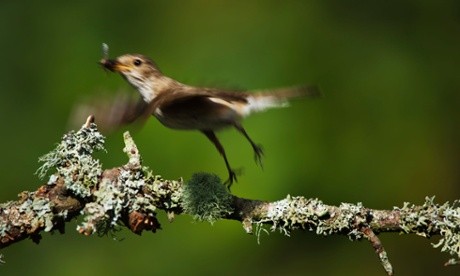
It is not easy to turn one’s thoughts from the horror of recent calamity and really enjoy nature, yet the peaceful beauty of the rapidly unfolded and developed foliage commands attention even when the heart is heavy; seldom has summer come so swiftly. Among the trees the ash alone delays; the oak has fairly beaten it this year, and the spreading leaves of the horse chestnut have suddenly been topped by towering spikes which in a few days will be ablaze with waxen flowers. Standing beside a shallow pool, shimmering in the sun, we gazed on one of the Cheshire commons at its very best; in front were the young spruces, deep green, with here and there the graceful birches in striking contrast, and as a background the ancient Scots pines, almost black beside the tender green of the youthful foliage of slender larches. A little bird, pale grey in the sunshine, sallied from a rail which bounded a thorn hedge full of promise of snowy blossom, turned, dodged and twisted, snapped, at something in the air and returned to its perch on the rail. There it sat, very upright, it’s grey streaked breast and white underparts towards us; then off again and again, each time it caught sight of some passing insect. It was the spotted flycatcher, one of the latest migrants to arrive, energetically performing a useful work, one indeed which is being urged as necessary, the destruction of flies. Three black terns, birds which have a peculiar interest because they once nested regularly in England, paid a passing visit to one of the Cheshire meres and were noted by one my regular correspondents, and a few days before he saw a lesser tern on the same water; passage migration is at its height.