A small group of American universities is crossing a threshold that once seemed absurd: $100,000 for a single year as an undergraduate.
At least 16 institutions are now approaching or exceeding that figure when tuition, fees, housing and other miscellaneous costs are combined, according to a recent analysis by New York Magazine. The list — corroborated by data obtained by CNBC — is dominated by elite, high-demand schools, including the University of Chicago, Georgetown University and Wesleyan University.
College costs have surged in the past 40 years but the leap to six-figure price tags — both a financial and psychological milestone — raises new questions about how colleges set prices, who ultimately pays and whether the higher education market is nearing a breaking point.
Yet, beneath the headline-grabbing figure lies a more complicated reality. Even as top-line prices hit new highs at elite schools, overall tuition prices have slowed, or even reversed, in recent years. And while the six-figure price tag commands attention, relatively few students actually pay full price, experts told The Independent.
Understanding how the U.S. arrived at this moment — and what it portends for the future — requires looking beyond the sticker shock.
A long climb, then a plateau
For decades, college tuition seemed to climb relentlessly upward. Richard Vedder, an emeritus professor of economics at Ohio University, recalled a dramatically different era.
“At my university, in the mid-'60s when I started teaching, the tuition fee was $450 a year,” he told The Independent. “In today's dollars, that'd be about $4,000 a year. And the reality is the current tuition is more than three times that. And that same picture holds with regards to private schools.”
For much of the postwar period, tuition rose modestly — typically just a percentage point or so above inflation. That changed sharply after 1980.
“Tuition fees really started taking off,” Vedder said, pointing to the expansion of federal student loan programs as a key driver. “Universities said, ‘What the heck? We'll just raise fees more aggressively than before because people would just go out and borrow the money fairly cheaply from the federal government.’”
Cost structures have also evolved. Vedder argued that “administrative bloat” and expensive investments have played a major role, describing what he sees as a proliferation of non-teaching staff and layers of management.
“We have nine provosts [and] associate provosts. When I started teaching, we didn't have any,” he said. “What the hell do they do? I've been wondering that for years.”
Others dispute that explanation, or at least its scale. Phillip Levine, an economics professor at Wellesley College, said the focus on administrative excess is often overstated.
Spending that appears extravagant — luxury dorms and resort-style amenities—often serves a strategic purpose. Public universities, in particular, invest in such features to attract out-of-state students who pay higher tuition and can help subsidize in-state enrollment, he told The Independent.
A deeper structural issue, Levine said, is that colleges have seen little productivity growth. Unlike other sectors, higher education cannot easily increase output without sacrificing quality.
“For the most part, the education enterprise hasn't changed in a very long time…There’s no efficiency gains,” he said. Faculty still teach classes, grade work and mentor students much as they did decades ago. Meanwhile, institutions must compete in the same labor market as other industries, where wages have risen alongside productivity.
“And so if everybody else is getting wage increases in the rest of the economy, higher education has to do that too to compete for workers,” Levine said.
Despite these pressures, overall college tuition growth has slowed significantly, or even reversed, over the past decade, said Sandy Baum, a nonresident senior fellow at the Urban Institute, told The Independent.
Between roughly 2015 and 2025, average sticker prices at private four-year institutions rose just 2 percent in inflation-adjusted terms. Prices actually fell 7 percent at public four-year institutions over the same period, Baum said, citing data from the non-profit, College Board.
“It’s clear that prices have leveled off in recent years. No one has really noticed that,” she said. “The conversation still seems to assume rapidly rising prices.”
The pandemic — which saw a major drop in student enrollment — played a part in the slowdown. And as inflation surged, colleges were reluctant to raise prices aggressively, she said.
The meaning of $100,000
If overall tuition growth has cooled, why are some schools now breaching the $100,000 mark?
Part of the answer lies in how college pricing actually works. The published price is not what most students pay.
“The most important thing to keep in mind when you're having these sorts of discussions is recognizing that not everyone pays the sticker price,” Levine said. The sticker price is the “maximum price,” which, in practice, is only paid by students from higher-income families, such as those making over $400,000 per year.
Colleges increasingly rely on institutional aid to discount tuition for a large share of their students. Vedder estimated that the average discount rate is now around 50 percent, meaning schools often collect less than half of their stated price.
Baum similarly noted that “most students at the expensive places don’t pay the full price because they give very generous institutional grant aid.”
In that sense, the $100,000 figure can be misleading. It functions less as a universal price than as a ceiling in a highly segmented market.
Still, the figure carries both material and symbolic weight — especially given that Americans already spend roughly twice as much on tuition as their peers in other developed countries.
“It’s a threshold, so the reason why it matters is because it catches people’s attention,” Levine said. “There’s no doubt that $100,000 is a lot of money per year.”
That attention can shape public perception, even if the underlying economics are more nuanced. For families who do not qualify for substantial aid — and for those simply trying to make sense of the complicated system — the headline figure reinforces a sense that higher education is becoming increasingly unaffordable, he said.
At the same time, most of the schools flirting with $100,000 per year sticker prices, which include Barnard, Duke and Vassar, have enough prestige and demand to avoid major discounts, New York Magazine noted.
Many Americans have readjusted their plans accordingly. Last year, an Ipsos survey revealed that 79 percent of families making over $100,000 wrote off a college option due to high costs. This figure stood at 61 percent in the mid-2010s.
These considerations come as student loan debt has more than doubled over the last 20 years. As of September 2023, roughly 43 million Americans collectively owed more than $1.6 trillion in federal student loans, according to the Council on Foreign Relations. When private loans are factored in, that total surpasses both auto and credit-card debt.
Colleges, for their part, defend their pricing models by pointing to the net cost after aid. A spokesperson for Wesleyan University, where the cost of attendance exceeds $100,000 for the coming academic year, told The Independent that the school “commits to meeting students’ demonstrated financial need and, on average, students receive grants totaling $69,744.”
A narrowing pipeline
Demographic and economic forces are already reshaping the higher education landscape in ways that have dampened demand — and this trend could accelerate in the future, experts said.
Between 2010 and 2021, colleges and universities experienced a 15 percent decline in enrollment, according to the National Center for Education Statistics. Around 60 higher education institutions are shuttering every year, a 2024 Federal Reserve Study found.
One of the most significant factors is the so-called demographic cliff: a decline in the number of college-age students driven by falling birth rates.
“There are going to be fewer 18-year-old Americans graduating from high school five years from now than there are now,” Vedder said.
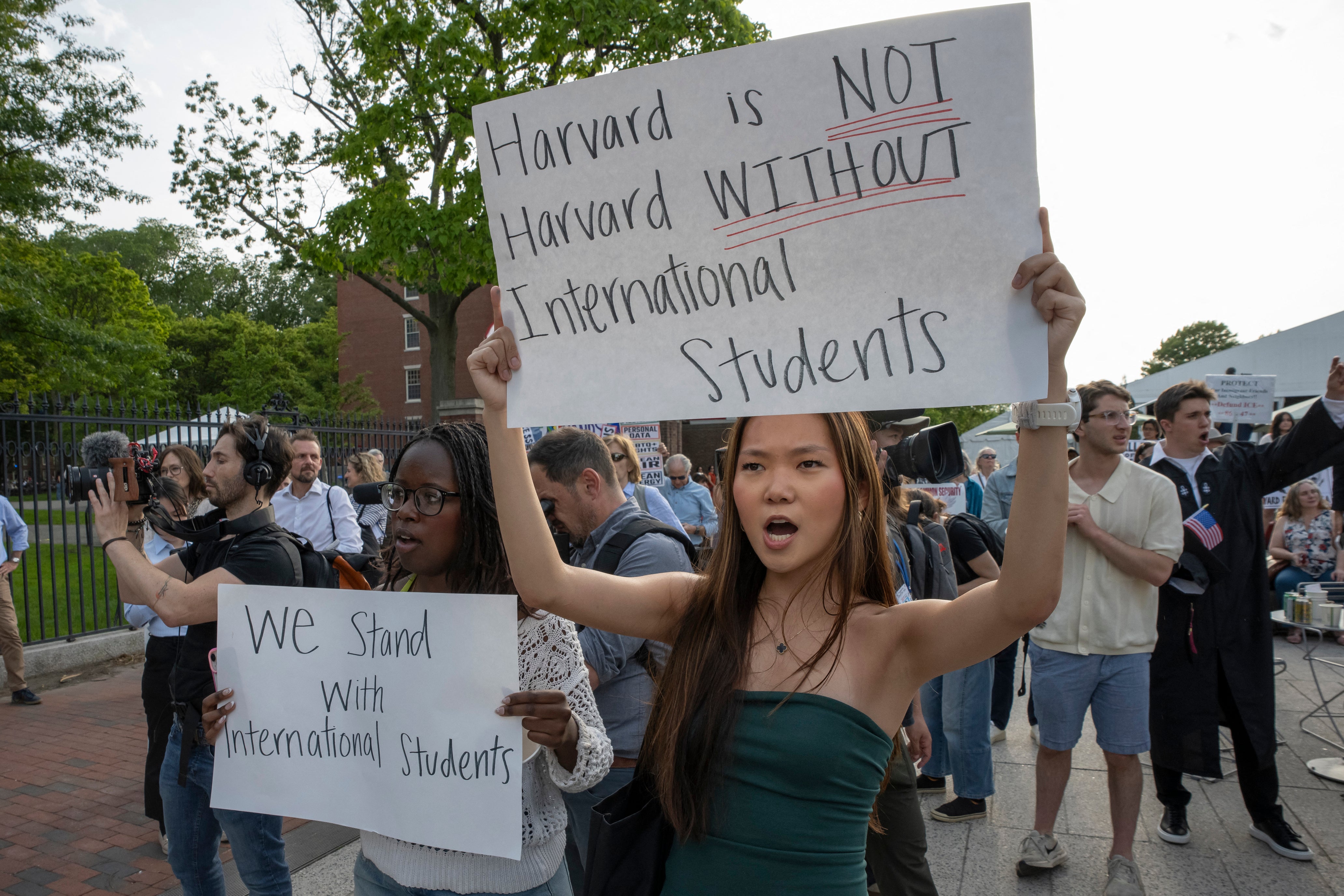
A decreasing number of international students, long a crucial source of revenue — often paying full tuition — add another layer of uncertainty. Recent Trump administration restrictions on immigration have already shrunk that pipeline for the first time in years.
“To the extent that we make it unpleasant for them to want to be here or because we just outright restrict them, once you change that and once you change the culture, who knows how long it will be before they, if and when they return,” Levine said.
These pressures are likely to play out unevenly. Highly selective institutions with strong reputations, like those in the Ivy League, are expected to remain in high demand, multiple experts said. Less selective colleges, however, may face tougher choices. Declining enrollment, combined with already high discount rates, could strain finances and force closures or consolidations.
Vedder also pointed to shifting labor-market dynamics. While unemployment among college graduates remains relatively low, underemployment has risen, reaching a six-year high of 42 percent this year, according to Forbes.
At the same time, new technologies such as artificial intelligence are beginning to reshape job prospects, complicating families' college-making decisions.
“AI is kinda cool, but it's replacing brainpower,” Vedder said. “And so the labor market has turned in a way that has disadvantaged colleges.”
He added: “If I were guessing, there would be fewer kids going to college, say, three years from now, five years from now. And part of it will be people are scared away by these high fees.”
The public is largely on the same page. According to a 2025 NBC News poll, 63 percent of Americans believe a four-year degree is “not worth the cost.”