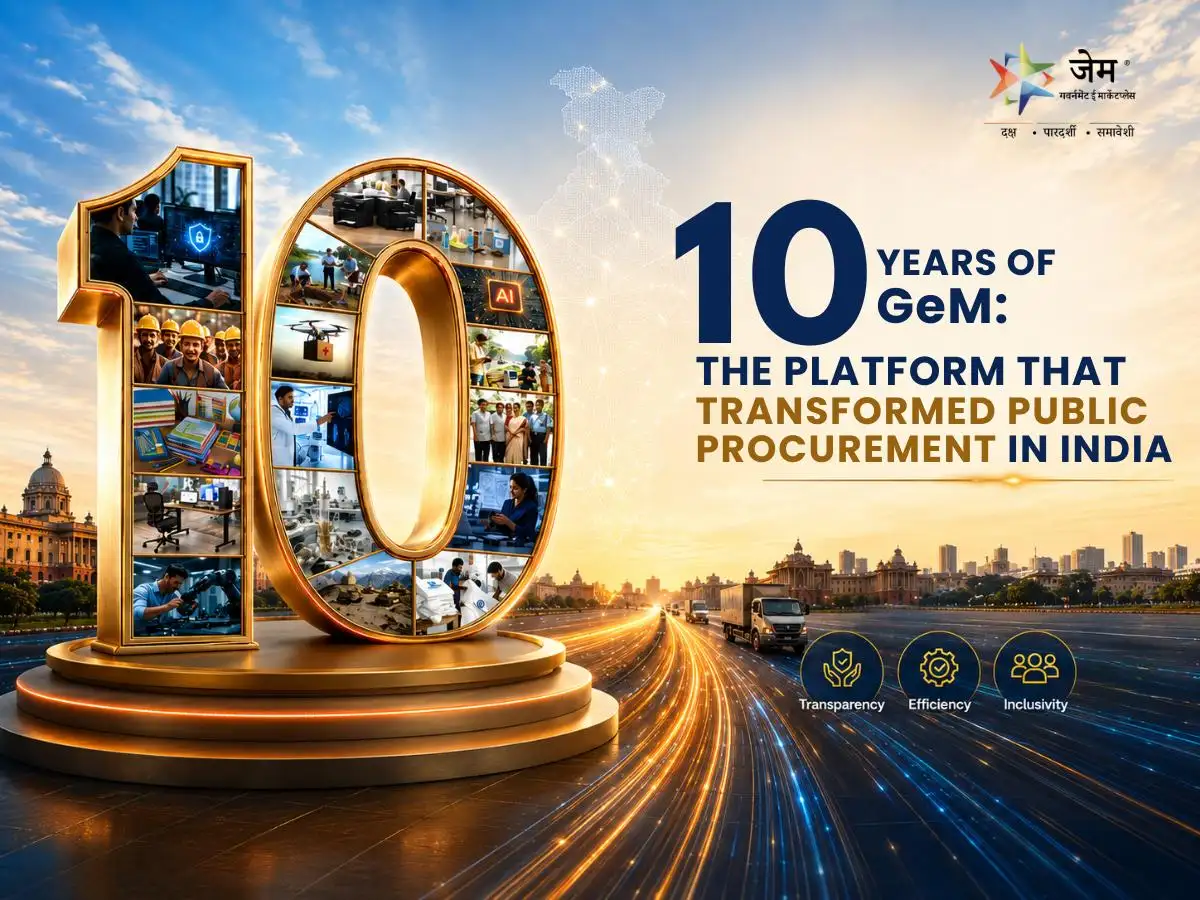
Government departments across India need things everyday: computers for a school, medicines for a hospital, furniture for a district office and much more. For decades, this purchase happened through a system that was slow, paper-heavy, and had access limited to select few. In 2016, the Government e Marketplace (GeM) was launched as a single online platform where government organisations, could easily buy goods and services from registered sellers, ranging from large companies to small-town entrepreneurs.
Ten years on, the more interesting story is not what GeM sold, but what it built in the process. Its true legacy does not lie in the volume of transactions or the categories it covered. It lies in something harder to quantify and far more durable: the confidence it created across an entire ecosystem of buyers, sellers, and institutions that never thought of easy access.
That confidence did not come on day one. It was built with every step, one decision at a time.
Reimagining Public Procurement
Public procurement, before GeM, carried friction. It was not just broken by design, but also accumulated the weight of the process, layers of paperwork, uneven access, and a system that rewarded those who already knew how to navigate it. For a small manufacturer in a district town, or a first-time entrepreneur without institutional backing, the marketplace of government buying often felt distant even with a genuine opportunity.
The Foundation of Transformation
This is where GeM's real innovation lies, not in the technology itself, but in what technology made possible: a procurement experience that behaved the same way every time, for everyone. Standardised systems removed discretion. Digital governance removed ambiguity. Every seller who won a bid and completed a transaction, every buyer who found a reliable supplier without friction, added one more data point to a growing, collective sense that the system worked.
Trust, in other words, became the product. And unlike most products, it compounded.
From Access to Empowerment
Once that foundation existed, the platform stopped being merely accessible and started being enabled. MSMEs found a market larger than they had imagined. Startups found early, credible buyers. Self-help groups, artisans, and weavers, many of whom had never sold beyond their immediate geography, found a marketplace that did not ask them to become someone else's vendor before becoming a supplier to the government. A weaver in a small town listing products alongside established manufacturers is not just a number. It is a form of participation that simply did not exist a decade ago.
Bringing more India into the Marketplace
The more the voices participate in a marketplace, the stronger it becomes. Every new participant - a woman entrepreneur, a rural producer, a small-town startup - did not merely benefit from the platform,they expanded it, adding depth and resilience to a system that grows stronger precisely because it grows wider.
Digital Infrastructure for Trust
None of this happens without technology. But technology is not the story here; it is the plumbing - invisible when it works. And it worked! Its purpose was never to impress; it was to make transparency effortless, and participation simple enough that trust could be the outcome, not the exception.