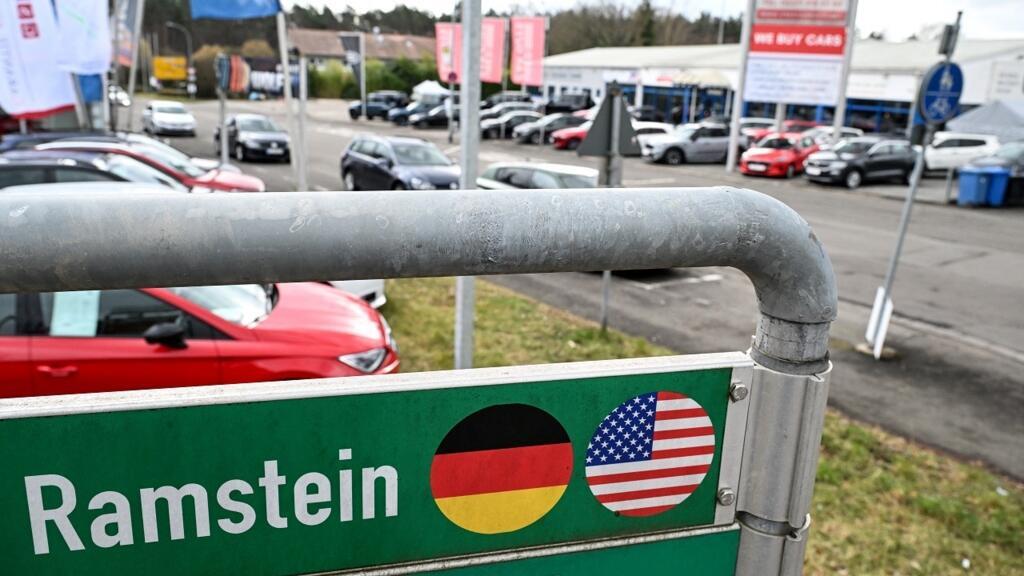
As Washington begins its review of the United States' military presence in Europe – confirmed this week by Under Secretary of War, Elbridge Colby – few observers welcome the prospect more than David Vine, a long-time critic of the sprawling network of American overseas bases.
Vine, an American anthropologist and the author of Base Nation and The United States of War, has spent decades documenting what he calls the US "empire" of military bases.
A fierce critic of US President Donald Trump and of US foreign policy in general, Vine nonetheless finds himself in agreement with the president: it is high time, he argues, for Europe to stand on its own two feet.
RFI: The US Secretary of War, Pete Hegseth, announced last June that Washington would review the US military presence in Europe. This process has now started, as confirmed by Elbridge Colby earlier this week. First of all, what is the main function of this military presence in Europe?
David Vine: The US presence in Europe has been characterised as defensive in nature. The record shows that US bases on the continent since the end of the Cold War have been primarily a platform for war-making in the Middle East. The war in Iran illustrates this with bases in Germany, Greece, Cyprus, Italy, Romania, the UK and beyond supporting US war efforts.
RFI: How big is the US military presence in Europe today?
DV: Massive. Since the Cold War's end, the US military has maintained a major presence around the continent. It’s one that I think should change. Despite disagreeing with Donald Trump on nearly everything, his rethinking of the US military presence in Europe is actually quite a good thing.
There are people around Europe who are rethinking the presence of the US military on their soil, given the erratic behavior of Donald Trump, given his starting a number of illegal wars, kidnapping foreign leaders... And it's a presence that should have been rethought years ago.
RFI: Where in Europe are most US troops stationed?
DV: There remain a large number of US military bases in particular in Germany, Italy and the UK, but there are now US military bases in almost every country in Europe – barring France.
France had US military bases after World War II, but under Charles de Gaulle, the French kicked the US and NATO out in the 1960s.
There are [119] US bases in Germany, [44 in] Italy and [25 in] the UK – and tens of thousands of US troops.

RFI: Earlier this year, Congress published the National Defense Authorization Act 2026, which mandates a minimum of 76,000 US troops in Europe. How does that figure in this decision to review these troops?
DV: This act is a reflection of the way that many in the US Congress are attached to the status quo of maintaining hundreds of bases and tens of thousands of US troops throughout Europe, and [that they] want to try to push back on Trump and any attempt by his administration to close bases and withdraw significant numbers of troops.
RFI: Trump announced in April that he would withdraw 5,000 troops from Germany alone.
DV: He is making these sort of threats against Europe to advance his own economic interests, to squeeze European countries to advance the interests of US corporations.
Once US bases in Europe and other foreign countries are established, they offer a promise of security and economic development. But often they become a Trojan horse, a way for US leaders to apply political and economic and military pressure on the host nation.
It is difficult to know what Trump is really after. He has questioned the US presence in NATO for many years, asking 'what are we getting out of this?'.
It's a presence that should have been rethought years ago.
01:35
REMARKS by David Vine
Jan van der MadeMaintaining large numbers of bases and troops in Europe is terrible for the US and for host countries. It is a myth that military bases are an economic gift. They do enrich some people. But it's a terrible economic strategy, because there are far more effective ways of creating jobs by investments in other industries. It's mostly US military personnel and US contractors that get the vast number of jobs.
And these bases take up large swaths of territory that could be used for other economically productive activities or for non-economic activities – parkland, for example. This review of the US base presence in Europe is an opportunity to imagine what converting them into other civilian uses could allow – schools and hospitals, universities, housing, office space, museums. This is possible now.
RFI: What effect do you think this will have on European military decision makers and politicians?
DV: Trump has shown how erratic US leaders can be. In many ways, he is just a continuation of US leadership since World War II, launching illegal wars. George W. Bush, of course, launched illegal wars in Afghanistan and Iraq and leaders after him perpetuated those wars largely. So Trump is not so different.
This review of the US presence in Europe is an opportunity for European leaders and people throughout Europe to rethink the future of military policy on the continent and to disentangle themselves from the United States militarily.

RFI: What signal do you think such a reduction in US military presence would give to Russia?
DV: European unity would signal to Europe the strength of Europe. Now, I think we do need to step back and beware of the kind of fear-mongering about Russia that has been widespread for many years, really since the Cold War. But it escalated before the Russian invasion of Ukraine and [has] continued since then.
The Russian war on Ukraine has, of course, shown the weakness of the Russian military and Russia itself. And we need to remember that the combined GDP, for example, of Europe dwarfs that of Russia. And so too military spending of all the European countries combined vastly exceeds that of Russia.
RFI: But the war in Ukraine has also shown Russia’s willingness to invade its neighbours...
DV: Indeed, there is a reason to be concerned, and especially countries bordering Ukraine or Russia have more reason to be concerned. If I were Polish, I would be more concerned than, for example, people in Spain, or Germany even.
But I think there is a grave danger of exaggerating the Russian threat. And that's why, again, greater European military self-sufficiency is ultimately a good thing for Europe – showing that kind of unity and an ability to rethink military relations on the continent.