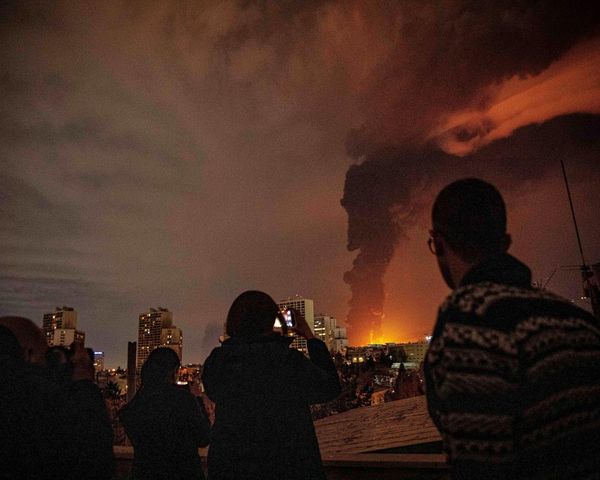
The US carried out airstrikes across Venezuela overnight on Friday, with explosions rocking the capital, Caracas, before dawn. Shortly afterwards, Donald Trump announced that US forces had captured the Venezuelan president, Nicolás Maduro, and his wife, Cilia Flores, and flown them out of the country.
The US attorney general, Pam Bondi, said they would face trial in New York on charges of involvement in narco-terrorism. A fresh indictment was issued on Saturday.
Trump later posted a picture on his Truth Social platform with the caption “Nicolas Maduro on board the USS Iwo Jima”. Late on Saturday, the White House posted a video on social media that appeared to show Maduro handcuffed and escorted by agents at the US Drug Enforcement Administration offices.
The attack and unprecedented capture of a sitting president follow months of an intense US pressure campaign against Venezuela. The US navy has amassed a huge fleet off the Venezuelan coast since September, carried out airstrikes against alleged drug trafficking boats in the Caribbean and the Pacific and seized Venezuelan oil tankers. At least 110 people have been killed in the strikes on boats, which human rights groups say could amount to war crimes.
The attack was the largest, most direct US action in Latin America since the 1989 Panama invasion. The lightning operation stunned the international community. US allies and adversaries alike were taken aback by the brazen interference in a foreign country.
At a Mar-a-Lago news conference, Trump said the US would “run the country” until a leadership transition could take place, and that US oil companies would go into Venezuela, bragging that “no nation in the world could achieve what America achieved”.
The future of Venezuela’s ruling regime remains uncertain. Despite Trump’s statements that the US will decide the fate of the country, the Venezuelan military appears to be in control of the country and its military assets.
On Saturday, the country’s supreme court ordered the vice-president, Delcy Rodríguez, to assume the role of acting president during Maduro’s “temporary absence”. Trump later said Rodríguez had offered her support to Washington, observing: “She really doesn’t have a choice.”
Rodríguez has a strong leftist pedigree as the daughter of a Marxist guerrilla who won fame for kidnapping a US businessman, but she is also a French-educated technocrat who has forged links with Venezuela’s economic elites, foreign investors and diplomats.
Trump appeared to dismiss Venezuela’s democratic opposition, saying the Nobel peace prize winner María Corina Machado did not have the necessary respect and support to lead.
How did we get here?
Since Trump took office for his second term, he has put Maduro squarely in his sights, pursuing a maximum pressure campaign against the Venezuelan regime. He accused Maduro of being behind destabilising activity in the Americas, including drug trafficking and illegal immigration to the US. In July, the US announced a $50m (£37m) bounty on Maduro’s head, accusing him of being one of the largest narco-traffickers in the world.
Trump’s administration declared Venezuelan gangs such as Tren de Aragua as terrorist organisations and began carrying out airstrikes against alleged drug traffickers in the Caribbean Sea. Soon, the US began to seize Venezuelan tankers and build up its military presence in the waters surrounding the South American country.
Trump has openly flirted with the idea of regime change in Venezuela. In late November, Trump gave Maduro an ultimatum to relinquish power, offering him safe passage out of the country. Maduro refused the offer, telling supporters in Venezuela that he did not want “a slave’s peace” and accusing the US of wanting control of his country’s oil reserves.
As the Trump administration ratcheted up the pressure, the government in Caracas at times seemed bewildered. Maduro repeatedly said Venezuela did not want war with the US, at one point dancing in front of Venezuelan students to the lyrics “no war, yes peace” and mimicking Trump’s double-fist pumping dance move.
Trump was reportedly not amused, and the dancing is said to have contributed to the decision to remove him from power. On Thursday, two days before his capture, Maduro said in a televised interview he would welcome US investment in the country’s oil sector.
A newly unsealed US justice department indictment accuses Maduro of running a “corrupt, illegitimate government” fuelled by an extensive drug trafficking operation that flooded the US with thousands of tonnes of cocaine.
Why are the US and Venezuela at odds?
Relations between the US and Venezuela have been strained since Hugo Chávez became Venezuela’s president in 1999. A self-professed socialist and anti-imperialist, Chávez angered the US in his opposition to its invasions of Afghanistan and Iraq, as well as his alliances with countries such as Cuba and Iran. Relations further spiralled after Chávez accused the US of backing a 2002 coup attempt.
To many in the US, particularly in the more hawkish wing of the Republican party, the socialist ideological orientation of Venezuela’s government has made it a natural adversary of the US, alongside its ally Cuba.
As Chávez consolidated power, punished political opponents and expropriated much of the country’s private sector, the US condemned Venezuela for its poor human rights record. Despite occasional minor thaws in relations between the two countries over the years, the relationship has continued to deteriorate, especially after Maduro took power in 2013.
Under the Trump administration, the US has portrayed the Maduro government as illegitimate, recognising Juan Guaidó, the speaker of the parliament, as Venezuela’s president in 2019.
In July 2024, Maduro appeared to suffer a landslide defeat in the presidential election, amid widespread anger at his increasingly authoritarian rule and Venezuela’s economic collapse. The Biden administration recognised the opposition candidate Edmundo González as the victor. Detailed voting data released by the opposition and verified by independent experts indicated that González won the vote, but Maduro clung to power after launching a ferocious crackdown.
In early December, the Trump administration published what it called the “Trump corollary”, which said the western hemisphere must be controlled by the US politically, economically, commercially and militarily. As part of the new Trump doctrine, the US military can be used to gain access to energy and mineral resources in the area.
During a press conference hours after the capture of Maduro, Trump invoked the 19th-century Monroe doctrine, which was used to assert US military power in Latin America. Dubbing it the “Don-Roe doctrine”, he said: “American dominance in the western hemisphere will never be questioned again.”
Who is Nicolás Maduro and why did Trump capture him?
Maduro has been the president of Venezuela since 2013. The former bus driver rose to prominence under Chávez, working as his minister of foreign affairs, before becoming the country’s president after Chávez’s death.
Maduro’s rule is considered dictatorial, with the UN estimating in 2019 that more than 20,000 Venezuelans were killed in extrajudicial executions. Key institutions such as the judiciary have been eroded under Maduro and the rule of law has deteriorated.
Over recent months, Trump has repeatedly called for the ousting of Maduro, accusing him of sending drugs and criminals into the US – a claim experts have said lacks evidence. He also claimed that Maduro was stealing US oil.
Despite months of escalating rhetoric, Saturday’s capture of the sitting president arrived without warning and Venezuelan authorities seemed to have been caught off guard by the brazen operation.
At least 40 people, including civilians and soldiers, were killed in Saturday’s attack, the New York Times reported, citing a senior Venezuelan official.
What happens next?
The future is uncertain. Venezuela’s defence minister has vowed to fight on and has called on citizens to unite to resist the foreign “invasion”, calling resistance to the US a “fight for freedom”.
Though Maduro has been captured, Venezuela’s institutions and military appear to be intact. It is unclear if Saturday’s attack on Venezuela was the beginning of a wider conflict or a one-off operation, as Trump said the US retained the right to mount further military operations in the country.
What is clear is that the US is determined to play a large role in Venezuela, through the use of military force or otherwise. Trump said on Saturday that the US would be making decisions on what was next for Venezuela. “We can’t take a chance in letting somebody else run and just take over what he left, or left off,” Trump said.
It was unclear what exactly Trump meant when he said the US would run Venezuela, as there were no signs that the US had taken over the capital and Venezuelan soldiers remained at their posts at military bases across the country. Trump did not rule out US military boots on the ground but said Venezuelan officials were agreeable to his demands – a sharp contrast to the defiant statements of officials in the hours after Maduro’s capture.
The US has in the past carried out war games to simulate a scenario where Venezuelan leadership was “decapitated”. The simulations predicted prolonged chaos, with refugees pouring out of Venezuela and rival groups fighting one another for control of the country.
“You’d have prolonged chaos … with no clear way out,” said Douglas Farah, a Latin America expert who helped run the war games.
Colombia has mobilised its armed forces and expressed concerns about a potential influx of refugees.