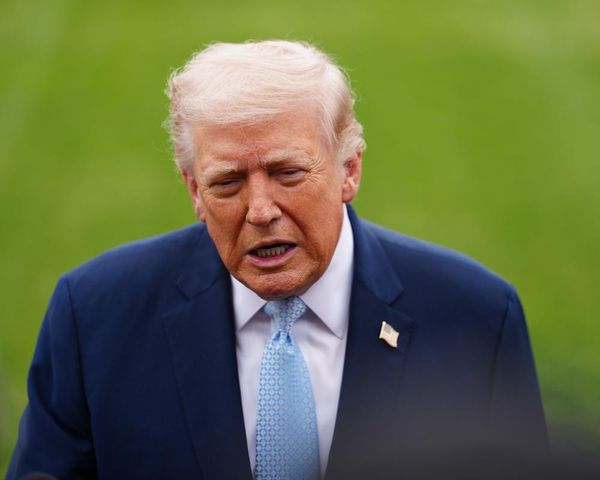
Britain’s attempt to improve relations with China is viewed by Donald Trump as “very dangerous”. The president chose not to elaborate during his brief remarks at the premiere of his wife’s eponymous film, Melania, which was, understandably, the focus of his attention.
Sir Keir Starmer might well be relieved that Mr Trump didn’t offer a more fiery response (instead, he reserved his scorn for Canada’s recent rapprochement with China), but the prime minister might also have ruefully reflected to himself, “if only”. That is because the paucity of tangible results from this high-profile trip couldn’t be remotely described, even by someone as paranoid as President Trump, as anything close to “dangerous”.
A small concession on tariffs on Scotch; visa-free travel for British tourists; the lifting of sanctions on British parliamentarians critical of President Xi. That’s no danger to anyone. The biggest announcement on inward investment was a £10.6bn commitment by AstraZeneca – but to build facilities in China, not Britain.
Even taken together with the vague pledges about future cooperation in tech and investment, these takeaways could hardly be described as a Great Leap Forward, to borrow a slogan, still less a threat to American interests in the UK. When Sir Keir stresses that the UK doesn’t have to choose between America and China in terms of strategic partnerships, he is, for the moment, obviously correct.
Indeed, managing to secure something like a strong and stable long-term relationship with either of these superpowers would be a considerable achievement. Britain’s post-Brexit diplomatic weakness is all too apparent at moments such as these.
Even so, there is no need to be churlish about the prime minister’s efforts. He is the first British leader to set foot in China in eight years. Relations deteriorated significantly after Theresa May went there in a futile search for a post-Brexit trade deal. Espionage, Beijing’s alliance with Moscow and China’s continuing abuse of human rights, particularly in Hong Kong and towards the Uyghur Muslim people, were the main depressants.
Britain, more than most other Western powers, also carries a shameful legacy from the colonial era, and there is no denying the gross disparity in military and economic power. China is, according to some measures, already the world’s largest economy and, during last year’s trade wars, even proved that it can defy the will of the United States. The background to the visit was not propitious.
So, seen from that perspective, this is, as the prime minister indicates, only the start of a process that could bring enormous benefits to the UK. If President Trump views the future prospect as dangerous, then he should ask himself how a middle-ranking economy such as Britain, one that is unusually open and depends on overseas trade, is supposed to make a living when access to the American market is being restricted.
British business has to contend with periodic threats of still more punitive tariffs being imposed without warning and on a presidential whim. That is the lesson, both of the Trump administration’s behaviour on trade after his so-called “Liberation Day” last April, and again during the Greenland crisis.
What Sir Keir calls a “more sophisticated” Sino-British relationship is actually, therefore, inevitable. With little realistic prospect of rejoining the EU in the short term, and given America’s choice to pivot away from European allies it now criticises for their “civilisational erasure”, the British have no choice other than to pursue new relationships with other major economies. That means India, where a trade agreement has already been reached, and China.
There is no harm at all in the prime minister leading a delegation of British business and cultural figures to see what might eventually be done to alleviate the UK’s £40bn annual trade deficit with China, and to win investment so desperately needed in the industries of the future. With closer economic and cultural relations may come more influence over, for example, the persecution of Jimmy Lai and the democracy activists in Hong Kong – and even on China’s support for Russia’s war machine.
It will take time. It was, after all, the Chinese statesman Zhou Enlai who, when asked by President Nixon during his epochal 1972 visit about the impact of the French Revolution, remarked that “it is too early to say”.
We may echo that about Sir Keir’s seemingly underwhelming diplomatic initiative as we peer into the future. Economic necessity, on the British side, means that various geopolitical rivalries – including with America – will have to be managed. Sir Keir was wise to avoid talk of a “golden age”. Success will demand a more sophisticated approach than that.
Bye bye, Labour – the next election could be Reform vs Green… and nothing in between
‘I won’t go near Trump’s America’: Readers on why tourists are ditching US trips
Is Iran heading for its ‘Venezuela moment’?
Keir Starmer is too cowardly to do the right thing on welfare
Yet another stinging betrayal for the Waspi women
This must be a turning point in the fight to end indefinite detentions