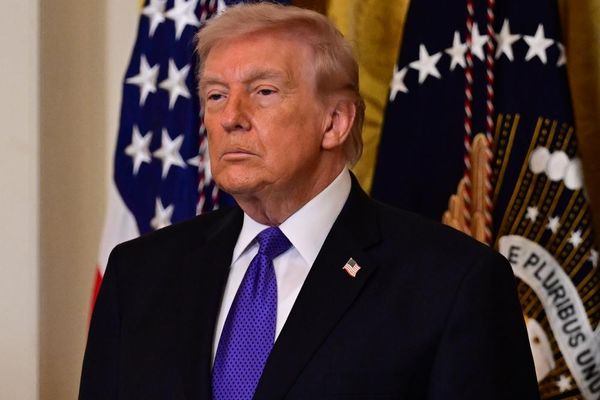
Donald Trump has landed in Switzerland for the Davos global gathering as Nato’s secretary general said “thoughtful diplomacy” was the only way to deal with growing transatlantic tensions, remarks that came shortly after the US treasury secretary had dismissed Denmark as an irrelevance.
The US president’s threats to seize Greenland, a largely self-governing part of Denmark, risk tearing the transatlantic alliance apart, while his promise to impose tariffs on European nations who oppose him could trigger a trade war with the EU.
Speaking at the World Economic Forum in the Swiss town on Wednesday, Nato’s Mark Rutte said that there were “tensions at the moment” but that talks, and a concerted drive to bolster Arctic security, were the only ways forward.
He dismissed fears that the Greenland crisis could unravel the 76-year-old alliance, and pushed back at repeated comments from Trump casting doubt on whether its European members would help to defend the US if asked, saying: “They will.”
Speaking on the sidelines of the forum, the US treasury secretary, Scott Bessent, earlier dismissed Denmark as “irrelevant” and brushed aside claims that European investors, such as Denmark’s pension funds, might pull out of the US market.
Bessent said the size of Denmark’s investment in US Treasury bonds, “like Denmark itself, is irrelevant … It is less than $100m [£75m]. I’m not concerned at all.”
He described as “inflammatory” statements on Tuesday by the French president, Emmanuel Macron, who said Europe preferred “respect to bullies” and “the rule of law to brutality”, and Ursula von der Leyen, president of the European Commission, who promised an “unflinching” tariff response.
“If this is all President Macron has to do when the French budget is in shambles, I would suggest he focuses on other things for the French people,” Bessent said. He urged leaders in Davos not to show “reflexive anger” and “bitterness”.
Trump, whose arrival in Davos was delayed by a “minor electrical issue” with his presidential jet, was expected to face a tough reception from angry European leaders in the ski resort but said overnight that he thought “we will work something out”.
Von der Leyen said on Wednesday that the EU had to get faster and stronger in a world now defined by “raw power”. The spat between allies over Greenland would only embolden geopolitical rivals, she said.
“The shift in the international order is not only seismic, but it is permanent,” von der Leyen told the European parliament. “While many of us may not like it, we must deal with the world as it is now … We need a departure from Europe’s traditional caution.”
The commission chief, who is not due to meet Trump in Davos, said Europe was “at a crossroads”, adding that the 27-nation bloc “prefers dialogue and solutions – but we are fully prepared to act, if necessary, with unity, urgency and determination”.
Trump has repeatedly said the US needs to take control of Greenland for “national security”, despite the US already having a military base on the island and a bilateral agreement with Denmark allowing it to massively expand its presence there.
The Finnish president, Alexander Stubb, told a Davos audience that he believed a diplomatic solution could be found. There were “curveballs flying in different types of directions”, he said, but: “I think at the end of the day, we’ll find an off-ramp.”
Trump has threatened to impose a 10% tariff on imports from Denmark, Norway, Sweden, France, Germany, the UK, the Netherlands and Finland unless they drop their objections to his Greenland plans, prompting EU leaders to consider retaliation.
The commission’s deputy chief spokesperson, Olof Gill, said on Wednesday that the EU was continuing trade conversations with Washington at the “technical and political levels” because “it is time for engagement not escalation”.
But the European parliament is expected on Wednesday to suspend ratification of a EU-US trade deal sealed in July. Other options include a package of tariffs on €93bn (£80bn) of US imports or the bloc’s “big bazooka”, its “anti-coercion instrument”.
Separately, the governor of California, Gavin Newsom, responded to Bessent’s claim that he was smug, self-absorbed and economically illiterate. Newsom said: “I’m in his head.”
Newsom – a plausible candidate to be the Democratic candidate in 2028 – picked out the Canadian prime minister, Mark Carney, von der Leyen and Macron for praise, telling reporters: “I was very pleased to hear Prime Minister Carney’s remarks yesterday, the EU president’s remarks were powerful, and Macron’s.”