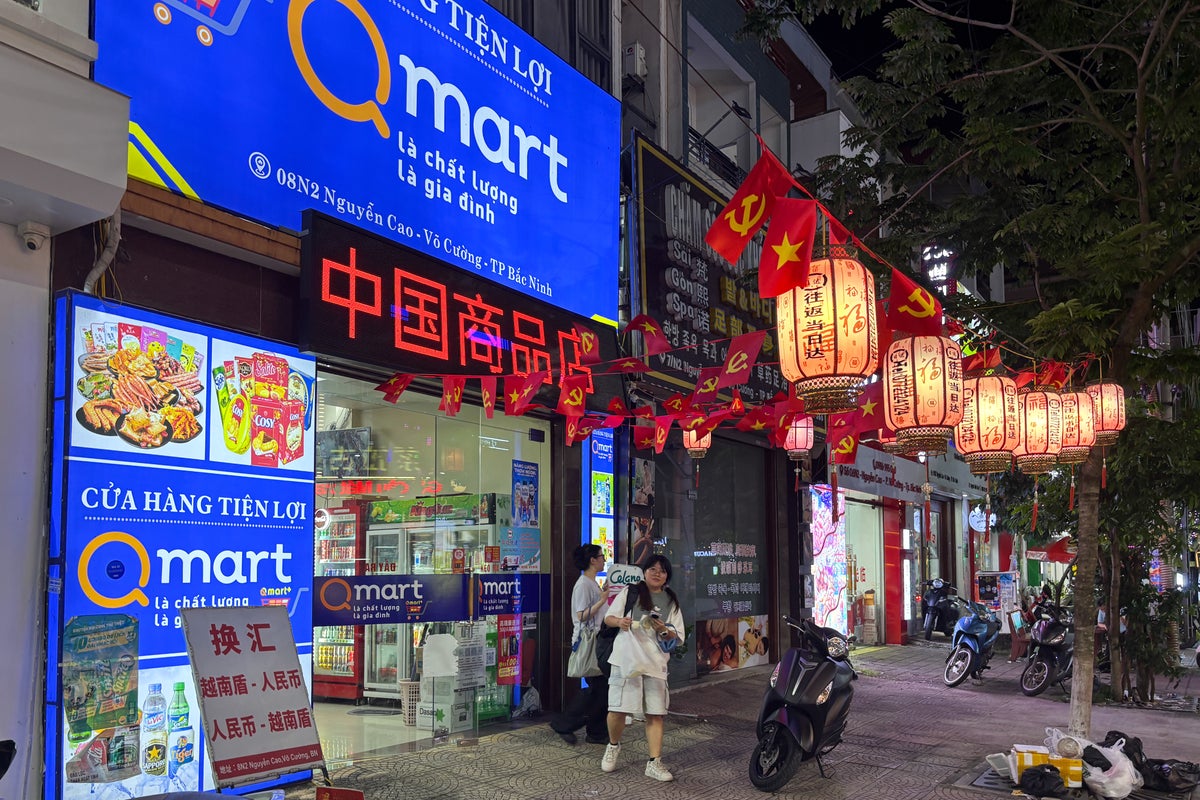
The transformation of Vietnam's Bac Ninh is evident in the signs above its shops and the spicy Chinese and Korean dishes on its tables.
Once known for its rice fields and the love duets of its centuries-old Quan Ho folk songs, the city just north of Hanoi has become one of Vietnam's busiest factory zones, reflecting a surge of investment, hastened by President Donald Trump’s tariff hikes, that are reshaping the region.
The economy has profited from friction between Washington and Beijing as factories shifted out of China, joining earlier waves of foreign investment by the Japanese and South Koreans that have made Vietnam a global manufacturing hub. But rising labor costs, worker shortages and inadequate infrastructure are exposing the limits to its rapid rise.
With rivals like Indonesia and the Philippines competing hard for new projects, Vietnam is trying to climb into higher-value manufacturing and expand export markets to maintain that momentum. That effort is evident in Bac Ninh.
Vietnam is building more capacity
Traditionally a center for artisans, Bac Ninh’s first boom began around 2008 when Samsung built its first phone factory there, turning Vietnam into its largest offshore manufacturing base.
Now, Chinese companies are pouring in as they diversify their factory locations to skirt U.S. tariffs and other trade restrictions. After Hanoi and Beijing normalized ties in the 1990s, inflows of Chinese investment began to pick up as Chinese firms in places like Bac Ninh tapped Vietnam’s electronics supply chain, labor force and supportive local governments, often aided by Chinese-speaking intermediaries who smooth paperwork and logistics.
But Vietnam is too small to replace China, whose economy is 40 times larger, as the world's factory floor. To try to keep up, its leaders are building new infrastructure, including a highway to the Chinese border that has cut travel time by more than an hour. A railway will connect Hanoi to Haiphong — Vietnam’s largest seaport — and then the border town of Lao Cai.
On Dec. 19, Bac Ninh broke ground on the expansion of an industrial zone for high-tech manufacturing, including electronics, pharmaceuticals and clean energy. It's part of a synchronized nationwide push in which Vietnam launched 234 major projects worth more than $129 billion just weeks before a pivotal National Party Congress in January, when leaders will decide the country’s political leadership and economic direction.
The China factor collides with reality
In Bac Ninh's downtown, a convenience store bears the name Tmall, after Alibaba’s flagship online marketplace. Signs in Chinese advertise services for investors. Chinese–Vietnamese language schools have opened to help locals and Chinese to learn each others' languages.
But as Chinese companies compete for the best labor and other resources, costs are rising for the “China plus one” strategy of moving factories out of China to other locations, for example, Apple's shift into India.
“It is becoming difficult to recruit workers,” said Peng, who works at a telecoms equipment company that moved from China’s southern technology hub of Shenzhen. He gave only one name because he was not authorized to speak to the media.
Labor costs have jumped 10%–15% since 2024, he said, "And we expect them to keep rising.”
Vietnam still need technology, equipment and expertise from China, which had created "the best manufacturing ecosystem," said Jacob Rothman, co-founder and CEO of China-based Velong Enterprises, which makes grill tools and kitchen gadgets and has shifted some production to Southeast Asian countries including Cambodia and Vietnam.
Supply chains and manufacturers in China have benefited from decades of government support, large-scale investment and its huge population, Rothman said. “You can’t recreate that overnight.”
Brian Bourke, global chief commercial officer at U.S.-based SEKO Logistics, said while factories making footwear, furniture and technology are still relocating to Vietnam, it lags China in infrastructure and logistics capabilities.
Some of those limits are surfacing in boomtowns like Bac Ninh, where firms are trying to lure workers with higher wages and bonuses, a box of instant noodles on their first day and bus fares if they commute from another city, according to state media.
Vietnam faces competition from its neighbors
Few countries have benefitted more from Trump's trade war than Vietnam, whose biggest export market is still the U.S. In 2024, Vietnam ran a $123.5 billion surplus with the U.S., the third largest behind China and Mexico. That irked Trump, who threatened a 46% import tax on Vietnamese goods before settling on 20%.
The two countries are still working toward a deal to keep most tariffs at 20%. Vietnam has offered broad preferential access for U.S. products, the White House said in October. So far, it has largely absorbed the tariffs, running a trade surplus of $121.6 billion in January-November 2025.
The agreement in October by Trump and Chinese leader Xi Jinping to a year-long trade truce and lower average tariffs on Chinese exports to the U.S. to about 47% helped ease some concerns. But persisting uncertainty over tariffs and other trade restrictions means companies aren’t just trying to shift factories out of China but to spread them across several countries, said Frederic Neumann, chief Asia economist at HSBC.
Even with lower U.S. tariffs on China, the calculus still favors moving to Southeast Asia where manufacturing inefficiencies add only about 10% in cost. But while large corporations can shift production easily, smaller firms may struggle to fit a new factory with expensive equipment.
“(The) race to move outside of China is still happening, and it's accelerating,” Rothman said.
Vietnam is still attracting ample foreign investment. Cumulative foreign investment topped $28.5 billion as of September, up 15% from last year. But scrutiny of Vietnam's role as a hub for tariff-dodging transshipments has some manufacturers hedging their bets.
One of SEKO Logistics' customers has shifted some of its furniture making to India, not wanting to “put all their eggs in Vietnam,” Bourke said.
Countries like Indonesia and the Philippines, which missed the early gains Vietnam captured, are promoting themselves as alternative manufacturing bases. In the Philippines, a new law allows foreign investors to lease private land for up to 99 years to attract long-term commercial and industrial investment.
Vietnam as a ‘tiger economy’
Vietnam has a goal of becoming rich by 2045. It aims to become Asia's next “tiger economy,” following export powerhouses like South Korea and Taiwan by shifting from low-cost assembly work to manufacture higher-value products like electronics and clean energy equipment.
It's offering incentives like tax breaks on imported machinery and discounted rents to help factory suppliers upgrade and modernize. About a third still use non-automated equipment and only about 10% use robots on their production lines.
The country also is trying to reduce its dependence on the U.S. market by expanding exports to the Middle East, Latin America, Africa and India. Overseas trade offices have been asked to share market intelligence and promote products made in Vietnam.
Vietnam knows that rising costs and tougher competition will test how far it — and places like Bac Ninh — can climb. Announcing hundreds of projects in December, Prime Minister Pham Minh Chinh framed the stakes: Vietnam must “reach far into the ocean, delve deep underground and soar high into space.”
___
Chan reported from Hong Kong. Associated Press researcher Yu Bing in Beijing contributed.
___
The Associated Press’ climate and environmental coverage receives financial support from multiple private foundations. The AP is solely responsible for all content. Find AP’s standards for working with philanthropies, a list of supporters and funded coverage areas at AP.org.
Venezuela strikes mapped: Where did US hit during operation to capture Maduro?
Venezuela live: Maduro to appear in court as Trump warns Colombia of military action
Ukraine war latest: Trump denies Kyiv targeted Putin’s residence with drone attack
Why has Trump attacked Venezuela? What we know so far as Maduro captured
Marjorie Taylor Greene hits out at Trump after Venezuela strikes
Tragedy strikes as sixth person dies at Disney World property in recent months