Two sick Antarctic workers have arrived safely in Chile after a daring rescue mission through the hazardous South Pole winter.
Due to constant pitch black darkness and the extreme cold, flights into the South Pole do not usually take place from February to October.
But this convention was overruled when two Lockheed Martin employees working at the Amundsen-Scott station, located directly at the South Pole, became sick with an unidentified illness and required medical evacuation.
In two days of hectic flying, two rescue teams flew from Chile to the British Antarctic Survey’s Rothera station. One aircraft then went on to fly the 3,000 mile round trip to the South Pole – where the temperature was minus 60C.

The Canadian-owned Twin Otter aircraft – one of two chartered for the rescue – then returned to Rothera with the workers on Wednesday afternoon. They were then transferred to the second plane and flown to Punta Arenas, the southernmost town in Chile, where appropriate medical treatment was administered.
Although there is a doctor and assistant at the Amundsen-Scott base, medical facilities are limited. Just 48 workers inhabit the base over the winter, which lasts from February to October.
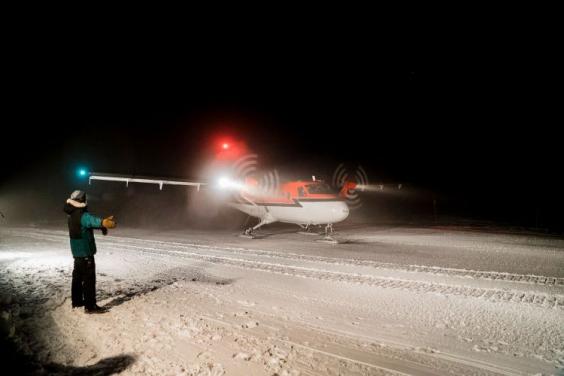
"The courage of the pilots to make the flight in extremely harsh conditions is incredible and inspiring," said Steve Barnet, a US based scientist who has worked at Amundsen-Scott.
The extreme cold affects a number of parts on the plane, including the batteries and hydraulics. Fuel must be also warmed before take-off.
"The air and Antarctica are unforgiving environments and punish any slackness very hard," said Tim Stockings, operations director for the British Antarctic Survey. "If you are complacent it will bite you."
He added: "Things can change very quickly down there," with potential hazards including ice from clouds, high winds and heavy snow.
There have been three emergency evacuations from Amundsen-Scott since 1999.
The 1999 flight, which was done in the Antarctic spring in slightly better conditions, rescued the station's doctor, Jerri Nielsen, who had breast cancer and had been treating herself. Rescues also were done in 2001 and 2003, both for gallbladder problems.
There has been a station at the South Pole since 1956 and scientists carry out astronomy, physics and environmental science using telescopes, seismographs and other instruments.
Associated Press contributed to this report