Without knowing the precise contents of their conversations, it is difficult to say with certainty why Karoline Leavitt, as White House spokesperson and on behalf of Donald Trump, brought up the option of using military force to take over Greenland.
However, given the timing, it seems to have been a defiant – and typically touchy – response to the polite but firm “joint statement” issued by the leaders of Denmark, France, Germany, Italy, Poland, Spain and the UK. They declared nothing less than the legal and moral truth that: “Greenland belongs to its people. It is for Denmark and Greenland, and them only, to decide on matters concerning Denmark and Greenland.”
Yet President Trump, fairly obviously, thinks it’s also a matter for the United States and, as he puts it, “national and international security”. Evidently, he was irked.
Of course, to some degree, what Ms Leavitt said about force was a truism: “Utilising the US military is always an option at the commander-in-chief’s disposal.” So it is – but the commander-in-chief has previously ruled out armed intervention; for example, in the case of Canada.
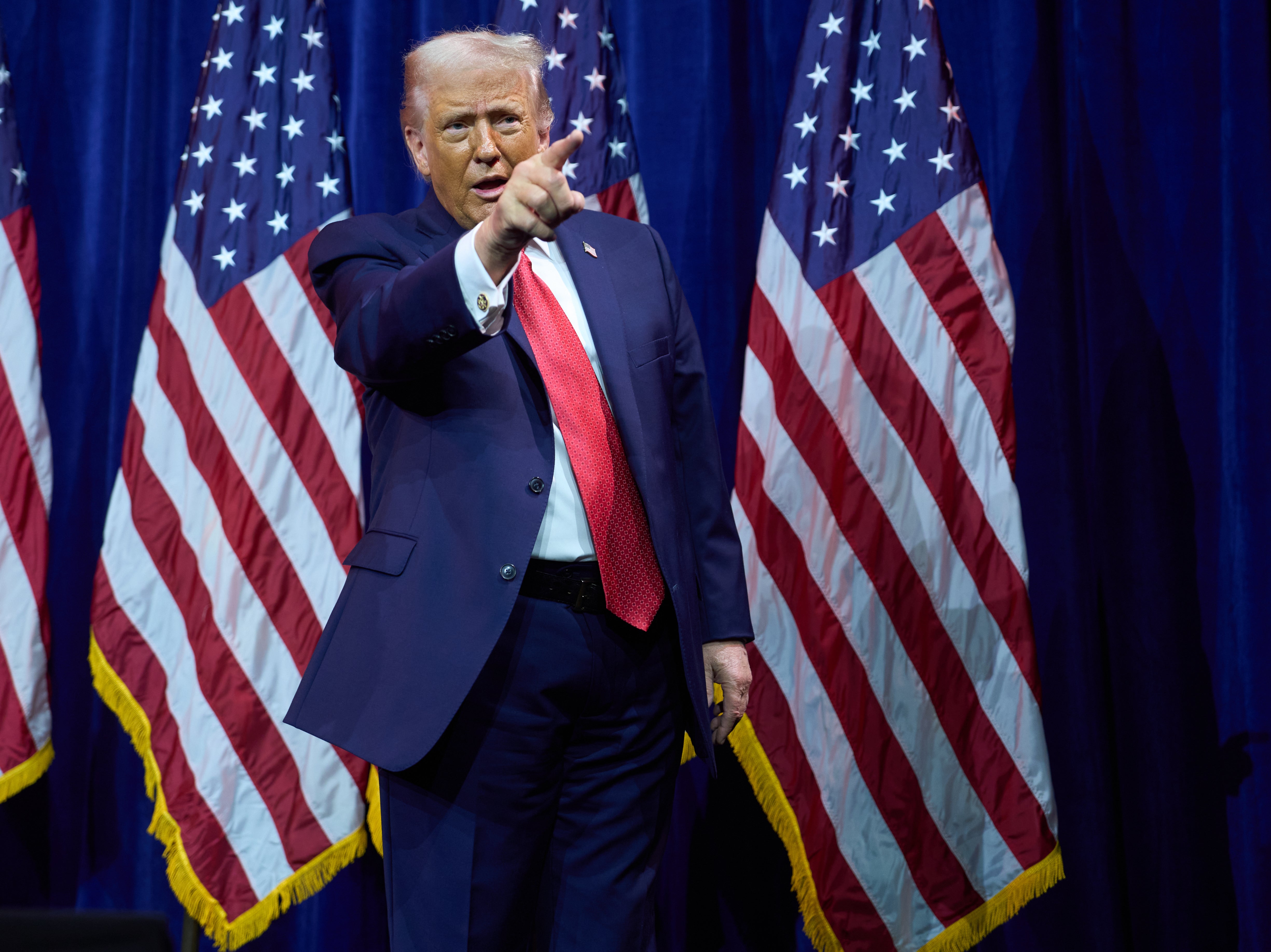
Ms Leavitt’s reference to force was pointed, and one to which the Greenlanders, Danes and Europeans have no adequate rejoinder. In terms of power, the United States can easily acquire Greenland, and most other places, without much difficulty. After the success of the Venezuelan mission – as well as the bombings in Iran and, to a lesser extent, the protection of Nigerian Christians – confidence in that capacity has grown. At the same time, inhibitions about breaking international law have evaporated.
One of Mr Trump’s senior aides, Stephen Miller, has been the most militantly outspoken member of the White House team on this point, no doubt reflecting Mr Trump’s own preferences: “The US is the power of Nato. For the US to secure the Arctic region, to protect and defend Nato and Nato interests, obviously Greenland should be part of the US ... Nobody’s going to fight the US over the future of Greenland.”
All that European leaders can really do in the face of an America veering off into becoming a rogue state is to use reason and diplomacy to try and influence those elements in Washington that still understand the dangers that the ultras in the White House are entertaining.
Somehow, someone needs to talk sense to Mr Trump – and most effectively, that will be done privately.
The principal argument that needs to be put, unfortunately neglected in the joint statement, is that Greenland does not have to change its constitutional status in order for it to be defended to the satisfaction of the US. The Americans can already station as many missiles, as many troops, as many ice breakers and submarines, even, perhaps, nuclear weapons on this vast island to protect the American homeland from any conceivable attack or incursion.
As the European leaders did point out, Greenland is Nato territory, and increasingly important as the ice cap recedes and the waterways open up. If Mr Trump wanted, he could devise a scheme whereby Greenland, and Canada for that matter, could also be placed, for a fee, under the defensive “Golden Dome” he wants to cover the continental United States with, safe from Russian or Chinese rockets.
There is another puzzle that the president needs to be gently challenged about. Why is he so very concerned about Russian ships being “all over” Greenland when one of the main strategic goals of his foreign policy is to normalise relations with the Kremlin and do deals with Vladimir Putin, as with Ukraine?
What is the Russian threat? Why does America need to fortify Greenland from Russia if President Putin is President Trump’s (more or less) respected friend and partner? China is more of a regional challenger, but, as the Danes point out, they’ve kept Beijing well away from Greenlandic resource assets. It’s also true that states such as Canada, Norway, Sweden, Finland and Iceland are also essential allies across the Arctic region.
The truth may be that Mr Trump is acquisitive by nature, and simply wants to take over Greenland to access its mineral resources as much as for its security benefits. Yet, within reasonable environmental limits, American companies could mine and operate on the island without it becoming US territory, and make money and enhance US energy security just the same. Greenland doesn’t have to become the 51st state of the union for economic development to proceed.
These are the kinds of arguments that can be pursued by America’s allies confidentially, through the usual channels. Mr Trump, more than most, is not amenable to “megaphone diplomacy”.
A figure such as the former defence secretary Sir Ben Wallace can accuse President Trump of trying to “thieve” Greenland’s mineral assets – and he’d be right. In an ideal world, Sir Ben would also be correct to say that the prime minister must be less “mealy-mouthed” in condemning his actions. But with Europeans woefully short of defence resources and still so dependent on America for weapons and technology, impugning the president would be counterproductive.
President Trump famously works through personal relationships and requires a degree of respect – if not outright deference. Diplomacy is the best route forward, and the preservation of Nato – until such time as Europe can look after its own defence – has to be the aim.
It is also a time for creativity and exploring whether an agreed change in the status of Greenland would be in the interests of all. Some kind of “free association” with the US, for example, or a “leaseback” of sovereign territory, could be a solution to those tensions.
In time, an independent Greenland might also emerge with its own ideas. None, though, would be sustainable without them being agreed by the Danish parliament and, most importantly, the people of Greenland through a referendum. For the time being, nothing should be done to weaken what remains of the Western alliance any further.
What if Trump’s not bluffing about invading that big, beautiful island in the Arctic?
A divided coalition of the willing is no use to anyone
The only person who can stop Donald Trump now is Pope Leo
Even after Venezuela, the West must speak softly to Donald Trump
Trump’s Venezuela raid shows how exposed Starmer and Britain has become since Brexit
Trump’s Maduro gamble must be condemned – and turned to Venezuela’s advantage