As a small fishing boat bounced across the surface of Corpus Christi Bay, Clara “Cari” Villarreal Varner admired a stretch of wooded coast last June.
For the first time, Varner, a member of the Karankawa Tribe of Texas, was viewing the shoreline of a 3-square-mile area near Ingleside on the Bay, where archaeologists had discovered thousands of Karankawa artifacts in recent decades, including pottery shards, stone tools, and other pieces of evidence that this was once a frequently inhabited settlement.
“We see this beauty,” Varner said. “We can imagine that our ancestors were all … living their lives. And then, fast-forward.”
In the 1800s, many of the Karankawa, a tribe that inhabited much of the Texas coast before the arrival of the Spaniards, were massacred by militiamen and settlers. The survivors, including Varner’s own ancestors, scattered—leaving modern tribal members without a homeland or even any formal state or federal recognition. Now they fear artifacts in their ancestral settlement will be destroyed.
In Varner’s field of view, huge tanker ships were filling up with U.S. crude oil at the Enbridge Ingleside Energy Center, North America’s largest crude oil export terminal. She and other Karankawa people had teamed up with the Coastal Watch Association, a local environmental group, to file a lawsuit to prevent Enbridge Inc.—a Canadian oil and natural gas export giant—from enlarging its terminal to include parts of the ancestral settlement. They lost. In March 2025, the federal 5th Circuit Court of Appeals rejected the group’s lawsuit and greenlit Enbridge’s expansion in Indigenous Peoples of the Coastal Bend v. United States Army Corps of Engineers.
“I feel saddened, I feel angry,” Varner said. “I feel not beaten down, though. I will not—we will not—give up.”
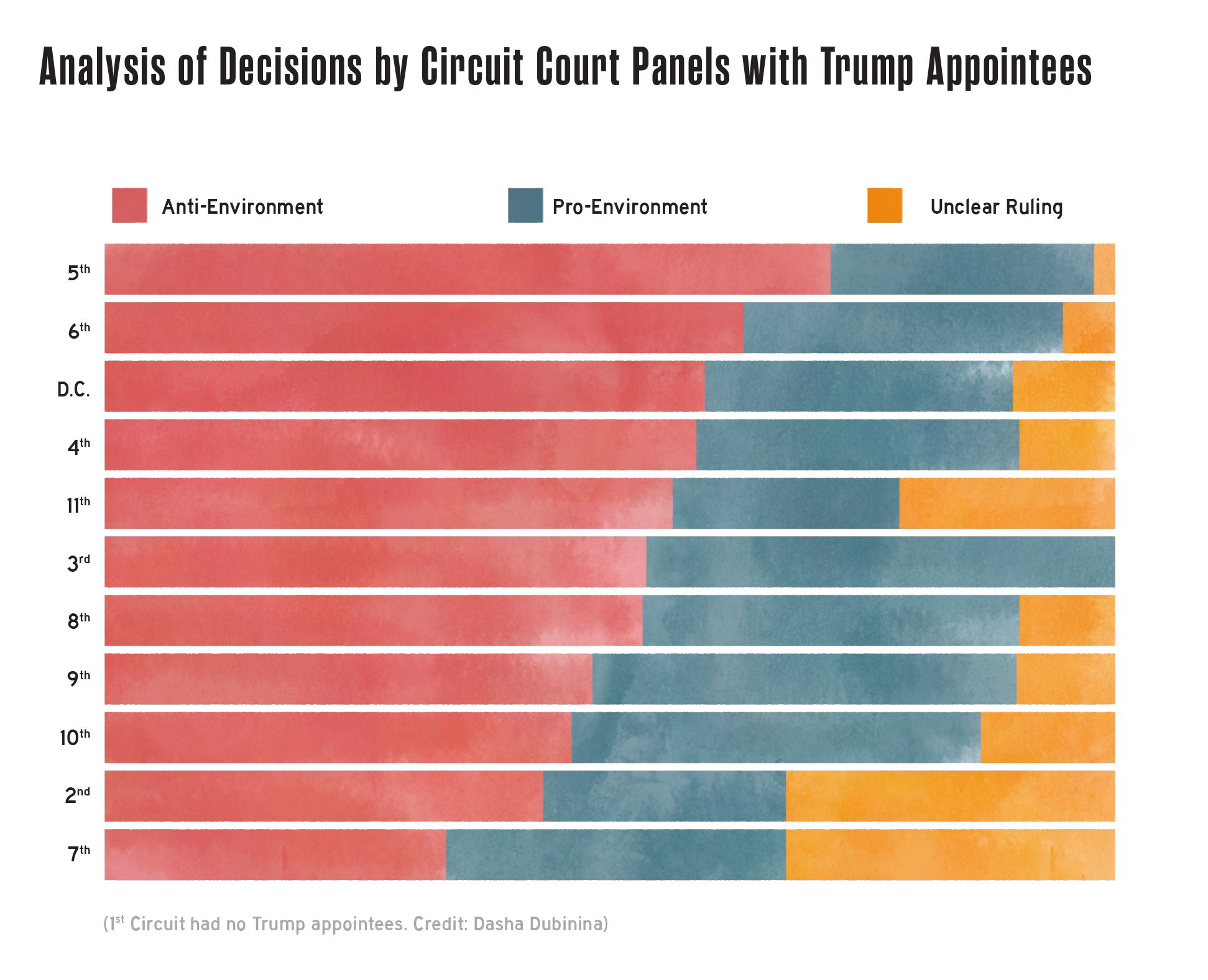
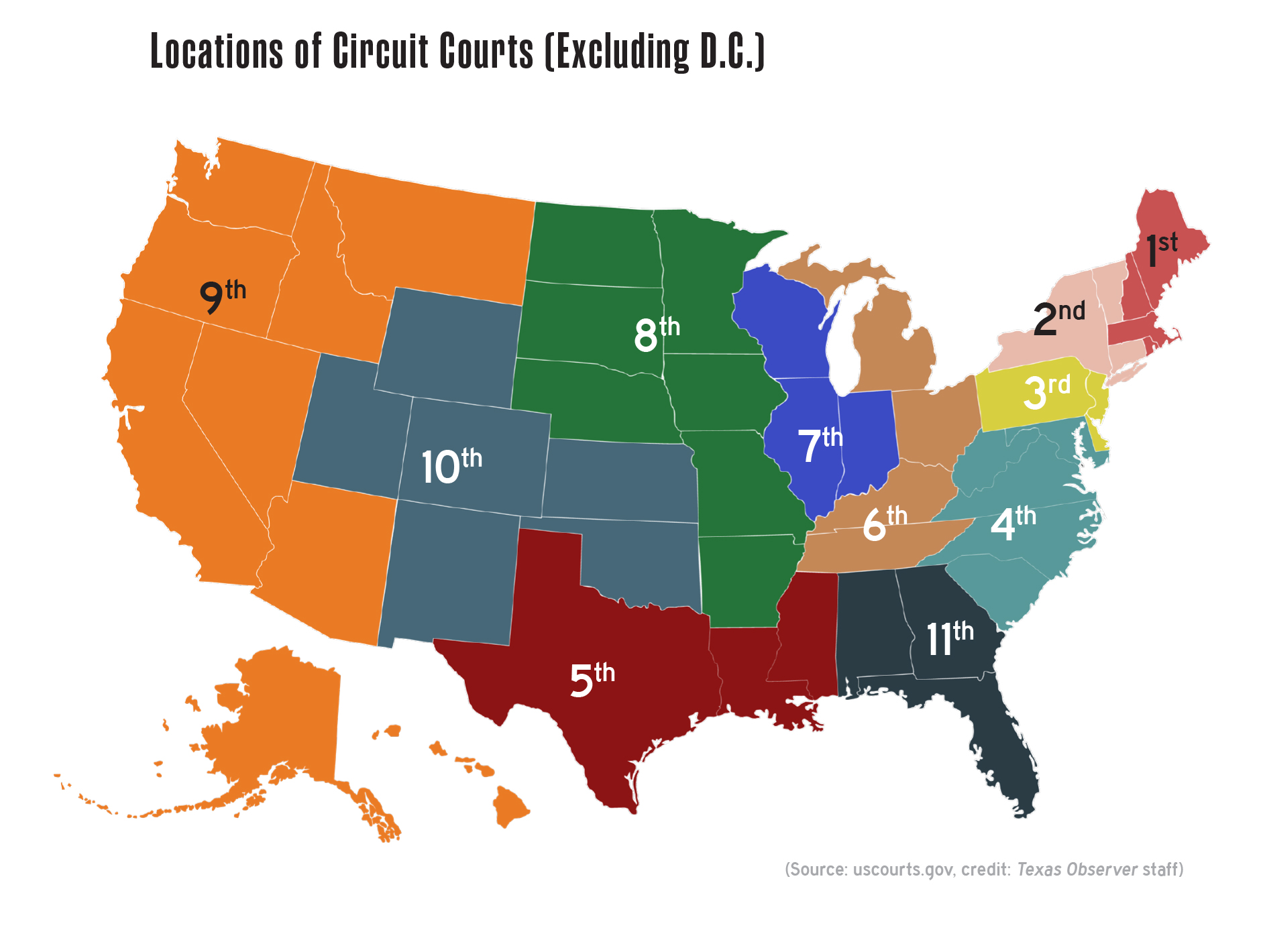
The anti-environment ruling, handed down by two judges appointed by President Donald Trump and a third Republican-appointed judge, was not unusual in federal cases in which Trump appointees participated, according to an analysis of 309 circuit court decisions issued between January 2018 and September 30, 2025. The analysis, by students at Northwestern University for the Texas Observer, focused on decisions by panels that included at least one Trump appointee and that included the words “environment,” “pollution,” or “climate” in all circuits except the 1st, which has no Trump appointees.
“This case reeks of environmental racism.”
More than half—167 of those rulings—were clearly anti-environment. The rulings generally benefited industry or other polluters, diminished environmental protections, or narrowed agencies’ ability to safeguard people and nature. Only a third favored environmental groups or causes; the results in the rest were mixed or unclear.
In his first term, Trump appointed a record-setting 54 federal appellate judges. Circuit judges are nominated by presidents and, if confirmed by the Senate, serve lifetime appointments. This analysis provides an early look at how those appointments will likely reverberate nationwide in terms of dismantling or failing to uphold environmental laws and policy, legal scholars said.
“Long term, it’s going to set a lot of precedent that pushes the law away from environmental protection, which will either lead to more-harmful outcomes for the environment, broadly speaking, or will necessitate the development of new legal and policy approaches,” said Ted Lamm, Associate Director of UC Berkeley’s Center for Law, Energy & the Environment.
In the 5th Circuit Court of Appeals, where the Karankawa lost their case, 71 percent of those rulings were anti-environment, the highest percentage among courts in the analysis. During that period, the 5th Circuit—which covers Texas, Louisiana, and Mississippi—decided 31 cases.
“All of us that practiced before the 5th Circuit know that with an environmental case, we’re gonna have a hard time, whether it’s during the Biden administration or going all the way back to the Clinton administration,” said Jim Blackburn, a longtime environmental lawyer in Texas who serves as co-director of the Severe Storm Center at Rice University.
Nationwide, many major environmental lawsuits and cases are settled at the circuit level, which handles appeals from district courts, since very few are reviewed by the Supreme Court.
“I think it’s always been true that the circuit courts aren’t doing the big flashy thing as much,” said Justin Pidot, who served as general counsel for the White House Council on Environmental Quality and is now a law professor at the University of Arizona. “But in terms of just the breadth of litigation that occurs, most of it gets resolved at the circuit court. So they’re incredibly influential.”
In Indigenous Peoples of the Coastal Bend, the Native American and environmental groups argued that the project would have major impacts on environmental and cultural resources.
“Among those impacts are the risk of oil spills and accidents, direct and indirect impacts to seagrasses and the marine life that depend on them, impacts to cultural resources, light pollution, noise pollution, erosion, and air emissions,” reads the lawsuit initially filed in federal district court in Corpus Christi in 2021. The groups also argued that when the U.S. Army Corps of Engineers approved the project, it failed to follow requirements of federal laws to sufficiently consider climate change or the negative environmental impact of the export terminal expansion.
Yet Judge Don Willett, a former Texas Supreme Court justice and a Trump appointee, who wrote the 2025 majority opinion, found that the Corps of Engineers had complied with the court’s narrow interpretation of the National Environmental Policy Act (NEPA), a 1970 law that governs how agencies assess environmental impacts.
“In our circuit, the Corps’s obligations under NEPA to analyze climate change impacts are limited to ‘discussing relevant factors and explaining its decision,’” Willett wrote. “The Corps’s discussion of climate change here easily meets that standard.”
Enbridge embraced the rulings and underscored the importance of its expansion, which would “add five additional berths for oil tankers and barges, and essentially double its vessel capacity,” according to legal filings.
“The terminal serves as a critical link in serving U.S. and global energy markets,” Enbridge spokesperson Michael Barnes said in an October email response for this story. “The Army Corps’ staff archaeologist confirmed there would be no effect from the dock project on cultural resources. We believe the district and appellate courts’ decisions were thoughtful and thorough.”
The 6th Circuit Court of Appeals, which handles appeals from Kentucky, Michigan, Ohio, and Tennessee, had the second highest percentage of anti-environment rulings in the analysis—10 of 16 cases or 62.5 percent.
In another case involving Enbridge, two Trump-appointed judges in the 6th Circuit reversed a district court decision in 2020 by ruling in Enbridge’s favor in a case involving its Line 5 pipeline, which carries oil from Wisconsin through Michigan into Ontario, Canada. The plaintiff, the National Wildlife Federation, argued that the company’s plan for responding to potential oil spills did not comply with requirements in the Endangered Species Act and the National Environmental Policy Act. An Enbridge spokesman said the 2020 ruling provided “confirmation for all pipeline operators” that the Pipeline and Hazardous Materials Safety Administration’s review was sufficient.
The lone non-Trump appointee on that panel, Gilbert S. Merritt Jr., authored a dissenting opinion, arguing the Trump-appointed judges took an “extremely narrow view” of wildlife and environmental protections. (Merritt, appointed by President Jimmy Carter, died in 2022.)
Trump’s appointees also affected rulings in circuits that traditionally leaned pro-environment, such as the 9th Circuit Court, the nation’s largest appellate court and the busiest for environmental cases.
For decades, the 9th Circuit had been considered liberal. But, with Trump appointing 11 judges, it’s shifted right. By the end of 2025, 45 percent of the 9th Circuit’s judges had been appointed by Republican presidents, compared with only 28 percent before the first Trump administration.
“It’s historically been one of the two or three most liberal-leaning circuits, and then just the recent Trump run of appointees has just been able to shift the balance of who appointed the bulk of the judges there,” Lamm said.
Out of 70 decisions issued by 9th Circuit panels during the period included in the analysis, 35 percent were anti-environment, compared with 30 percent that favored environmental causes or litigants.
The Trump judges on the 9th have repeatedly weighed in against the environment and local communities, the analysis of opinions showed, including in a 2021 case called Center for Community Action & Environmental Justice v. the Federal Aviation Administration.
In this case, local residents and environmental groups sued to block a new 600,000-square-foot Amazon cargo facility at San Bernardino International Airport, arguing that the Federal Aviation Administration (FAA) failed to fully assess air-quality and socioeconomic impacts, as required by federal law. A 9th Circuit panel rejected the claims, ruling that the agency took a “hard look” at emissions and cumulative effects in its environmental review.
In a dissent, Judge Johnnie Rawlinson—the only Democrat-appointed judge on the panel—described San Bernardino as one of the nation’s most polluted corridors, with some of California’s highest asthma rates. Rawlinson said the federal government failed to adequately consider the disproportionate health burdens on San Bernardino’s largely Latino and Black communities in approving the Amazon air cargo hub. She criticized her Republican colleagues’ ruling.
“This case reeks of environmental racism,” she wrote.
In a response, Trump appointee Patrick Bumatay defended the ruling. “Of course, every judge is entitled to his or her own views, but the dissent’s assertions are unfair to the employees of the FAA and the Department of Justice,” Bumatay wrote.
In Trump’s first presidential term, federal judges often blocked administration efforts to roll back environmental protections. But as Trump has increasingly filled the courts with people who share his views, legal experts said he could have an easier time gutting environmental protections.
“One of the changes now, as compared to in the first Trump administration, is that the courts were quite favorable to environmental plaintiffs in the first Trump administration and are not so favorable to environmental plaintiffs now,” Pidot said.
Legal experts also said shifting the demographics of federal judges tends to stack the deck against environmental plaintiffs. Of the 54 federal appellate judges Trump appointed in his first term, 85 percent were white, and 80 percent were male.
“I think if you look at the types of people that President Trump is appointing to the federal bench, they are not broadening the federal bench’s lived experiences,” said Robert Weinstock, the director of the Environmental Advocacy Center at Northwestern Pritzker School of Law.
In Indigenous Peoples of the Coastal Bend, two of the judges on the 5th Circuit panel were white male Trump appointees: Willett and Kurt Engelhardt. The third judge was Edith Jones, a white woman and a Ronald Reagan appointee.
In the ruling, the judges didn’t mention the Karankawa’s or other Native Americans’ concerns about the destruction of the land that holds artifacts of their forebears.
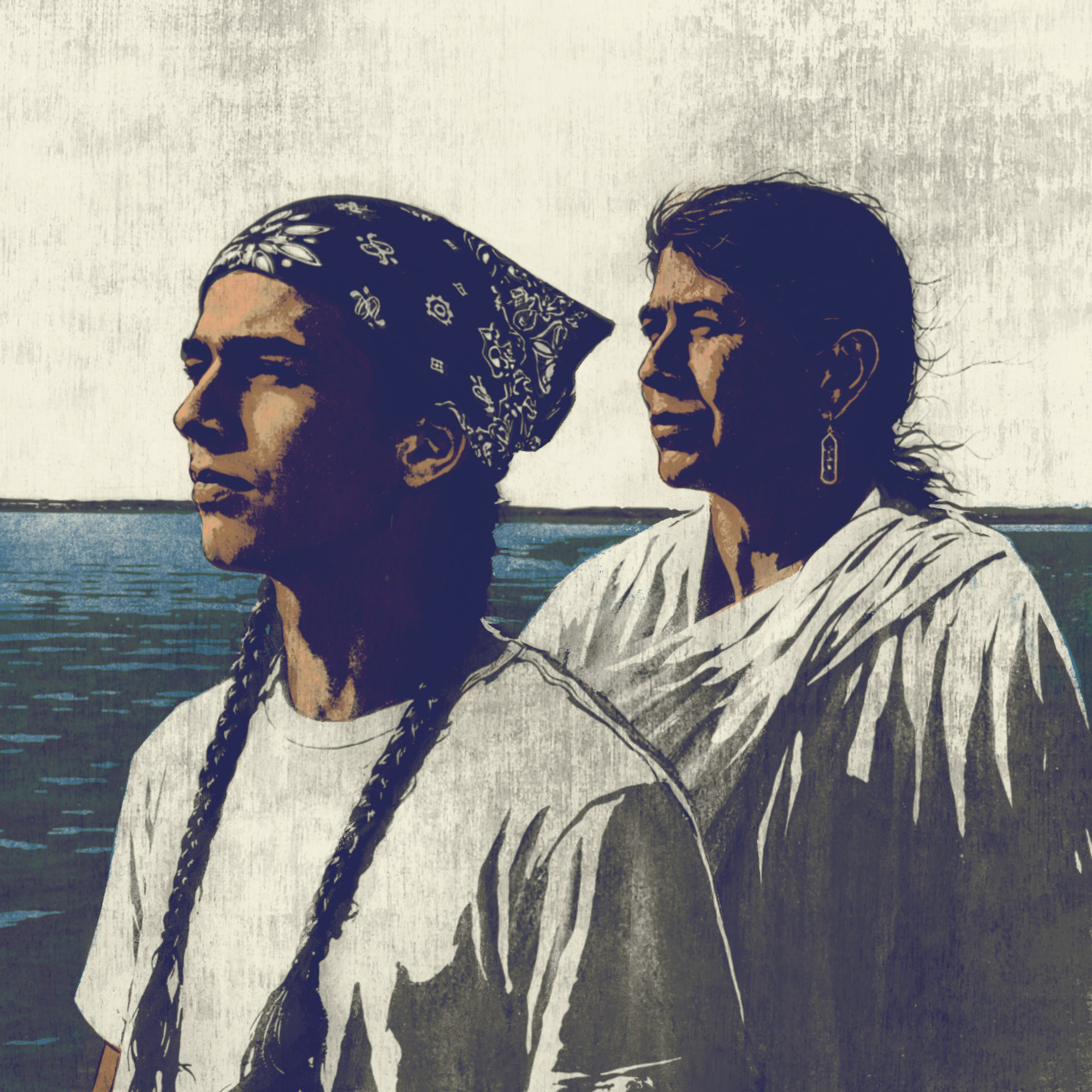
Love Sanchez founded the Indigenous Peoples of the Coastal Bend, an intertribal group representing Indigenous people from the Karankawa and other tribes whose traditional lands lie in the Corpus Christi area.
Sanchez expressed dismay about the prospect of losing that coastline—and artifacts from Indigenous cultures—to an oil export terminal.
“It was so hard,” Sanchez said in an interview in October. “I was very sad. It was a blow, taking the loss because we had been working on stopping Enbridge since 2019 and—I’m sorry. I’m gonna cry talking about it, reliving it.”
Sanchez criticized Enbridge for not reaching out to the Indigenous groups. “They don’t even acknowledge us,” she said.
However, in an email provided for this story, Barnes cited Enbridge’s long record of working with Indigenous groups. “We rely on a collaborative approach in the communities where we operate,” Barnes said. “This includes working with hundreds of Indigenous communities across North America.”
Some community leaders argued that Enbridge’s expansion would be vital for the region’s economic growth, including Mike Culbertson, 68, who has served as president and CEO of the Corpus Christi Regional Economic Development Corporation since 2009.
Culbertson said he supports the court’s decision to permit the crude oil export terminal expansion because, in his opinion, it would affect Ingleside’s industrial corridor, not residential areas. “We did not believe that [expansion] was encroaching on anybody,” Culbertson said. “It was the same use, essentially, for what they were asking for, and it only increases the economic wealth of the region.”

On a drive down State Highway 361 in May 2025, Culbertson pointed to towering storage tanks and sprawling manufacturing facilities that spanned the road for several miles. Culbertson, at the wheel of his red pickup, rattled off the names of each company, its square footage and number of employees.
To him, the region’s massive expansion of plastic, liquefied natural gas, steel and chemical production, and export facilities illustrates how the area is capitalizing on its geographic location. “They’re here because you can get oil from the Eagle Ford or the Permian, and Enbridge can have it out into the Gulf in 15 minutes,” Culbertson said.
Culbertson grew up in the Coastal Bend and said he has witnessed the benefits of the fossil fuel industry expansion. “When I left here in 1975 to go to college, we were at 254,000 [people]. When I came back 30 years later, we were at, like, 280,000. That’s it. That’s all we’ve grown,” Culbertson said. “As we’ve brought companies here that bring wealth into the region, we have grown, and people have started staying here. Now we’re over 315,000.”
Culbertson dismissed claims made by Indigenous groups. “The Karankawas are actually gone. They don’t exist anymore,” he said.
The Karankawa’s historic presence along the Texas coast is undisputed. Texas A&M-Corpus Christi researchers have recognized four Indigenous tribes who traditionally occupied the Coastal Bend: “the Karankawa (Copanes), the Lipan Apache/Nde, the Comanche/Tonkawa, and the Coahuiltecan (Pamoque).”
Many Texans assumed the Karankawa had been wiped out after members of the tribe were massacred and forced to disperse in the 1800s. In fact, their descendants moved, intermarried, and assimilated into Hispanic and Tejano communities. Then, in recent decades, some started reclaiming their identity as Karankawa and challenging the narrative of extinction.
Increasingly, non-Karankawa people also accept the tribe’s legitimacy and take offense at comments like Culbertson’s.
“Yes, they do exist. How could they not exist?” said Courtney Shane, 50, a politically conservative stay-at-home mom who lives near the terminal site (and whose husband is employed by another big fossil fuel exporter). Shane also opposed Enbridge’s expansion. She shares the Karankawa people’s concerns and also believes her community is being overwhelmed by industrial facilities that drive out smaller businesses and drive up land costs.
“I think we are growing too quickly, too irresponsibly,” Shane said. “And it’s sad because everybody loves Texas, and we are losing our Texas by all these industries.”
She’s trying to slow down that industrial growth by speaking at city council meetings and posting on a Facebook page called “Patriots of the Texas Coastal Bend.” A self-described “Constitutional Republican,” Shane said that more conservatives in Ingleside have started attending meetings and joining the opposition.
Janet Laylor, a retired employee of the National Institute of Health and a resident of Ingleside, can watch dolphins swim through the back windows of her house. This was supposed to be her retirement home, but now she worries that industrial development will push her and others out.
“This is not a Democrat or Republican issue. This is a community issue. And I think I have seen people at our meetings that are die-hard MAGA and people, like myself, that are very progressive, and we come together on this issue,” Laylor said.
A dense row of homes faces the waterfront, with foundations raised on pilings to accommodate the shifting tides. Residents gather on docks that jut out into the water to fish. Increasing numbers of huge tanker ships motor past. Patrick Nye, 71, has lived in his bayfront beach house since 1967 and has long considered Ingleside a peaceful escape, but he said it’s being threatened by Enbridge’s expansion.
“We are already smelling the smells of the loading of the oil into the tankers,” Nye said. “We’re seeing smoke coming up from the tankers themselves as they idle. We see the seagrass being smothered by silt as they dock these vessels. And we’re seeing this whole thing propagate throughout this whole region.”
In 2019, Nye founded the Coastal Watch Association, a nonprofit environmental organization that joined Indigenous Peoples of the Coastal Bend in the legal battle to try to stop Enbridge’s expansion. With more than 200 participants and a seven-member board of directors, the association generally monitors and often opposes pro-industry permits issued by the Texas Commission on Environmental Quality (TCEQ) and works to raise public awareness about environmental destruction.
“This feels like a very colonialistic action.”
Members got involved in the federal lawsuit because they believed Enbridge’s expansion would harm marine ecosystems, encroach on Native American archaeological sites, and move industrial facilities close to residential areas, he said.
“This feels like a very colonialistic action. … Somebody with a lot of money comes into your town, uses up all your resources, does not talk to the people that are there, makes money, and sends it somewhere else,” said Charlie Boone, president of the Coastal Watch Association and a neighbor of Nye’s.

Still bruised from its 5th Circuit loss, the group has turned its focus to another industrial expansion threatening its coastal hamlet: an Enbridge joint venture to build a blue ammonia plant. Blue ammonia is low-carbon ammonia that generates power for electricity and transportation. The Coastal Watch Association has gone door-to-door in Ingleside getting locals to submit forms to TCEQ challenging the plant’s permits.
With the federal courts increasingly in the hands of anti-environment judges, the group sees the court of public opinion as its best option for future fights against polluting facilities. In fact, to some extent, the area’s environment defenders are deciding to strategically avoid the federal judiciary now. With six of nine judges on the U.S. Supreme Court appointed by Republicans, three of them by Trump, the odds seem greater of setting a harmful new precedent than of scoring a win.
Sanchez fears how future legal challenges might go: “[The 5th Circuit is] going to rule the same way, and then we’re going to go to the Supreme Court and we’re going to change the law and mess it up for other people challenging these things.”
Dasha Dubinina, Norah D’Cruze, and Rachel Schlueter are journalism students at Northwestern University. They began working on this story in January 2025 through an undergraduate research program overseen by Associate Professor Elizabeth Shogren and expanded it for the Texas Observer.