
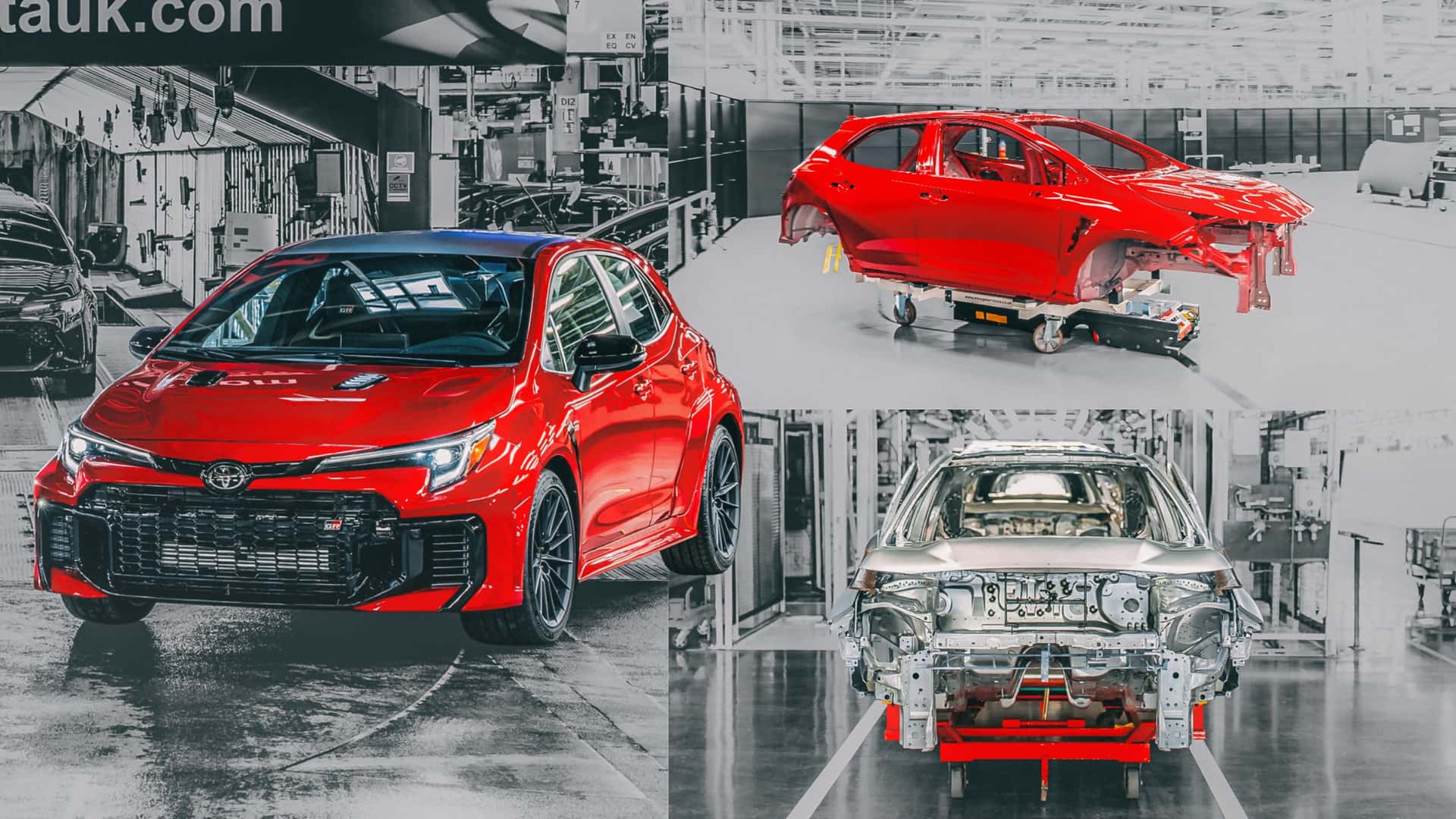
Toyota is indeed building its pride and joy, the GR Corolla, in England. Of all the places in the world, it seems like an odd choice, especially for a Japanese megacorporation that’s had more factories than most people will have shoes… in their lifetime.
Theoretically, Toyota could choose to produce the GR Corolla anywhere it likes. So why did it choose England? Well, Toyota flew me out to the factory so I could find out for myself.
The choice was far from an accident. Toyota says that the GRC is a victim of its own success, and that production capacity at the automaker’s historic Motomachi plant is maxed out. About a year ago, Toyota realized it couldn’t keep up, so it started searching for the ideal plant to pick up the slack.

Of Toyota’s 57 or so plants and joint ventures worldwide, about 12 build Corollas in some capacity. Of those 12, only four build the Corolla as it's known to western markets: Two in Japan, one in the United States, and one in the United Kingdom.
Only one of those plants could build the GR Corolla: Motomachi in Japan. The same plant that once built the Lexus LS400, Lexus LC500, Lexus LFA, Toyota Supra, and currently builds the Toyota Century. Motomachi is where Toyota’s halo products are born, and as I was assured, it is the crown jewel of Toyota’s production network. The very best build the very best at Motomachi.
And as I learned, it’s no simple feat to build a GRC. It’s an entirely separate production process from a regular Corolla, with specialized personnel, different tooling, and completely different methods. For any one plant to build the GR Corolla, it would take an entirely new production line and a dedicated staff. And Toyota would settle for nothing less than the Motomachi standard for Toyota Motor Manufacturing UK (TMMUK).
Inside TMMUK
"The target is Motomachi," one of TMMUK’s production leads assures me. And that wouldn’t be the last time I’d hear that exact phrase.
Machinery clanks and bangs around me as I struggle to listen to our tour guide. But the machinations of TMMUK’s main factory floor, where normal Corollas are built, fascinate me. Every 89 seconds, a freshly built Corolla rolls off the line. That means each station in the production process has 89 seconds to do its job, so the Corolla’s production line is quite long.
There’s a station for the dashboard, windshield, and a wiring harness. Another that marries the front and rear subframes, including the engine, to a Corolla in that amount of time. All four seats go in at once, and so on, each station taking 89 seconds or less. Even under a tight timeframe, nobody moves too quickly—all motions are fluid, careful, and efficient.
'The target is Motomachi,' one of TMMUK’s production leads assures me. And that wouldn’t be the last time I’d hear that exact phrase.
The entire production line’s performance is judged on that target number, and more specifically, around the amount of stoppages to correct errors and overruns. One error stops the entire line, making efficient, fast, and perfect operations imperative.
For TMMUK, the line uptime target is 98.6 percent, meaning that the line is moving for 98.6 percent of an entire shift. There are screens everywhere showing that number and how the production shift is doing relative to it. Another readout shows the errors that occurred.
What’s more fascinating is the method of correction, something called "Kaizen." It’s a Japanese philosophy that simply means "continuous improvement." If you’ve been around Japanese cars long enough, you’ve probably heard the phrase; it’s a core tenet of the Toyota production process.
Much of what you’ll see around the factory is distinctly Japanese. The worker safety briefing areas are called Dojos. “Hoshin,” the Japanese word for direction, is used in planning documents. Workers, who are called Members, are trained in Japanese working philosophies and methods, and encouraged to speak up about improvements and weaknesses.
There are even regular competitions among teams to figure out the best Kaizen, which can help the plant build cars faster and more safely without compromising quality. At any given station or rest area, Kaizens are celebrated and highlighted—and the plant is positively covered in them.
You’ll see things like reshaped 3D-printed accessories that prevent heavy tools from falling from their holster. There’s an overhead conveyor belt that safely transports wiring harnesses from above instead of from a cart. It was found that workers were accidentally stepping on connectors and breaking them; feeding it from above made it much less likely to cause damage.
The GR Corolla Line
Yet the star of the show is the GR Corolla line. After spending the morning seeing how normal Corollas were built, Toyota ushered us further into the sprawling facility. Immediately, the atmosphere was different.
Where the regular Corolla line sprawled further than I could even process, the GR line was more… compact. It took up about a third of the size of the normal line and had far less specialized machinery. The workers moved with a similar grace, but each station did many more tasks. Instead of 89 seconds, each GR station gets about 22 minutes.
After spending the morning seeing how normal Corollas were built, Toyota ushered us further into the sprawling facility. Immediately, the atmosphere was different.
Instead of simple, small tasks being divided up, the GR line had a more technician-focused production line, with several major assemblies happening at one station. One station was dedicated to the entire front end of the car, with a few workers handling the engine bay wiring harness, intake ducting, plastics, headlights, and a few other items. Another did the interior, dashboard, seats, wiring, headliner, and windshield in one go.
The process was shockingly manual. One could say a lot of the GR Corolla’s production was left up to the skill of the people assembling it, such was the reliance on human hands. I would almost argue that it is functionally hand-built.
Speaking to the workers on the line revealed a process by which GR production line members were trained for months on the regular line, and then hand-chosen for the job. Almost everyone I spoke to—and I spoke to a dozen people in various stations—was a car or motorsport enthusiast who knew exactly what they were building. The passion and pride, and the sense of being “trusted” to build the GR Corolla, were palpable.
Around 13 truckloads of parts come in per day to supply the GR Corolla line. Almost every part of the GR Corolla is still Japan-made, with the engines, subframes, brakes, suspension, and major running gear all being imported.
TMMUK stamps out the bodies and body panels, while nearby suppliers make the seats. Dashboards and interior plastics are mostly shared with the Corolla, so that doesn’t change. The bodies that get stamped out are also subjected to extra stringent checks—they’re mounted to a rig with locating pins and an extremely high-resolution scanning arm to verify body accuracy down to a hundredths of a millimeter.
The entire line is explicitly modeled after Motomachi, though in Motomachi, they’ve Kaizened their way to 13-minute intervals. Still, several Toyota chiefs have spent months helping TMMUK develop the line, including GR Corolla chief engineer Naohiko Saito and Master Test Driver Hiroaki Ishiura, providing input and quality assurance.
At the end of production, each car is measured against what Motomachi can do, and according to Saito-san, it is as good or better. I even heard a whisper (in Japanese) from Ishiura-san that the UK Corolla felt slightly better than the Motomachi cars.
The Result
Though we didn’t have to take their word for it. Toyota organized some time with the UK-built cars at Brands Hatch circuit for us to test. Bravely, Toyota gave me practically unlimited and unsupervised track time with my choice of automatic or manual GR Corolla, and I put the things through 25 minutes of hell.
Compared to my many experiences with the GRC back home, tracking them at Buttonwillow Raceway and Laguna Seca, the UK cars felt identical. England’s brisker weather definitely did the cars a favor in terms of cooling, but they took abuse as well as any GR Corolla could have. Hot lap after hot lap, the brakes and engine temperatures remained consistent and settled in for nice long stints.
The experience proves just how stringent modern production procedures are. Two cars can be made identically a world over, and even with how manual the GR production process is, the quality seems quite assured. It’s said that Akio Toyoda himself has visited the plant several times and spoken to the Members of the importance placed on GR cars. That it isn’t about outright production speed or efficiency, but about precision, care, and extreme high quality.
"We chose the UK because it is the spiritual home of motorsport," said Saito-san. "Morizo knows the importance of the UK and wanted to access it to improve the GR Corolla even more."
Not all GR Corollas will be built in the UK, however. The UK is primarily providing extra units for the demanding North American market. Motomachi, meanwhile, will continue to stamp out GR Corollas as quickly as it can.
"Our target is Motomachi," another Member repeated to me. He continued with a challenge. "I hope that one day we can even beat them."