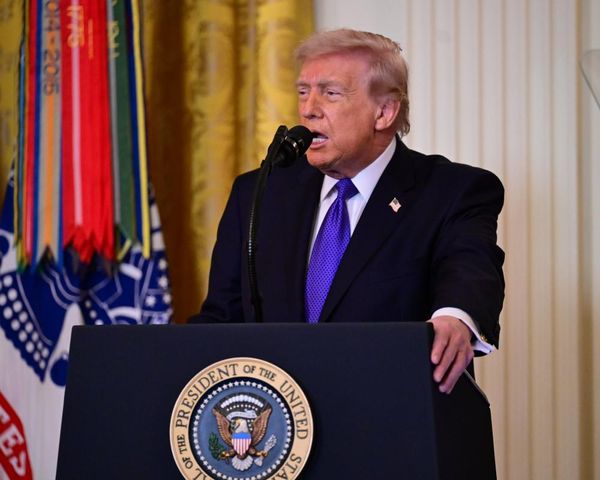
The Reserve Bank governor has defended her US counterpart from the Trump administration’s escalating attacks, calling for interest rates to be set free of political pressure.
Michele Bullock and nine foreign central bank heads on Tuesday said they held Jerome Powell in the “highest regard” after he claimed a new criminal investigation was prompted by his failure to follow Donald Trump’s interest rate orders.
Economists have warned Australia would face higher inflation and more volatility if Trump successfully pushed the US Federal Reserve to cut interest rates.
Here’s why Trump’s pressure on the Fed matters for Australia.
Why is Donald Trump attacking the Fed?
Trump has called for the Federal Reserve, the US equivalent of the RBA, to lower interest rates, claiming that cutting rates would spur economic activity and save the country US$1tn a year.
Lower interest rates would reduce borrowing costs for Americans with mortgages, businesses and the federal government, which faces soaring debt.
The Fed and its chair, Jerome Powell, cut rates only three times in 2025, fearing further cuts would push up inflation. Consumer prices rose 2.7% in the US over 2025, above the Fed’s target of 2%.
Sign up: AU Breaking News email
Trump has blamed Powell for a slowing economy and accused him of overseeing a $400m blowout in the renovation of the Fed’s Washington headquarters.
He appointed Powell chair in 2018 but said last month he would “love to fire him”. Trump is expected to appoint a new chair who favours rate cuts when Powell’s term ends in May.
What has the RBA said about Trump’s attack?
Powell on Sunday revealed that the Department of Justice was threatening him with criminal charges, which he said was the result of his interest rate decisions going against Trump’s preferences.
Powell said the charges related to an investigation of his remarks in 2025 to a US Senate committee, when he explained why the Fed’s offices needed renovating.
Australia’s Reserve Bank governor, Michele Bullock, leapt to Powell’s defence on Tuesday, signing an open letter declaring her “full solidarity”, along with central bank chiefs from the UK, the EU, Sweden, Denmark, Switzerland, Brazil, South Korea, Norway and Canada, later joined by South Africa and New Zealand.
The bankers said central banks needed to be independent from governments to keep their economies stable and backed Powell personally for his “unwavering commitment to the public interest”.
The letter also noted banks’ independence must have “full respect for the rule of law and democratic accountability”. Trump has claimed he is unaware of the DoJ investigation and continued to verbally abuse Powell on Tuesday, saying: “The jerk will be gone soon.”
How would a Trump takeover of the Fed affect Australia’s economy?
Political cuts to interest rates would mean more inflation and less financial stability in the US and Australia, economists have warned.
Central banks are commonly given independence from politicians so they can make unpopular, inflation-beating rate decisions, according to Harry Murphy Cruise, head of economic research at Oxford Economics Australia.
Excessive and unpredictable rate cuts would increase market volatility and weigh on share markets, first in the US and then internationally, he said.
“Financial markets need steady policy [and] when you start to de-anchor inflation expectations, then you see financial markets run wild,” Murphy Cruise said.
The US dollar has already declined in value since April amid rate cuts, persistent inflation and Trump’s pressure on the Fed, increasing the Australian dollar’s value to 67 US cents, from 63 cents.
Higher inflation could spread to Australia by increasing the price of goods imported from the US, such as heavy machinery and computer equipment, according to Richard Holden, scientia professor of economics at the University of New South Wales.
“If there’s big inflation in the US and the price of a bunch of the things that we import from the US goes up, then that’s inflationary here,” Holden said.
Why did the RBA speak up?
Bullock and her counterparts made a unique intervention against political interference in interest rate decisions in their statement, according to Jonathan Kearns, chief economist at Challenger.
“It is still quite unprecedented for central bankers to be making a collective statement in this way,” Kearns said. “If the US government was successful in having more influence over the Fed, does that create a benchmark that other governments in other countries want to emulate?”
The Fed is the latest central bank to face political pressure, after interference in Argentina and Turkey increased inflation and slowed income growth.
New Zealand’s foreign minister, Winston Peters, on Wednesday rebuked his nation’s Reserve Bank governor for signing the open letter.
“The [bank] has no role, nor should it involve itself, in US domestic politics,” he wrote in a post on X. “We remind the Governor to stay in her New Zealand lane and stick to domestic monetary policy.”
Australia’s central bank, the RBA, makes independent interest rate decisions with bipartisan support.
Symbolising its independence, it has faced scrutiny but not political attack for cost overruns in its Sydney headquarters renovation, Kearns said.
“There has been appropriate oversight or questioning of that by politicians, but there has not been a targeting of the central bank,” Kearns said.
The RBA is not free from pressure, with the treasurer, Jim Chalmers, facing criticism in 2024 for claiming it was “smashing the economy”. The government retains the legal power to overrule the RBA’s interest rate decisions, prompting the Greens in 2024 to demand early rate cuts.
The RBA governor has previously avoided firing back at politicians’ criticisms and in July praised Powell for doing the same, sidestepping Trump’s renovation-related accusations.
“What’s going on in the United States is challenging but I’d have to say, at the moment, that the Fed is doing what it’s supposed to be doing, which is focusing on the economy … not getting drawn into the debate,” Bullock told a July lunch hosted by Australian Business Economists.