
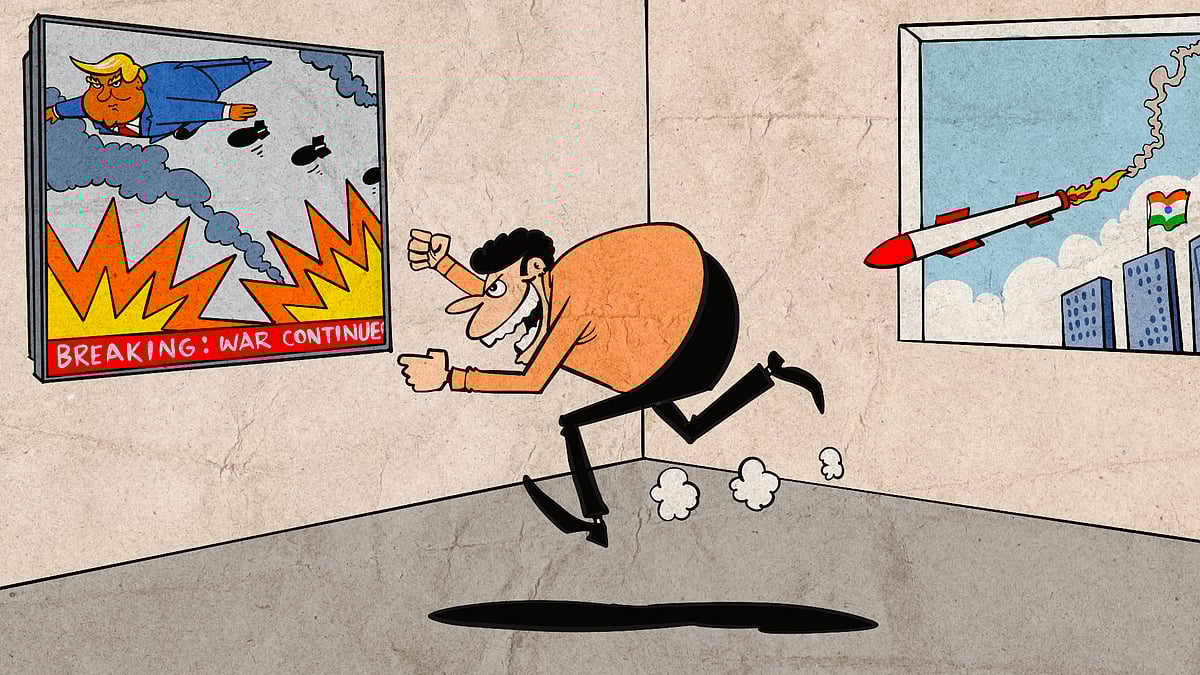
With guns in their hands and God on their side – Bob Dylan
John Mearsheimer writes in The Tragedy of Great Power Politics: “States rarely go to war unless they think that rapid success is likely.”
It has been more than a month since Benjamin Netanyahu and Donald Trump started the war in West Asia by attacking Iran. Clearly, they must have thought that things would not escalate, and they would see rapid success. But that hasn’t happened.
And every day the war continues, countries all across the world – including India – have to bear its cost.
In 2025-26, India imported close to 89 percent of the crude oil that it consumed. More than half of the natural gas consumed was imported.
The war in West Asia has, for the most part, closed the Strait of Hormuz, through which a significant share of global oil and gas production passes. India sources barely any crude oil from Iran, but relies heavily on suppliers such as Saudi Arabia, Iraq, the United Arab Emirates, Qatar, Kuwait and Oman. In 2025–26, these countries together have accounted for well over half of India’s oil and petroleum product imports.
Much of this energy supply travels through the narrow Strait of Hormuz, which links the Persian Gulf to the Gulf of Oman. Roughly one-fifth of the world’s oil output passes through this chokepoint. With the war disrupting maritime traffic in the strait, tanker movement has slowed sharply, pushing up global oil and gas prices.
The price of the Indian basket of crude oil averaged at around $69 per barrel in February. As of April 1, it stood at $120.84 per barrel. Natural gas prices have risen from $6.21 MMBTU (Metric Million British Thermal Unit) in February to $10.76 MMBTU in April, a jump of over 73 percent. This has impacted the entire Indian economy.
1) The price of industrial diesel has gone up by Rs 22 per litre or 25 percent to Rs 109.6 per litre. Firms buy industrial diesel bulk to meet their specific energy needs. This hike will creep into inflation. Of course, some firms will try to get around this by buying retail diesel at pumps.
2) The price of the 19kg commercial LPG cylinder has been increased. This makes eating out expensive. News reports suggest a shortage of these cylinders, leading to limited menus at restaurants. Many news reports also suggest a shortage of domestic cooking gas cylinders. This seems to be leading many migrant workers to return to their home states. Hoarding and black marketing haven’t helped.
3) The price of aviation turbine fuel used to fly planes has also gone up, though “only a partial and staggered increase of 25 percent (only Rs 15/litre)” has been passed on to the airlines flying domestic routes.
4) In all this, the prices for domestic cooking gas, retail petrol and diesel have not been increased. So, you and I have been protected on this front. But this will have broader repercussions, which we will look at later in the piece.
5) The points made above are rather obvious ones. But the impact of the war in West Asia on India will be much greater than that. Take the case of medicines. The production of drugs depends heavily on petrochemicals and a wide range of energy-intensive processes, making it vulnerable to any sustained rise in oil and gas prices.
A report in The New Indian Express points out that many medicines – such as paracetamol, penicillin, antibiotics and sedatives – are ultimately derived from petrochemical feedstocks like benzene, toluene and ethylene. The war in West Asia has disrupted supply, suggesting that once pharmaceutical companies run out of their current stock of medicines, prices are bound to rise.
6) Then there is the very important case of fertilisers. As The Economist points out: “A third of global seaborne fertiliser trade passes through Hormuz. Roughly two-thirds of this is urea (often produced from natural gas); most of the rest is phosphate.”
A significant share of the fertiliser that India consumes comes from West Asia. India is the world’s largest importer of urea, a kind of fertilizer. According to S&P Global, a financial information provider, India imported 10.2 million metric tonnes of urea in 2025, of which more than 41 percent came from West Asia.
Further, it also imported a lot of Diammonium Phosphate – another kind of fertiliser – a good proportion of which came from Saudi Arabia.
Also, to produce urea, natural gas is used as a feedstock. As Harish Damodaran, writing in The Indian Express, points out: “The fertiliser sector accounts for close to 29 percent of India’s total natural gas consumption.”
Indeed, fertiliser prices have moved up sharply, and someone will have to bear the cost. The government of India subsidises fertiliser bought by farmers. So, they may not end up paying a higher price, but there is no free lunch in economics. The government has said that the country’s fertiliser stocks are robust and secure.
7) Then there is the case of condoms. The war in West Asia appears to be affecting their production as well. A report in Mint points out that the production of condoms uses ammonia to stabilize latex. Post that latex is processed into condoms. Around 86 percent of this ammonia is imported from countries such as Saudi Arabia, Qatar, and Oman, the report points out. Not surprisingly, the price of ammonia has surged, as has that of silicone oil, which is also used in making condoms.
8) Then there is plastic, which is used in everything from making everyday products to packaging. Most basic plastics are made from petrochemicals such as ethylene and propylene, derived from crude oil or natural gas. A large share of the world’s low-cost petrochemical feedstock comes from West Asia.
So, it’s no surprise that the price of everyday plastic products has been rising. The Times of India points out that buckets that were earlier available for around Rs 200 are now being sold at Rs 260–270. Further, Fast-Moving Consumer Goods companies and milk cooperatives will now face higher packaging costs. If the situation persists, this cost will eventually have to be borne by the end consumer through higher retail prices.
9) India is almost entirely dependent on imports for helium, a critical industrial gas used in everything from MRI machines to semiconductor manufacturing. A large part of the global helium supply is tied to natural gas production in Qatar, making the region central to the global helium market.
Helium is not produced independently; it is extracted as a by-product of natural gas processing. In fact, Qatar alone accounts for nearly one-third of global helium production, meaning any disruption there would sharply tighten global availability.
The impact is already being seen across the magnetic resonance imaging (MRI) sector. A report in The Times of India points out that helium is used to cool MRI magnets. A shortage could impact the health sector.
These are some of the impacts of the war in West Asia at the firm and sectoral level.
Now, let’s look at how things are likely to be at the macro aggregate level.
1) Inflation is expected to rise in the coming months as the costs of imported products go up. More than that, the prices of many raw materials used in manufacturing products within the country are rising, which will also add to inflationary pressures.
Further, freight and insurance costs in West Asia have increased, making imports into India more expensive and thus inflationary. This will also impact goods exporters, particularly the smaller ones working on tight margins.
2) Over the last few years, the central government hasn’t passed on the benefit of lower oil prices to consumers in the form of lower pump prices for petrol and diesel. So, it’s only natural that it shares the cost of higher oil prices with oil companies and does not pass them on to the end consumer.
The central government recently cut the excise duty on both petrol and diesel by Rs 10 per litre. It has also decided to provide full customs duty exemption on critical petrochemical products. But such measures will also have several impacts.
First, if the government continues to bear the higher cost of petrol, diesel and fertilisers, that money has to come from somewhere. Economist Rathin Roy, in a recent piece for The Morning Context, laid out the different scenarios.
The government can simply increase its overall expenditure and fund this. In this scenario, its fiscal deficit – the difference between what it earns and what it spends – will increase. This will have to be funded through greater government borrowing, leaving less for the private sector to borrow, thereby driving up interest rates.
This can slow down the growth in lending carried out by banks and have an impact on overall economic activity as well as growth in private consumption – the money you and I spend on buying goods and services.
Second, if the government decides to fund this through higher receipts/earnings, then that money has to come from somewhere. In the past, central governments have been known to get public sector units, as well as the Reserve Bank of India, to give out higher dividends to finance such expenditure. There have also been cases of one public sector company buying another, and passing the money on to the government. Anything along these lines will lower the government’s fiscal credibility.
Third, if the government decides to cut expenditure, it’s more likely to cut asset-creating capital expenditure. And that’s bad news for the overall economy.
3) The higher price of oil, natural gas, fertilisers and a whole host of other derivative products will lead to a higher import bill. This will lead to a higher trade deficit – the difference between imports and exports.
It will also lead to a higher demand for dollars needed to buy the imports. Along with that, if foreign investors keep selling out of India’s stock market – they have net sold Indian stocks worth Rs 1.38 lakh crore from the end of February – the demand for dollars will only keep increasing. This will lead to the rupee’s value continuing to come under pressure against the dollar.
This can have multiple impacts.
First, we will end up paying more for our imports in rupee terms. This will push up the trade deficit. If the government keeps picking up the tab alongside oil companies, it will push up the government's fiscal deficit, which may lead to higher interest rates.
Second, if the rupee keeps falling, foreign investors will earn lower returns in dollar terms, which is how their performance is judged – encouraging them to sell even more stocks and putting further pressure on the rupee.
Third, the Reserve Bank of India (RBI) has tried to manage the rupee's value by discouraging banks from speculating in it. This is, at best, a short-term measure, simply because it’s not the speculation that is causing the rupee to fall majorly, but the fact that the demand for dollars is more than their supply.
Fourth, in this scenario, the RBI may have to raise interest rates to defend the rupee. There are only so many dollars it can sell to defend the rupee, given that, unlike the Federal Reserve of the United States, the American central bank, it can’t create dollars out of thin air. This can be gauged from the fact that as of March 27, India’s foreign exchange reserves had declined by nearly $40 billion over four weeks, to $688 billion. Much of this decline came from the RBI selling dollars to defend the rupee.
Indeed, the story of the goldilocks fairy tale of the Indian economy sold by the RBI Governor, Sanjay Malhotra, will come to an end. This isn’t good news for a country that is already struggling to achieve nominal economic growth and to get private consumption growing faster.
Fifth, if the war in West Asia continues, the second, third and nth order effects on the Indian economy will play out even more. These will be more and more difficult to measure and predict. A Mint news report points towards this phenomenon where it says that a government move to divert petrochemical feedstocks to boost domestic LPG supply amid the West Asia war triggered a near-crisis in India’s pharmaceutical sector.
It disrupted production of isopropyl alcohol, a key drug input. The crisis was averted after emergency measures restored critical inputs for priority sectors, including pharma.
Sixth, given that the government chose not to pass on the benefit of lower oil prices to citizens, it’s politically difficult for it to pass on the increase, at least until state assembly elections are held in April. The trouble is that if oil prices don’t rise for end consumers, they might keep consuming the same amount of petrol and diesel as they did in the past. This will push up the trade deficit and put further pressure on the rupee.
Seventh, India’s lack of energy security has come into focus again. How the government plans to tackle this in the days, months and years to come is a very important question. Do we continue to depend on US permission to buy oil from Russia?
Ultimately, the wreckage of the West Asian war mirrors the cynical truth in Bob Dylan’s song “With God on Our Side.” Leaders often march into conflict with the moral “certainty” that victory will be swift and guaranteed.
But as the Strait of Hormuz chokes and oil prices soar, that hubris has turned into a protracted, expensive reality for the rest of the world. For India, the cost of this so-called “righteous” war is measured in more than just dollars and rupees; it will be felt in the price of medicine, food and a strained rupee. We are left to foot the bill for a conflict fuelled by the dangerous delusion that power is always right.
Or as the great Amrish Puri might have said if he ever played Donald Trump on screen: “Trump Khush Hua!”
Vivek Kaul is an economic commentator and a writer.
Elections in four states and a UT are around the corner, and Newslaundry and The News Minute are bringing you reports from the ground that are in the public interest. Click here to support us.
Newslaundry is a reader-supported, ad-free, independent news outlet based out of New Delhi. Support their journalism, here.