When you speak to those near the very top of Fifa, pretty much as close to Gianni Infantino’s presidential office as you can get, many still declare themselves baffled by the decision to suspend two matches of Cristiano Ronaldo’s ban. They weren’t privy to any extra explanation about the process or rationale, beyond the brief statement to which the global body has directed media, as well as references to the fact that this was the 40-year-old’s first international red card.
Fifa duly cited Article 27 of its disciplinary code, which allows its judicial committee the option to “fully or partially suspend” such disciplinary measures. So, an “elbowing” offence that is normally supposed to bring a minimum of a three-match suspension only brings one. It isn’t completely unprecedented – but it is unusual.
That can be felt in the response of the wider game, as many struggle to understand the rationale. Ronaldo may not have been sent off for Portugal, but he has received 12 red cards. It’s far from an uncharacteristic moment that warrants leniency.
Ronaldo himself understands how real power works. He’s been closer to it than most footballers.
Fifa’s decision was all the more conspicuous, given that it dropped a mere six days after Ronaldo’s appearance at a state dinner at the White House. It was quite a setting for his first photographs in the US since the 2018 leak of allegations of sexual assault, which Ronaldo denies and have never been proven.
The selfie featuring Elon Musk and Infantino inevitably generated the greatest number of responses, but the very room offered a snapshot of where the game is as it heads into 2026.
It certainly is unprecedented that a foreign footballer, in his mere role as “a footballer”, appears at an official White House event with the heads of state of the United States and Saudi Arabia. The event was quite the precursor to the political theatre we’re going to see here in Washington around the World Cup draw, which takes place at the Kennedy Center on Friday.
Infantino is at least well used to such invitations by now. He could once more speak to both leaders about their hosting of the 2026 and 2034 World Cups, respectively.
Perhaps Musk will make another appearance, as he did at the 2022 World Cup final in Qatar, complete with strange commentary over footage on a post of a penalty, itself the sort of copyright infringement that Fifa used to insist was taken down in seconds. One rule for some.
The event was primarily a refresh of US-Saudi relations, with Donald Trump even defending Crown Prince Mohammed bin Salman over the 2018 killing of journalist Jamal Khashoggi. The response to that outrage has been cited as one of the motivations for the wider Saudi sporting – or sportswashing – project, which will reach a peak with that 2034 World Cup.
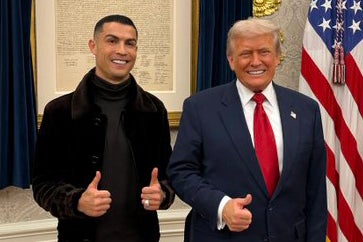
As such, you almost say the East Room served to showcase every single major football issue in 2025: sportswashing; overt commercialisation; the landgrab of the new frontier of the US; the manner in which the game is being used to further authoritarian politics, right up to how social media – and especially Musk’s X (Twitter) – has served to poison discourse around the sport, while reshaping its culture for the worse.
The modern Fifa has repeatedly been criticised as a willing facilitator of all this, especially given Infantino’s constant proximity to Trump. And yet, many in football are now arguing that the Ronaldo decision is – in the words of one senior figure – “one of the worst things they’ve done”.
Clearly, it does not have the real-world dimension of political influence or human rights and sportswashing. But all of that can often feel opaque, and is usually met with waves of PR and pushback that serve to confuse the discussion. The great difference with the Ronaldo decision is that it cuts to Fifa’s very raison d’etre, which is the running of the sport. It cuts to sporting integrity. The questions couldn’t be clearer.
A three-match ban has been reduced to one, for fairly nebulous reasons, ensuring the most famous footballer in the world can instantly play in what is intended to be the most commercially lucrative World Cup ever. And yet that is also of a piece with the bigger issues.
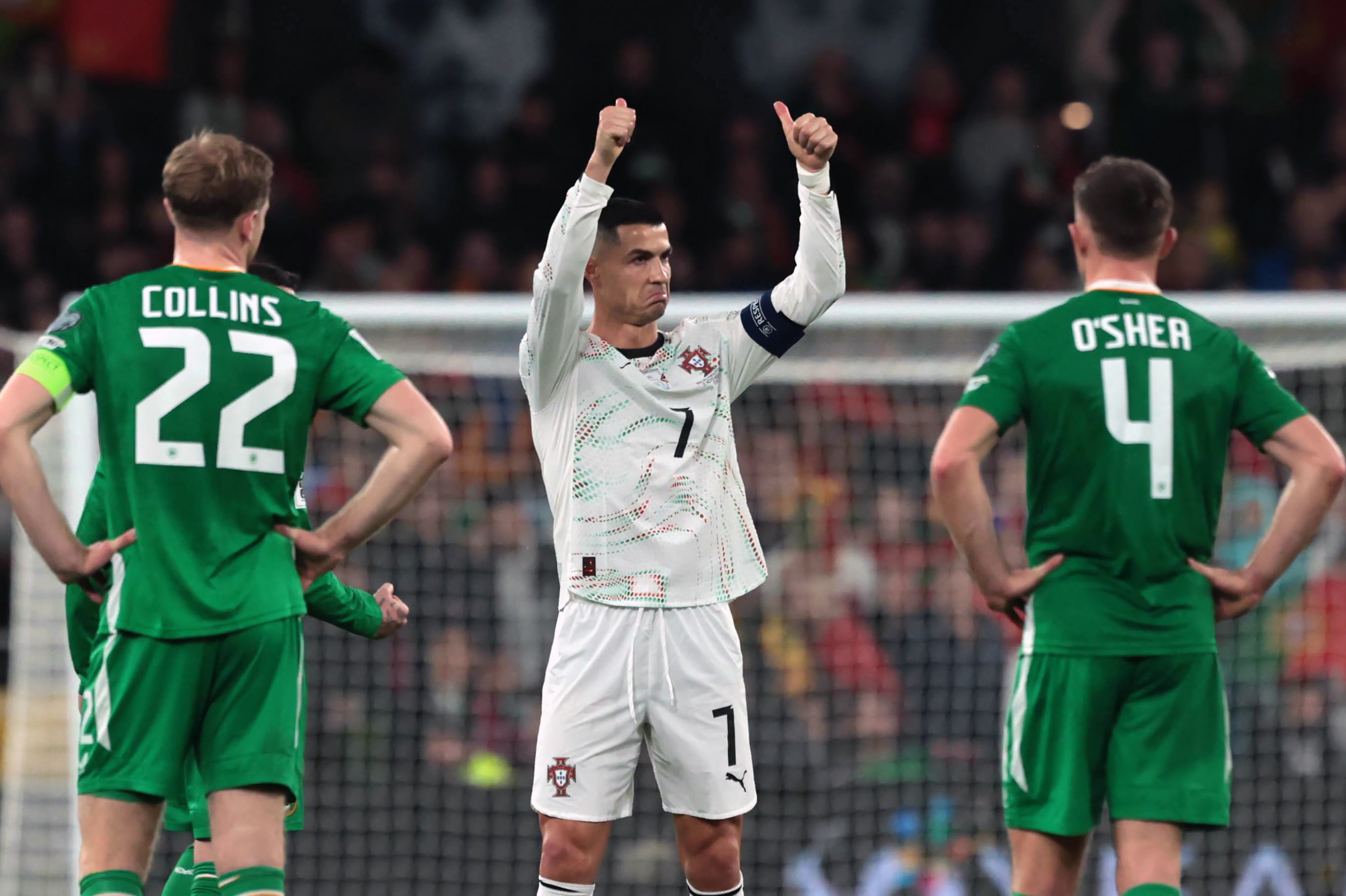
Despite – or almost because of – the lack of transparency in these processes, the Ronaldo decision conversely starts to make clear how this Fifa has distorted the norms around football. It is as if everything surrounding the game has been so warped that the effect has started to seep into the sport itself.
This is only a natural follow-on from developments such as: the World Cup-hosting parameters being changed so Saudi Arabia was the only possible host; a new calendar being unilaterally imposed; the Club World Cup entry rules being altered so Lionel Messi’s Inter Miami could feature; and a bespoke transfer window being set up for that tournament.
A decision like this – at the “discretion” of Fifa – just feels like a logical and yet absurd next step.
And it needs to be stressed that this is new. Fifa and Uefa, for all their historical faults, used to be commendable at this type of thing. They usually refused to bend to star power.
In 2002, Rivaldo was given no latitude for simulation. Ahead of Euro 88, Uefa refused to shorten Liam Brady’s ban for a similar incident, and that despite some of the most powerful figures in Italian football writing on behalf of the Irish international.
Things have evidently changed, and that could create further disruption. Other federations, from Argentina to Romania, are now seeking to have bans for their players reduced. Countries that end up in Portugal’s group in Friday’s draw may appeal to the Court of Arbitration for Sport.
Worse, it is like something historically sacrosanct – the very rules of the game, and the sense of fairness that all sport fundamentally requires – is being affected.

It looks like the modern Fifa is bending the game to the will of the current hierarchy rather than serving its members, as is supposed to be its mission.
So much for the way Fifa lauds itself for upholding integrity, from its “integrity initiative” and “Global Integrity Programme” to “establishing preventative measures to protect” its competitions.
Compare the rules on this to rugby, where such situations are impossible. Regulation 17 is core legislature: there, in black and white, it reads: “All Matches are equal. A Player suspended from playing the Game shall be suspended from participating in any Match at any level during the period of the Player’s suspension.” That is inarguable.
With football now, other considerations may abound.
On coming to power in 2016, Infantino promised his voters more money, and a more commercially successful World Cup does that. Ronaldo certainly helps that.
All of this may also test something even more fundamental, as well as integrity. Through that rise, Infantino inherited what is arguably the most perfect sporting format ever devised, a 32-team World Cup. It has a magic that overcomes everything, from human rights questions to the more questionable side of the game.
Fifa has already messed with it for a new 48-team World Cup. It is now risking the sporting trust that underpins it all.
Lionel Messi drops World Cup hint ahead of 2026 draw
World Cup 2026 schedule, fixture dates and venues
Everything you need to know about the new World Cup 2026 format
World Cup 2026 draw: Start time, pots, teams qualified and how to watch on TV
Man Utd vs West Ham prediction: Red Devils too strong for travel-sick Hammers