AI-generated images and videos following the arrest of Venezuelan president Nicolas Maduro have flooded social media, receiving millions of views as experts warn that visual cues are no longer a reliable tell for artificial intelligence.
Within hours of Donald Trump’s announcement that Maduro had been captured, AI-generated images of the arrest and outdated footage claiming to show the military operation in Caracas were widely shared on social media.
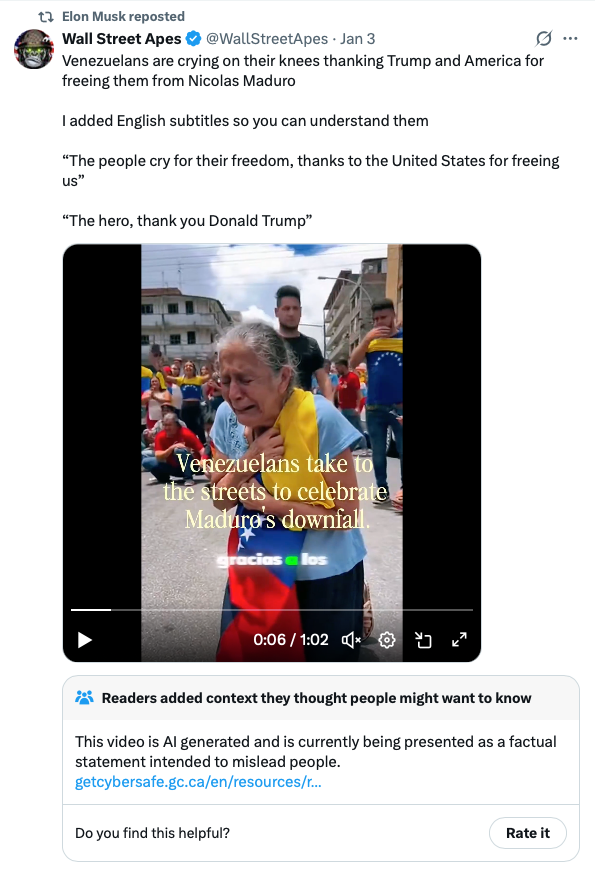
Elon Musk reposted an AI-generated video of Venezuelans crying on their knees, thanking Trump and the US for freeing them from President Maduro. The footage, originally published by an account on X called Wall Street Apes, has been viewed 5.7 million times on the platform.
Research by Shayan Sardarizadeh, a senior journalist for BBC Verify, revealed that the video was originally posted on TikTok by an account called Curious Mind, which regularly shares AI-generated videos. A community note underneath the reposted video described it as “AI generated and is currently being presented as a factual statement intended to mislead people.”
Multiple errors can be spotted in the video, from incorrect flag patterns and disappearing objects to missing teeth. The video has since been taken down on TikTok but remains on X.
Musk has gone on to share multiple “AI slop” videos, including one deepfake of Maduro breakdancing with President Trump, and another of the Venezuelan president in prison with Sean “Diddy” Combs.
While he has not responded to claims on social media that the video of the Venezuelans crying was false, he has since reposted content that vouches for X’s accuracy.
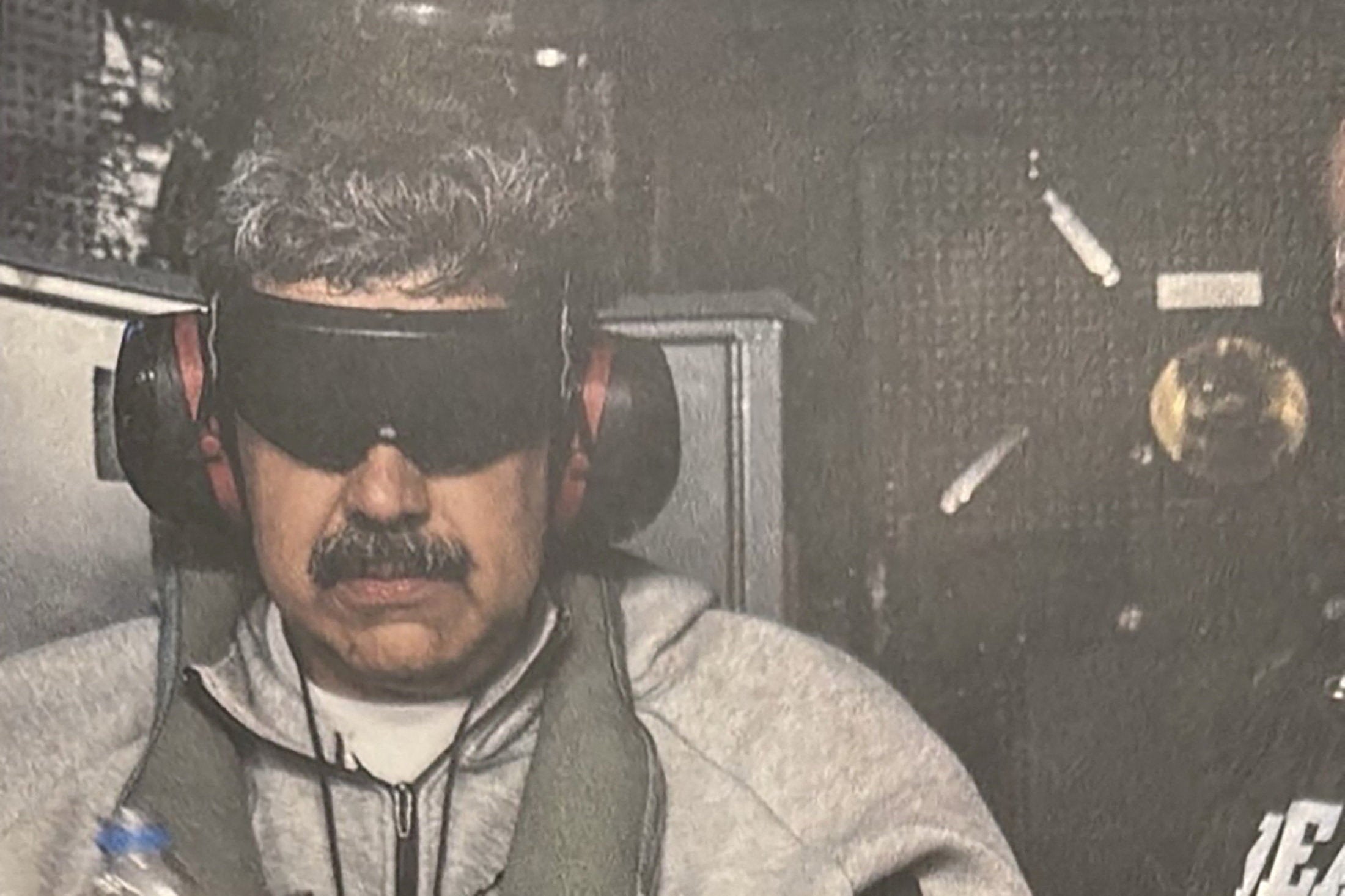
Vince Lago, mayor of Coral Gables, Florida, was one of many who reposted a hyper-realistic, AI-generated photo of Maduro being led off a plane by US law enforcement agents on Instagram.
Analysis by Google’s SynthID detection tool revealed an invisible watermark on the content that proves it was generated or edited using AI software. According to Google Gemini, this watermark is “imperceptible to the human eye but can be detected by software”.
As part of his post using the fake image on social media, the politician declared: “With the capture of Nicolas Maduro earlier today, America is safer and Venezuela is one step closer to freedom.
“President Trump and Secretary of State Marco Rubio were clear from the start: Maduro is not President of Venezuela, he is the leader of a narco-terrorist organization threatening our country. God bless our men and women in uniform, and may God continue to bless our great country.”
The creator of the now-viral, AI-generated photo of Maduro later came forward as a Spanish-based X user with fewer than 100 followers. A self-described “AI video art enthusiast”, who goes by the name Ian Weber, told AFP that he had never expected it to become so widely shared.
Maduro has been captured. He has been flown out of the country. #trump #Venezuela pic.twitter.com/BcNWmSeIDM
— Ian Weber (@San_live) January 3, 2026
He created the fake with Google Gemini’s Nano Banana Pro to post within 20 minutes of Trump’s announcement of the operation on Truth Social, according to AFP.
Another AI-generated photo showed a soldier posing next to Maduro, who has a black hood over his head, according to a report from NewsGuard outlining fabricated and out-of-context photos and videos linked to the military operation in Venezuela.
NewsGuard, which provides services such as misinformation tracking, said that seven of the misleading photos and videos it identified have now garnered more than 14 million views on X alone.
Benjamin Dubow, a democratic resilience fellow at the Center for European Policy Analysis (CEPA), explained to The Independent that the AI-generated content came about as social media users attempted to fill an information void in the hours after Maduro’s capture was announced.
“With the capture of Maduro, you have one of the biggest, most shocking news stories of the past couple of years and especially Saturday morning US time, the couple of hours after the event happened, there’s almost no news coming out because there’s just a lot of uncertainty.
“You have the press conference at 11 o’clock Eastern Time, but you have news already broken before then about the event and you have a lot of demand for an understanding of what’s been going on and what’s happening.
“There were a lot of people on social media generally who were more than happy to step in to fill that void,” he added. “What’s kind of interesting about what Musk shared, what the mayor of Coral Gables shared … They were fakes, but they weren’t really conveying anything that different than what happened.”
He added that basic media literacy remained important in the face of the sheer volume of content and misinformation online.
“Best practice is waiting until there are actual reliable sources, validating the sources, making sure they’re credible, reliable and up to date,” he said. “Basic media literacy as it existed 20 years ago still applies now. It’s a much bigger challenge because the volume of content is hundreds or thousands of times greater than it was back then.
“The really big thing is you should be the most suspicious of content that you most agree with, which is very hard and counterintuitive to do, but the stuff you agree with, the stuff that makes the most sense, that’s the easiest way to trick you into believing something that’s not true,” he added.
“You’re never gonna believe something that makes the other side look good, so the other side’s misinformation really isn’t gonna affect you."
Sofia Rubinson, senior editor of NewsGuard’s Reality Check, told The Independent: “As AI-generated images and videos improve to the point where visual cues are no longer reliable, it’s more important than ever to approach content on social platforms with skepticism, even when shared by prominent or verified accounts.
“In situations like Venezuela, where credible news organisations may lack immediate access or visuals, AI-generated content and manipulated media can quickly fill the information void. These images may not always invent events outright, but they can misrepresent context, timing, or scale. Our ability to trust what we see on social media is rapidly declining.”
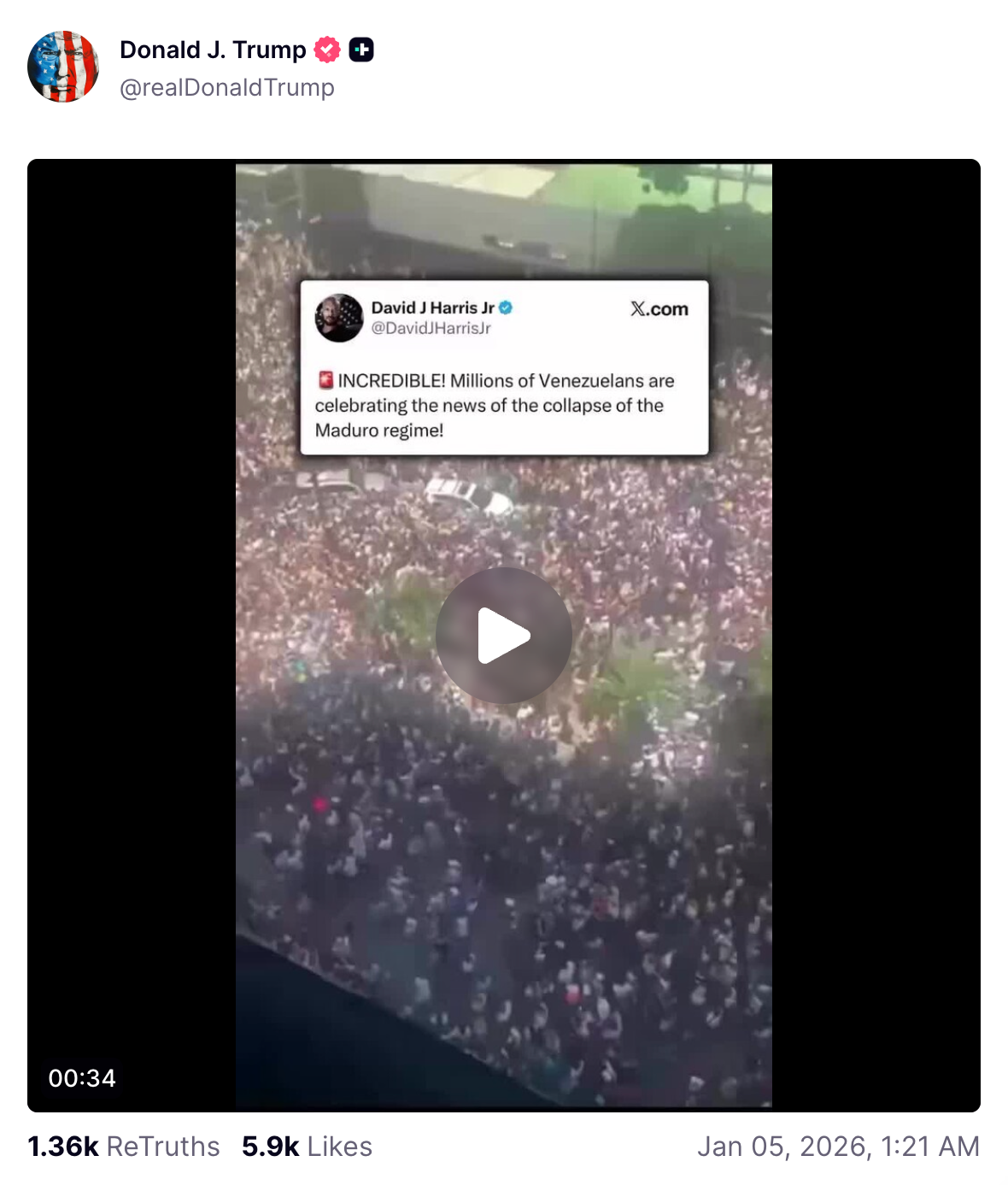
As well as AI-generated media, old footage of previous incidents in Venezuela has been recycled, causing further confusion. Even President Trump has shared footage purporting to show throngs of Venezuelans “celebrating” the US military’s recent capture of President Maduro.
The post on Truth Social showed a massive crowd of people gathered in Caracas. Its caption states: “Millions of Venezuelans are celebrating the news of the collapse of the Maduro regime.”
A reverse image search of the clip showed the footage was actually from a protest in Caracas after Maduro’s disputed presidential win in July 2024.
The same video has been reposted by right-wing influencer and conspiracy theorist Alex Jones on X, who alleged to his audience of 4.4 million followers it was to celebrate “the ouster of Communist dictator Nicolas Maduro”. It has been viewed 2.2 million times.
The Independent has contacted X and Meta for comment.
UK and Nato allies boosting Arctic defence as Trump ramps up Greenland pressure
‘We don’t want to be Americans’: Greenland’s indigenous Inuit hit back at Trump
UK wants ‘peaceful transition’ in Iran as violent crackdown continues
Starmer considering sending military to Greenland as Trump ratchets up rhetoric
Singer Yeison Jiménez among six killed in plane crash after tragic final post
US military launches dozens of strikes against ISIS in Syria with ‘Operation Hawkeye’