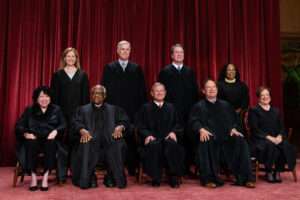
Debate over the Supreme Court's performance in recent years has become highly polarized. So it's worth noting that prominent left-liberal Georgetown law professor David Cole recently published a qualified defense of the Supreme Court's recent rulings in the New York Review. He emphasizes their crucial role in constraining abuses of power by Trump. Cole is also the former National Director of the ACLU, and thus - to understate the point - not a natural ally of the Court's conservative majority. As we shall see, he's far from an unqualified fan of their recent performance, and still takes them to task on some points. But the more positive aspect of his appraisal is still notable:
Can we rely on the courts, and most importantly the Supreme Court, to resist major assaults on the rule of law by the Trump administration? That question was front and center during the Court's recently concluded 2025–2026 term. With its six Republican appointees—three nominated by Trump—some feared that, much like the Republican-controlled Congress, the Court would reflexively back the president….
By the end of the term, however, the story was more nuanced. The Court blocked four of Trump's major initiatives: ending birthright citizenship, imposing worldwide tariffs, firing Federal Reserve governor Lisa Cook, and dispatching National Guard troops to Chicago, Portland, and other cities. In other significant cases as well, the Court rejected positions advanced by Trump. In a decision that he called "a tremendous loss," it held that federal law permits the counting of mail-in ballots posted by election day but received thereafter. And it refuted the Trump administration's assertion of constitutionally unchecked power to demand that Google turn over the cell phone location histories of unlimited numbers of Americans. The justices may not be, as Trump called them after he lost the tariffs case, "fools and lapdogs for the RINOs and the radical left Democrats," but this is not Donald Trump's Court….
These are not the decisions of a Court doing the president's bidding or voting exclusively along party lines. By contrast, had these issues been put to a vote in Congress, would a single Republican have broken ranks?
The rulings cannot be dismissed as mere token losses for Trump. Each one established important guardrails on the executive branch. The tariffs decision rejected the president's assertion of emergency powers, a step courts rarely take. Justice Samuel Alito called the birthright citizenship case "one of the most important decisions in the history of the Court." The decision blocking the firing of Cook protected the independence of the Federal Reserve, the nation's most powerful financial institution. And the National Guard decision kept troops off our streets, halting Trump's invocation of a classic authoritarian move.
Some argue that all these cases that went against Trump were so easy and clearcut that the Court deserves little or no credit for them. Cole disagrees:
Nor can the decisions be discounted on the ground that no reasonable judge could rule in Trump's favor. They all raised serious and unresolved questions. In Trump v. Barbara, the Court ruled that the Fourteenth Amendment, which extends citizenship to all persons born in the United States and "subject to the jurisdiction thereof," was intended to adopt the then-existing common law rule of birthright citizenship….
In 1898 the Court affirmed this common law understanding in United States v. Wong Kim Ark. But that case involved the child of Chinese nationals who were permanently and legally domiciled in the United States, so it did not technically involve the classes of persons to whom Trump sought to deny citizenship: children of foreign nationals here illegally and children of transient visitors….
The tariffs case also presented a close question. The majority ruled that the president's power to "regulate" imports under the International Emergency Economic Powers Act (IEEPA) does not include the power to impose tariffs, as the Constitution generally assigns the power to tax to Congress, a tariff is a type of tax, and the IEEPA does not explicitly delegate the authority to tariff to the president. But Kavanaugh wrote a thoughtful dissent for three justices that echoed an earlier decision by Judge Richard Taranto, a widely respected moderate member of the US Court of Appeals for the Federal Circuit. The Supreme Court had previously interpreted the IEEPA broadly, and President Richard Nixon had imposed tariffs under a predecessor statute. Reasonable people could differ on the legal question, yet the Court sided against the president.
Cole makes similar points about some of the other major cases that Trump lost.
I actually think the birthright citizenship and tariff cases were more clear than Cole suggests. While there were indeed "reasonable" arguments on both sides, the plaintiffs' arguments were much stronger than those of the administration. In the birthright citizenship case, the administration's arguments would have undermined the main purpose of the Citizenship Clause: guaranteeing citizenship to freed slaves and other Blacks. In the tariff case (which I helped litigate), there was a long list of strong arguments against the Trump's position, any one of which would have been enough to justify ruling against him. I summarized many of them here. Still, both cases raised largely unprecedented issues, and in both a Supreme Court inclined to do Trump's bidding could have found at least minimally respectable rationales for doing so. The same is true of the National Guard case, and others.
Overall, I very much agree with Cole's point that the Court has been a crucial check on Trump's power grabs, even if some of the cases weren't that difficult, and even if it hasn't always constrained him as much as it should. I have made similar arguments, myself (e.g. here and here). But, in some ways, it means more coming from Cole, as he is more ideologically distant from the Court's majority than I am.
It's possible to dismiss the Court's rulings against Trump on the grounds that, even if they went against Trump, they were still in line with the interests of at least some in the Republican Party. Thus, the Court could still be considered "partisan." After all, in each of these cases, there were at least some Republicans - including influential Republican legal elites and prominent conservative legal commentators - who opposed the administration's position.
But that claim runs into the painful reality that - at this point - the GOP overwhelmingly backs Trump's policies, including on the issues at stake in these cases. If having the support of a few Republicans or conservative legal commentators is enough to make a decision partisan, the claim would be nonfalsifiable. After all, almost any plausible resolution of any major case has the support of at least a few prominent Republicans. For example, there are pro-choice Republicans like Maine Sen. Susan Collins who would have preferred to see the Court preserve abortion rights and Roe v. Wade. It doesn't follow that a decision reaffirming Roe (the opposite of what the present Court actually did) would be a partisan Republican ruling!
It is fair to say, as liberal Justice Elena Kagan recently did, that this is a conservative Court, reflecting primarily conservative jurisprudential philosophies. As she puts it, "there's a conservative court doing things that conservative jurists have long thought it appropriate to do." But, as she also pointed out, that's different from being either a Trump Court or a bunch of GOP partisans.
In the last part of Cole's article, he takes the Court to task for neglecting the principle of stare decisis, overruling some precedents and severely narrowing others. I agree with his critiques of some of these decisions (e.g. - the awful Haitian TPS immigration ruling), and differ on others. But in each of these situations, it isn't so much the doctrine of precedent that is doing the work, as our (sometimes divergent) perceptions of whether the precedent the Court overruled or narrowed was right in the first place.
Few judges, legal scholars, or commentators are genuinely willing to apply stare decisis to preserve constitutional precedents they believe to be badly wrong - and rightly so. I wrote about this in a 2019 post, that I think remains relevant today:
I simply do not believe that stare decisis will prevent either the liberal or the conservative justices from overruling constitutional precedents they believe to be badly wrong, though both are happy to wave the stare decisis flag whenever precedents they like are imperiled…
The liberal justices who appeal to stare decisis today also applaud the work of the New Deal-era and Warren courts, both of which overturned numerous longstanding constitutional precedents. Given the opportunity, they would likely happily overrule such precedents as Citizens United and the travel ban case, both much reviled on the left (the latter deservedly so, in my view)….
The Supreme Court needs to have the power to overturn flawed constitutional precedent, as this is usually the only way to correct wrong constitutional decisions, short of using the extraordinarily difficult amendment process.
If precedent were sacrosanct, the Supreme Court could not have reversed or superseded any of its most notorious past decisions… [I]n the travel ban case, the Court repudiated Korematsu v. United States, the notorious 1944 decision that upheld the World War II-era racially-based internment of over 100,000 Japanese-Americans. Hardly anyone objected that it was somehow inappropriate for the justices to junk a 74-year-old precedent….
Few people, particularly on the left, pine for the return of Bowers v. Hardwick, the 1986 case in which a narrow majority upheld the constitutionality of anti-sodomy laws. The Court eventually overruled Bowers in Lawrence v. Texas (2003)….
Today, pretty much every…. legal commentator can name Supreme Court decisions they would like to see overruled….
The justices' highest legal obligation is not to the Court's past precedents, but the Constitution. If they are convinced that the latter conflicts with the former, they should overrule, if at all possible. There is a good case for adhering to precedent in situations where the court is uncertain whether it is correct or not. In such situations, it might be reasonable to defer to the seeming accumulated wisdom of earlier judges, especially if there was a broad cross-ideological consensus among them…. [I]t is also justifiable to maintain wrong precedent in some instances where massive reliance interests would be upset otherwise.
But none of these considerations justifies maintaining precedents that the Court believes are badly wrong, and causing more harm than good in the real world. In such scenarios, the Court has a special obligation to help undo the evil that it had a major role in creating
See also my discussion here, of overturning precedents that protect individual rights.
I am far from an unequivocal defender of the current Supreme Court majority, and I think they have gotten some issues badly wrong. Just this term, we had the TPS case, and a severely flawed Takings Clause ruling. Earlier, there were clunkers like the Trump immunity decision, Trump v. Anderson, and the travel ban case, mentioned above. But when the Court goes wrong, it's generally not because they showed too little respect for precedent.
The Court's work could use significant improvement in a number of areas. But it's also important to acknowledge its very real achievements. And to resist efforts to destroy those achievements - and judicial review generally - by measures such as court-packing.
The post David Cole's Qualified Defense of the Supreme Court appeared first on Reason.com.