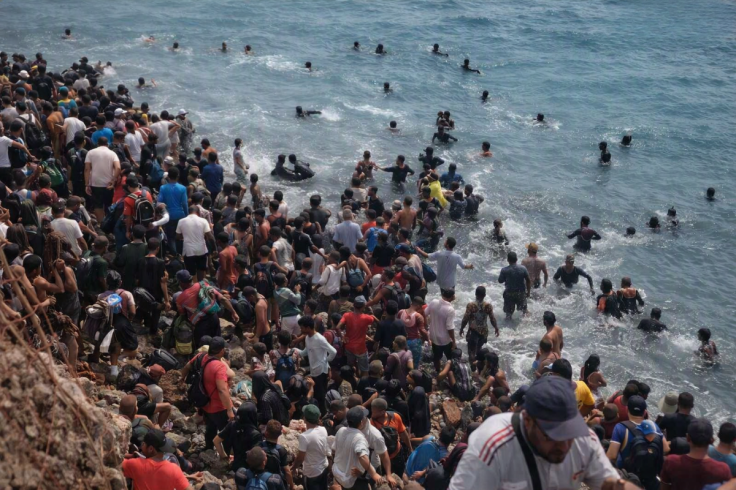
At least 72 people have died in Spain's North African enclave of Ceuta after tens of thousands of migrants crossed from Morocco in a sudden border influx, according to Spain's interior ministry and local authorities.
The deaths over several days as people tried to reach the tiny territory by land and sea have turned one of the EU's only land borders with Africa into the centre of a political and humanitarian emergency.
The surge has prompted several member states to call for Spain to be suspended from the Schengen free‑movement area, accusing Madrid of failing to protect the bloc's outer frontier.
According to public statements from European capitals, leaders now want urgent talks in Brussels to decide how the EU should respond and whether Spain's border controls meet Schengen standards.
EU States Demand Schengen Action Over Ceuta
Ceuta's president Juan Jesús Vivas and Spain's government delegate in the enclave say at least 72 migrants died during the mass influx, with victims among those pulled from the water or found near the breakwater and border fence.
Some people drowned while attempting to swim around coastal barriers, while others suffered fatal injuries in crushes as thousands tried to reach the fence at Tarajal beach.
🚨 IT'S OFFICIAL |
— Dr Sadi (@Dr_Sadi04) August 1, 2026
The USreali Sponsored Invasion of Spain has reached 60,000 illegal immigrants (and STILL RISING ).
USraeli backed Zio-morrocan regime is PUMPING more Morrocans into Ceuta.
The USreali Terrorists are a Threat to The World.
🇮🇱 must be REMOVED FROM Earth. https://t.co/XqkY6VWSHV
Spain's interior ministry data suggest that around 60,000 people crossed into Ceuta from Morocco by land and sea over several days, with more than 48,000 reportedly returning to Morocco within about 48 hours.
European government statements describe the volume of arrivals, combined with the death toll, as evidence that Spain failed to control what they regard as a critical external border.
Italy has taken the most far‑reaching step so far by temporarily suspending Schengen‑area air and sea travel links with Spain, in a decision announced as necessary to 'safeguard the security of our citizens and defend Europe's borders'.
Denmark and Finland have publicly backed calls to reconsider Spain's participation in Schengen, while France and other neighbours have reinforced their own checks at the border with Spain rather than explicitly demanding suspension.
Ceuta's Special Schengen Status and 'No Onward Route'
Despite heated political statements, EU officials stress that migrants who entered Ceuta do not automatically gain free movement into the wider Schengen area.
According to European Commission briefings and Spain's own Schengen guidance, Ceuta and Melilla are covered by a special regime that requires passengers travelling onwards from the enclaves to undergo identity checks before reaching mainland Spain or other EU countries.
#ForeignAffairsExplained
— Spain MFA (@SpainMFA) August 1, 2026
The Schengen Agreement abolished in 1995 border controls between EU countries and introduced common controls at the external borders.
Ceuta and Melilla have a specific regime, including checks on travellers to mainland Spain ⤵️https://t.co/f1u1oCuet6
Commission representatives have repeatedly said there are 'no onward movements towards the European continent' from Ceuta, insisting that the integrity of Schengen remains intact.
In public comments, former EU foreign policy chief Josep Borrell has warned that no member state can unilaterally suspend another's participation in Schengen, arguing that EU law does not allow one government simply to 'close the Schengen area' to a partner country.
1. After thousands of migrants crossed into Ceuta from Morocco this week, Italy threatened to “suspend Schengen with Spain.”
— Josep Borrell Fontelles (@JosepBorrellF) July 31, 2026
It just can’t.
Under EU law, no Member State can unilaterally suspend another’s participation in Schengen.
Spain's foreign ministry has said that people cannot travel from Ceuta or neighbouring Melilla to mainland Spain without passing through police identification checks at the port or airport. Foreign Minister José Manuel Albares has stated that 'the integrity of the Schengen Area is absolutely guaranteed'.
Spain Cites Traffickers and Past Border Crises
Spain's prime minister has condemned the border surge as a violation of territorial integrity and linked the influx to criminal networks exploiting recent court rulings.
According to the government's explanation, trafficking gangs took advantage of a Supreme Court decision affecting migrants who arrive by swimming, and whether they can be summarily returned, to encourage people to attempt the crossing.
Ceuta and Melilla have faced similar episodes before, including a major crisis in 2021 when thousands crossed into Spanish territory in a short period. Spain's authorities say the latest mass arrivals are on a larger scale, with tens of thousands entering in a matter of days and more deaths recorded than in many past incidents.
The national press is saying the immigrants left Cueta, but here they are. They haven’t gone anywhere.#BREAKING pic.twitter.com/GLdUc1HpVD
— HELLAS (@hellasxg) August 1, 2026
People sleeping in parks and streets, reception centres running beyond capacity and medical staff treating hundreds of injuries linked to the crossings are now part of daily life in a city that normally has around 80,000 inhabitants.
As EU ministers prepare for emergency discussions on how to respond, European government statements show the Ceuta crisis being cited by some as proof of Spain's failure and by others as evidence of wider structural pressures in Europe's migration and border‑control system.
The situation around the enclave now raises questions about the future of Schengen, the limits of unilateral national action and the consequences of Europe's border policies.