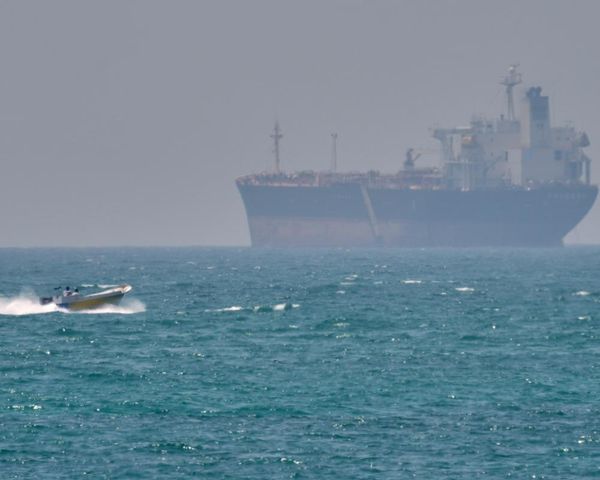
BP has come under fire after revealing profits more than doubled in the first three months of the year, thanks to the soaring cost of crude caused by the Iran war.
Chief executive Meg O’Neill praised the quarter as sending the firm “in the right direction” and “strengthening the balance sheet” - but critics have labelled the energy giant’s revenues as “horrifying” as “millions suffer the fallout” from war.
The FTSE 100 firm revealed its preferred profit measure – underlying replacement cost profit – surged by over 130% to a better-than-expected $3.2bn (£2.4bn) in the first quarter, up from $1.38bn (£1.02bn) a year earlier and $1.54bn (£1.13bn) in the previous three months. Most analysts had expected first-quarter profits of $2.67bn (£1.97bn).
Campaigners accused the group of profiting at the expense of households, who have seen fuel prices rocket at the pumps and are set to see energy bills jump higher once more when the price cap is next updated on July 1.
The price of oil has risen from the mid-$60s range in February to over $100 now, spiking close to $120 several times during the course of the Iran war.
Patrick Galey, head of news investigations at campaigning organisation Global Witness, said: “It is horrifying to see BP’s profits grow as millions suffer the fallout from the US-Israel war on Iran. Unfortunately we’ve been here before – when Russia invaded Ukraine four years ago we saw big oil firms make bumper profits from spiralling fuel costs.
“As oil prices drive up bills once again, it’s clear that fossil fuel companies don’t enhance affordability or energy security, they make life worse. They destroy the climate, push up the cost of living, and rake in billions in profit while innocent civilians die.
“It’s well overdue that we make oil companies pay for the damage their doing. If they broke it, they need to fix it. It’s clear they can afford to. BP profits, we all pay.”
Mike Childs, head of science, policy and research at Friends of the Earth, added: “Just as we saw in 2022 following Russia’s invasion of Ukraine, fossil fuel giants are quids in when global instability drastically inflates fuel prices.
“But again, it’s ordinary people who pay the price when soaring energy prices threaten to plunge the UK into an even deeper cost-of-living crisis.”
The End Fuel Poverty Coalition called for a windfall tax on firms profiting from the Iran-related energy crisis.
The campaign group’s co-ordinator Simon Francis said: “These astronomical profits are a startling reminder that when conflict drives up the price of oil and gas, energy companies profit and households pay.”
BP’s new chief executive Meg O’Neill, who took over at the helm on April 1, said the group was ensuring fuel supplies are met across the UK.
She said: “The teams across BP are playing their part to keep oil, gas and refined products flowing during an incredibly challenging time – focused on maintaining safe, reliable and cost-efficient operations.”
She added: “We are working with customers and governments to get fuel where it’s needed, helping minimise disruption and the impact it can have on people’s lives.”
Ms O’Neill took over from Murray Auchincloss, who himself served only two years in the role after succeeeding Bernard Looney’s three-year tenure. Prior to the recent regular changes, Bob Dudley spent a full decade in the job up to 2020.
BP have struggled with strategy direction and the transition to clean energy, first doubling down on their green plan before an abrupt about-face turn.
In share price terms, the results saw BP rise 2.5 per cent in early trading on Tuesday, adding to a surge of more than 28 per cent in the past three months alone, as investors watched a soaring oil price and predicted the profits to come.
“In February, BP announced it was halting share buybacks as weak oil prices hurt profitability. How times change,” said Freetrade’s investment writer, Duncan Ferris.
“The firm has been among the best-performing supermajors since the escalation of conflict in Iran. Higher oil prices, and the opportunities they offer to the company’s traders, have breathed life into a stock battered by faltering low-carbon projects and investor unrest.”
Oil prices have raced higher since the US-Israel war on Iran started on February 28 and are now more than 60% up so far this year.
Brent crude reached close to 120 dollars a barrel at one stage and, despite falling back, is still above the 100 dollars level as peace talks falter and amid fears over a looming global energy supply crisis.
BP’s update showed its customers and products division – including its oil trading unit – reported profits of 2.5 billion (£1.84 billion), compared with 1.4 billion dollars (£1.03 billion) in the previous quarter and just 103 million dollars (£76.2 million) a year ago as traders were able to capitalise on highly volatile oil prices.
Additional reporting by PA
Iran war latest: Trump ‘doesn’t love’ Tehran’s peace plan to stop the war
BP slammed over ‘astronomical’ profits amid oil price spike caused by Iran war
Starmer warns Iran war could put holidays and food shopping habits under threat
Barclays sets aside £823m for bad debts after fraud hit but profits rise
Oil prices edge higher as Trump weighs Iran’s latest proposal to open Hormuz