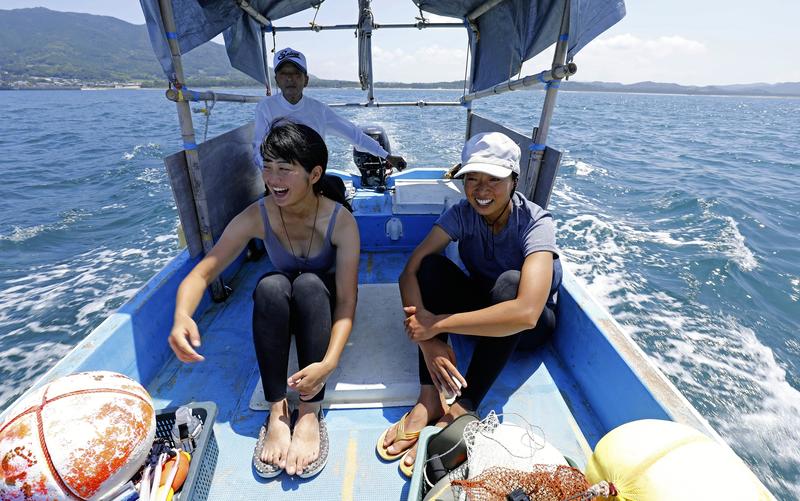
Two women sat laughing together in a small boat on the Genkai Nada sea. They were headed for a rocky area about 10 meters deep that teems with large numbers of abalone and sazae turban shells.
The women --Yukari Hayashi, 34, and Ai Honda, 31 -- are initiates to the traditional practice of ama diving, in which mainly female divers catch shellfish and other fish by free-diving without scuba gear or air tanks.
The Kanezaki district in Munakata, Fukuoka Prefecture, is said to be the birthplace of ama diving along the Sea of Japan.
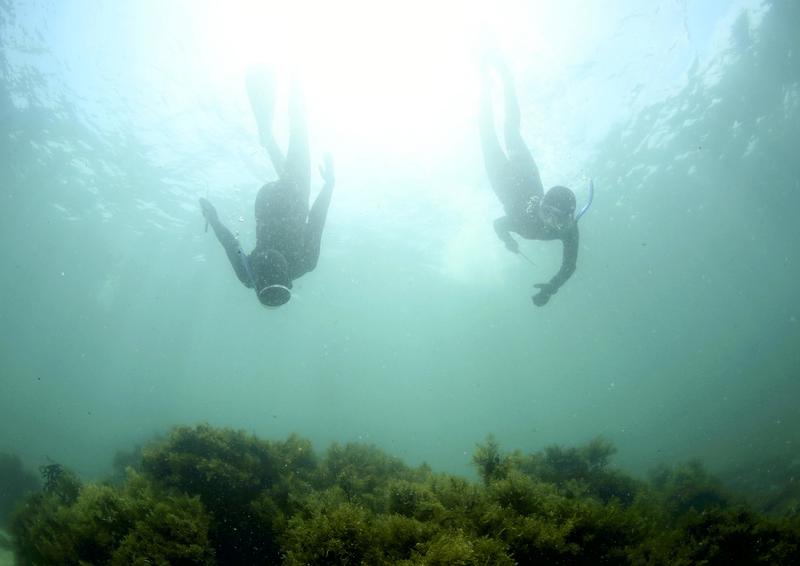
The city government has been recruiting short-term contract workers called "local vitalization cooperators" with the aim of passing down the culture of ama divers to future generations. Hired under the scheme, the two arrived in the area in April to work as temporary employees of the city.
About 200 female ama divers lived in the district in the Taisho era (1912-1926), but their numbers had dwindled to only two. Even including male free divers, also called ama in Japanese, the figure was only 15.
Hayashi and Honda have boosted their numbers. They have received instruction on diving techniques and fishing spots from senior ama, including veteran male diver Morio Ishibashi, 67.
Hayashi had worked at such places as an automobile manufacturing plant in Aichi Prefecture. She heard about the offer to work as an ama in Munakata in November last year, immediately before the deadline for applying.
"I worked like a machine every day," Hayashi said. The drudgery of her jobs and her love of the sea meant she felt no hesitation in switching to work deeply connected with the ocean.
"I can now live every day in a way that's suited to my own personality. I want to build experience as an ama," she said.
Honda, who is from Shiga Prefecture, applied for the job because she longed for a lifestyle in which "I can live off the food I obtain myself."
While a graduate student at Kyoto University, she experienced living in a student dormitory with a rich history and there were discussions on whether the building should be torn down. From the experience, Honda learned that preserving old things is valuable for the very reason that it is difficult.
Shooting a look toward the sea, she said, "I want to work to pass down the culture of ama to the next generation."
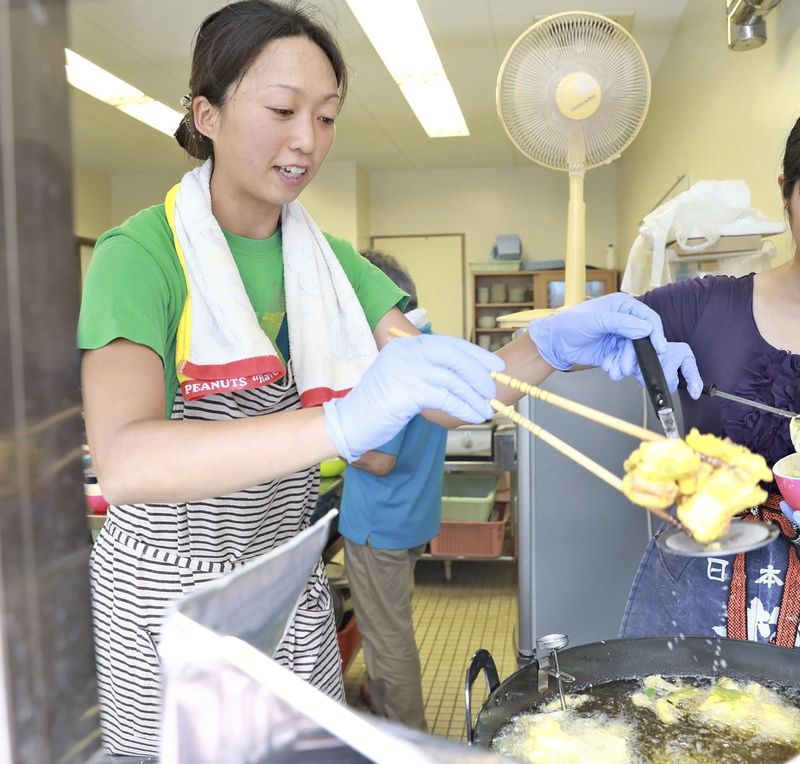
In late July, a diner named Ama-chan Shokudo opened in a corner of the Kanezaki head office of the Munakata fisheries cooperative. The two women are its main attraction.
The diner is only open during lunchtime on Sundays except the second Sunday of each month. Despite the limited hours, customers flock there to enjoy kakiage-don that the women cook -- a bowl of rice topped with kakiage-style mixed vegetable and seafood tempura that contains a generous helping of local specialty anago conger eel. One bowl is priced at 650 yen.
Some customers come to the diner just to meet the two women -- nicknamed "Munakata no ama-chan" -- as they busily go about their work in the kitchen.
Though their current job is scheduled to last up to three years, the pair dream of establishing themselves as independent ama divers and living in Munakata forever.
Read more from The Japan News at https://japannews.yomiuri.co.jp/