“Almost everyone is a zombie now,” yawns a blasé teenager in one of Stephenie Meyer’s Twilight novels. She is updating the heroine Bella – shortly to become a vampire’s virgin bride – on the progress of a horror film they are watching, but she might also be surveying the world outside the cinema. Are we surrounded by animated corpses, which lumpenly trudge along like the undead commuters on London Bridge in TS Eliot’s The Waste Land? Study the queues for public transport in the rush hour or workers numbly performing menial tasks: one way to get through the ordeal of existence is to behave as if you’re no longer sentient.
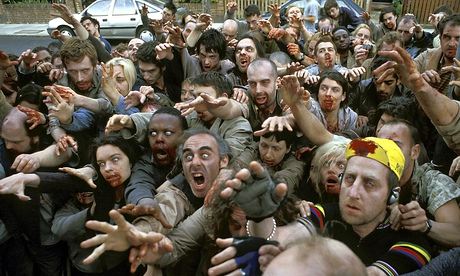
In Edgar Wright’s film Shaun of the Dead, it takes the baffled Simon Pegg a while to realise that the decrepit north Londoners staggering to the corner shop are cadavers in an advanced state of decay. In George Romero’s Dawn of the Dead, which Wright’s film parodies, packs of zombies maraud in slow motion through a shopping mall outside Pittsburgh, avid for flesh to gnaw: here are our culture’s ideal consumers, posthumously driven by appetites that have outlived them.
As Roger Luckhurst declares in his alternately solemn and zany book, these latterday zombies represent the predicament of those who have been “depersonalised, flat-lined by the alienating tedium of modern life”. Marx would have agreed: he thought that capitalism vampirically sucked life from labouring bodies and reduced proletarians to mechanised husks.
Though zombies have dwindled into a byword for brainless apathy, they began as experiments in black magic. Conjured up by priests in Haitian voodoo rites, they were bodies without the quickening spark that makes the rest of us human. Early western observers revered them as emissaries from a mystical netherworld. Luckhurst, grimly materialistic, dismisses such superstitions: he points out that the native populations of the region had been enslaved by American colonists and interprets zombies as evidence of an abusive economic system. He explains their intermediate existential status by saying that slaves were condemned to “social death”, and even attributes the shuffling gait of those reanimated stiffs to the clanking manacles that workers on sugar plantations dragged behind them.
As Luckhurst tells it, the zombie’s history is a delayed but gruesomely satisfactory revenge, another version of the archetypal Freudian plot that narrates the return of the repressed. In recent decades, the casualties of America’s rapacious Caribbean empire have clambered out of their graves, crossed to the mainland and formed into masses to invade American cities. In the “video nasty” Zombie Flesh Eaters, they troop over the Brooklyn Bridge towards the World Trade Center; in World War Z, they chomp through Philadelphia and forage on to global dominion, with only Brad Pitt, a punchy functionary of the World Health Organisation, to lead the resistance.
Luckhurst, an academic with all the requisite liberal attitudes, applauds the triumph of those ghoulish armies. He sees zombies as a “paranoid projection” of our feeble-minded panic as we wait to be blown up by jihadis or overrun by immigrants. The western world, embattled and insecure, is effectively dead but unwilling to lie down; zombies, Luckhurst says, mock us by presenting a reflection of ourselves, “the perfect emblem of decline coupled with denial”. Living in fear of a demonised “Other”, we overlook our own zombified condition.
For literary theorists, everything is reducible to language, so Luckhurst treats the zombie as a figure of speech rather than a spectral being. Having redefined the spook as a “syncretic object” and a “textual fantasy”, he goes on to uncover this “cultural trope” in anything he deems to be politically incorrect. He starts with West Indians enslaved by “colonial discourse” during the 19th century, then jumps ahead to prisoners worked to death in Nazi concentration camps. The identikit “organisation men” of the American 1950s are likewise reclassified as zombies, as are their robotic Stepford wives. The metaphor expands into an “allegory of globalisation”, acted out by “employees of low-wage, de-skilled service industries floating on the whims of international capital”, and it even stretches to the Resident Evil films. Ignoring Milla Jovovich’s kinky rubberised combat gear and her ripe scarlet mouth, Luckhurst says that the amnesiac character she plays is “less a human being… than a biotechnological device”, which makes her too an honorary zombie.
Finally, in our digital culture, “the zombie offers transmedial synergies for global entertainment corporations”. Reading that sentence, I began to suspect that Luckhurst might have joined the company of the shambling corpses he studies: this sclerotic lingo hardly sounds like living language. Soon enough he does admit to being defunct. He lost his nerve, he says, when playing the first Resident Evil computer game, and “can vividly recall being repeatedly bitten to death”.
Somehow, he valiantly revived and shuffled to his computer to type this book, but years of dogged research into splatter schlock and “cinema vomitif” can’t have been a balm for his turbulent stomach or a tonic for his addled brain. His critical conscience is by now a little off-beam: he seems weirdly exhilarated by the dross and dreck he has binged on. Thus some “trashy ‘Nazi sexploitation’ films” are said to be “among the most reviled ever made”, which of course renders them irresistible, and Ed Wood’s Plan 9 From Outer Space, where a clumsy stand-in replaced Bela Lugosi, who dropped dead halfway through, is given “the plaudit of being the worst film ever made”. Though Luckhurst denounces Resident Evil as “thunderously stupid”, he also calls it “delirious”: isn’t that a recommendation?
Fortunately, he discusses one genuine work of art, Jacques Tourneur’s 1943 film I Walked With a Zombie, a haunted reverie in which a comatose woman, roused by the throbbing of drums, drifts through the Caribbean jungle in her nightgown, led past effigies of crucified animals by a pop-eyed, skeletal shaman. Here too Luckhurst can’t resist grinding his post-colonial axe and he claims that the ambiguities of the story and the swoony camera’s “lateral moves and dissolves” show “how narrative authority slips from white command”. But this racial gripe misses the point: Tourneur’s Zombie is a waking dream and its surreal images offer glimpses of an invisible world.
Luckhurst treats the legends as lies devised to cover socioeconomic iniquities. I prefer to trust Truman Capote, who attended a torch-lit voodoo ceremony in Port-au-Prince in 1948 and reported that the incantations, bloody sacrifices and cavorting of a white-sheeted initiate brought him close to understanding “truth’s secret”. Luckhurst is a connoisseur of horror; it’s a pity he lacks the sense of terror and holy dread his uncanny subject ought to provoke.
Zombies: A Cultural History by Roger Luckhurst (Reaktion Books, £16). To order a copy for £12.80, go to bookshop.theguardian.com or call 0330 333 6846. Free UK p&p over £10, online orders only. Phone orders min. p&p of £1.99.