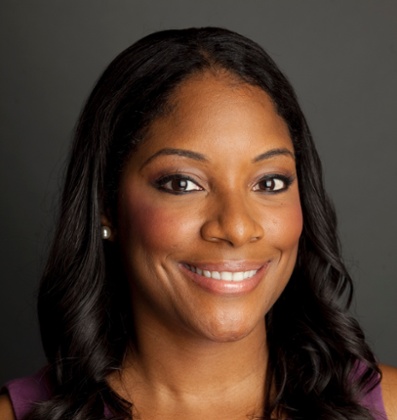
When the political analyst and owner of a JD degree Zerlina Maxwell appeared on Fox News’s Hannity in 2013 to debate whether state lawmakers should allow guns on college campuses to prevent sexual assault, she caused a sensation. While host Sean Hannity said women should be arming themselves against rape, she offered an alternative: “I think we should be telling men not to rape women and start the conversation there.” Two years on, she has inspired many women to follow in her footsteps and speak out. Here, she talks about withstanding online abuse and how Twitter can change the world.
How did you begin writing online?
I’ve always read and cared about politics. When Obama’s campaign began in 2008, it ignited a lot of young people – people of colour in particular – to get active. I decided to take a leave of absence from law school and participate in what turned out to be a historic election. I worked as a field organiser, but wanted to continue to channel that energy into something else.
I joined a blog started by a law school classmate. I was the girl in this group of four men writing about politics. At the same time, I began using Twitter to break into media by strategically picking out the editors of sites that I wanted to write for, other writers for sites that I read, writers I just liked. And then it snowballed from there. The more you get published, the more people want you to write for them.
I think I’m not alone when I say that I first came across your work in 2013, after you were on Hannity and spoke about being a survivor of sexual assault.
I always wanted to write about my personal experience with sexual assault, because when it happened, I was frantically looking for a personal narrative of someone else who had been through it. It was 2007, and the feminist blogosphere wasn’t the same as it is now. Essentially, I wanted to write the book that I was looking for. That was one of my motivations for joining Feministing as a contributor, as it was a safer space to discuss my experience from a first-person perspective. By the time I appeared on Hannity in 2013, I had already written about my experience for at least two years. It was the first time I had discussed it on national television, though.
When you said ‘teach men not to rape’, did you anticipate the reaction?
When Fox News asked me to do the segment, they didn’t know I was a survivor or that I wrote about these things. It was something I told them when I responded to the booking request. The entire premise of arming every woman in order to prevent sexual assault is absolutely ridiculous and it’s victim-blaming. As someone who’s been through that experience, not just as someone intellectualising it during a debate, I’m able to say with some authority that it would not have protected me nor any of the other survivors that I know. I wanted to talk about ways we can actually prevent rape. Looking back at that I would say Sean Hannity was sympathetic to the fact that I was a survivor. He was pretty nice through that whole experience. His fans, though, not so much.
I was aware of the kind of space I was going into to debate sexual assault and that it would be triggering, but I was also aware it could be an empowering experience. I knew that it would be difficult for a conservative audience to receive my message, despite it not being an original idea, but that audience had never heard that idea framed in that way. I wasn’t prepared for the death and rape threats, and it wasn’t something that was fun to go through.
It felt like a watershed moment.
Somehow it broke through in ways that feminist blogs hadn’t. Often feminist blogs are speaking to individuals who possess a fundamental understanding of the points you make. But when you enter a hostile place like Fox News, and Hannity at that, the audience is not prepared for anything you have to say. I knew it was going to be horrible and ugly, but I didn’t know how ugly. But I do believe it made the conversation more clear for people.
I truly felt I had broken through last year when the White House released their first PSA about sexual assault, starring Daniel Craig and President Obama. They’re all looking right into the camera, saying, “Hey guys, listen up.” The entire PSA was about targeting a rape preventation message at men. Vice-President Joe Biden actually came out and said, “We need to teach men.” My dad texted me, “Biden is saying what you said.” That was the moment I felt the message was truly resonating. I had never heard any statement like it before from a president or vice-president.
In 2014, Time included you in their top 140 Twitter feeds of 2014 in the “informer” category. Could you talk about how you’ve used Twitter as an agent for social change?
My approach to Twitter is largely informed by the specific time I joined, which was when the Green Revolution took place in Iran. I think when we look back 100 years from now that will be the moment we recognise Twitter becoming a serious tool.
Because of joining then, I saw the power of a hashtag. For me, hashtags are the digital version of the conscious-raising efforts of our parents during second-wave feminism. Sure, hashtags can be fun and useful for livetweeting Scandal, but hashtags are also for important social discussions. It’s a digital way we can all get together in this space and talk about something, whether it’s using #RapeCultureIsWhen or #SurvivorPrivilege. They allowed for users to provide nuanced details of personal stories.
I think we can use Twitter to make the world a better place. It’s about changing the small behaviours, like turning a guy at a frat party into an active bystander. It’s a wonderful way, especially for people that are really busy or are not able-bodied, to participate in activism in a real tangible way.
What has your experience been online?
I’m a target for harassment, threats, ugliness, racism, and because of that I am very protective of my emotional space. When I write an article about sexual assault, I pre-emptively disappear from social media, I don’t really check my email. I try to stay away for three days. I may check Twitter just by seeing the mentions from people I follow and that way I’m protected from the rightwing trolls sent over by the National Review. I also have a little cabal of folks who help each other out and I’ll give someone my login information for Twitter and they will go and block, report and screengrab anything that might be threatening.
It’s horrifying to wake up in the morning, check Twitter and have a strange man threaten to rape and kill you, particularly when you have survived an actual rape and know that it is very possible. And as a New Yorker who has to deal with strange harassment in public spaces, I definitely don’t want that in my online space. It really does affect me. But if I can push the conversation forward on sexual assault and make others think about it and behave differently and then I’ve done my job.
Do you believe there is a way we can curb, and hopefully end, online threats?
Often, it’s men running most online platforms – the bosses who supervise women writers and queer or trans writers, and often, it’s these writers that are broaching these difficult topics. We need to be protected once our work is published. As allies, it’s really important for those colleagues, bosses and editors to say, “I published that article that Zerlina Maxwell wrote, and I don’t think it’s OK that she’s getting threatened to death because of it.” I think a lot of men feel they can get away with being, like, “Wow, that really sucks that your mentions are so ugly.” But it’s not helpful for you to direct message me that. Please publicly say, “All the jerks trolling Zerlina need to stop it immediately.” I’m making a pitch for more public male allies. For too long, women have teamed up and supported each other while the men just sit and watch our mentions fill up with threats and don’t say anything.
Who are women writers you would recommend others read?
I try to keep my reading as diverse as possible, not only so I can cultivate my own ideas, but so I can support women who are doing similar work and maintain a sisterhood. I read Feministing and Talking Points Memo, which has Amanda Marcotte. I love reading Tara Culp-Ressler at Think Progress and Dani McClain at the Nation. I also love Ann Friedman; I will read anything she writes. I read Guardian contributors Jessica Valenti, Syreeta McFadden, and Roxane Gay. I also have a Twitter list of feminist writers, which I go to for reading their specific takes on the news.
What advice do you have for women who want to write online?
By reading a lot, you can find where your voice will fit and what topics you can best write about. It’s also a great start place for beginning to craft counterpoints, which is how I got my start. Every day, I’ll wake up and decide what I think of the news stories I’ve read and determine my unique take on them: what are the top five stories? What is the gender angle? What is the African American woman angle? That’s how I get the neurons firing. I would also recommend joining Twitter and using it as a networking tool. Make a list of the 15-20 top people in your field and follow them. The lowest bar to entry for networking is Twitter. That may not be what another journalist would say, but that’s the way I’ve done it, and it’s working so far. I would hate to not pay it forward.
It’s also important to understand that there’s really no such thing as truly objective journalism, which is something I’ve learned from others assuming I can’t be one. My perspective is informed by being a black woman, and we all have a perspective that informs the way we navigate the world, whether we want to admit it or not.
What is one fun fact about yourself that would you like to share with our readers?
My name comes from Mozart’s opera Don Giovanni.