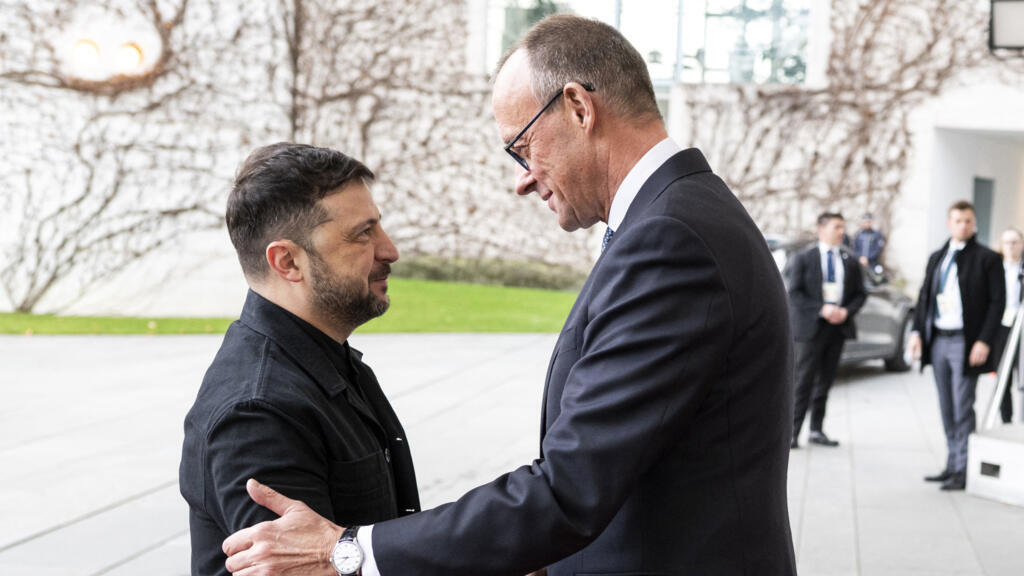
Ukraine's President Volodymyr Zelensky is using talks in Berlin to rally European backing, shape US-led peace efforts and test whether Kyiv could trade its NATO ambitions for binding security guarantees. This comes as disagreements over territory, funding and Russia’s intentions continue to complicate the search for an end to the war.
Zelensky spent more than five hours on Sunday in talks with US President Donald Trump’s special envoy Steve Witkoff and Trump’s son-in-law Jared Kushner, meeting under heavy security at the German chancellery.
The discussions are continuing this Monday, with Witkoff saying on social media that "a lot of progress was made" and that the sides would meet again the following morning.
Germany’s chancellor Friedrich Merz – who has emerged as a central figure in European efforts to support Kyiv alongside France’s Emmanuel Macron and UK Prime Minister Keir Starmer – is due to host a dinner bringing together Zelensky, European leaders and the heads of NATO and the EU.
This comes as US President Donald Trump has stepped up pressure on Ukraine to reach a settlement to end the almost four-year-old war, unveiling a plan last month that Kyiv and its European allies criticised as echoing Moscow’s demands.
Key sticking points remain territorial concessions, future security guarantees for Ukraine and whether Russia would accept any proposal hammered out by the Americans and Europeans.
NATO trade-off
As he travelled to Germany, Zelensky made clear he was pushing for a freeze along the current front line, rather than conceding territory outright.
"The fairest possible option is to stay where we are," he told reporters. "This is true because it is a ceasefire … I know that Russia does not view this positively, and I would like the Americans to support us on this issue."
More controversially, Zelensky signalled a readiness to drop Ukraine’s long-standing bid to join the NATO alliance – a key Russian demand – if the West offered binding security guarantees in return.
Speaking to journalists before the talks, he said that since the US and some European countries had rejected Ukraine’s NATO aspirations, Kyiv now expected assurances comparable to those enjoyed by alliance members.
"These security guarantees are an opportunity to prevent another wave of Russian aggression," he said. "And this is already a compromise on our part."
Germany to send soldiers to fortify Poland border
Zelensky stressed that any guarantees would need to be legally binding and backed by the US Congress.
Russian President Vladimir Putin has repeatedly framed NATO enlargement as a threat to Moscow’s security and cited Ukraine’s ambitions as a justification for launching the full-scale invasion in February 2022.
What Zelensky has rejected is the idea of ceding territory as part of a deal. He said the US had floated a proposal for Ukraine to withdraw from parts of the eastern Donetsk region to create a demilitarised free economic zone – an idea he dismissed as unworkable and unfair.
"If Ukrainian troops withdraw 5 to10 kilometres, for example, then why do Russian troops not withdraw deeper into the occupied territories by the same distance?" he asked.
Moscow’s response has been sceptical, with Kremlin aide Yuri Ushakov saying Russia had not yet seen the latest documents but warned that "the contribution of Ukrainians and Europeans to these documents is unlikely to be constructive."
Speaking on Russian state TV, he added that if amendments altered Moscow’s stated position, "we will have very strong objections."
EU funding crunch
The diplomacy in Berlin is unfolding against an intense debate within the European Union over how to sustain financial support for Ukraine.
EU leaders will gather in Brussels on Thursday for what foreign policy chief Kaja Kallas called a "very important" summit aimed at agreeing long-term funding.
One contentious proposal would use frozen Russian central bank assets to provide a €90 billion "reparations loan" to Kyiv.
Belgium, which hosts most of the assets via the clearing house Euroclear, has so far opposed the move, citing fears of legal and financial retaliation from Russia and demanding watertight guarantees that the risks would be shared.
EU plan to tap Russian assets for Ukraine meets opposition from Belgium
"We are not there yet, and it is increasingly difficult," Kallas said. "But we’re doing the work and we still have some days … We will not leave the meeting before we get a result."
European officials are also wary that Washington could seek to free up the frozen assets as part of any US-brokered peace deal.
Speaking on Monday, Kallas alsoi warned that taking over the Donbas region will "not be Putin's end game".
"We have to understand that if he gets Donbas, then the fortress is down and then they definitely move on with taking the whole of Ukraine," Kallas told reporters.
"If Ukraine goes, then other regions are also in danger," she said.
(with newswires)