Zambia’s official opposition, UPND, said on Saturday it was time to unite the country and urged people not to heed President Edgar Lungu’s statement that the presidential and parliamentary elections were not free and fair.
The leader of the United Party for National Development (UPND), Hakainde Hichilema, had taken an early lead against Lungu on Saturday as results rolled in.
“The other side clearly know they have lost and are trying to throw out the entire election just to cling on to their jobs,” said Hichilema’s spokesman. “This is the desperate final act of an outgoing administration,” he said.
Lungu, 64 and in power since 2015, faces a potentially close-run contest against Hichilema, a self-made businessman who was jailed after narrowly losing the last election.
Analysts have said the vote may be decided by frustrated young people amid economic turmoil. More than half of registered voters are 34 or younger, statistics from the Electoral Commission of Zambia (ECZ) show.

According to first results issued by the commission on Saturday, Hichilema has 449,699 votes from 31 of the country’s 156 constituencies against 266,202 for Lungu.
The results from constituencies that have long been seen as Lungu strongholds suggest that Hichilema – known as “HH” – has gained ground since the 2016 elections, which were marred by allegations of rigging.

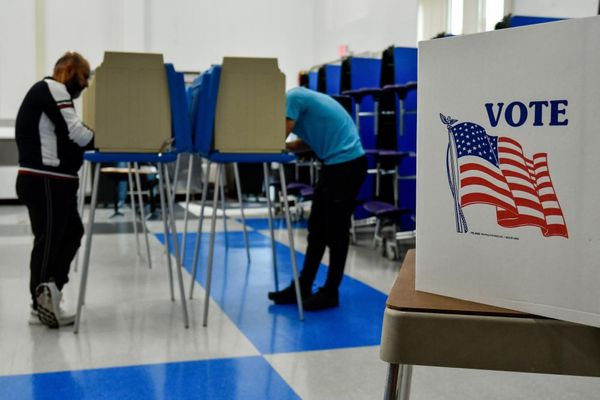
In an overwhelming turnout, particularly by young Zambians, who make up a majority of registered voters, long lines formed in front of polling stations on Thursday. Many had to close late to accommodate voters, said the ECZ. The first results had initially been expected on Friday but were delayed after counting went on overnight.
Zambia’s military was on the streets of the capital, Lusaka, and in other parts of the country on Saturday. Lungu deployed the military before the election saying it was to curb some outbreaks of violence and ordered more troops to be deployed in some restive parts of the country after there were two killings on election day.

Hichilema’s UPND claims the troop deployment is an intimidation tactic. Critics accuse Lungu of trying to reverse Zambia’s record of holding regular, credible elections and peaceful transfers of power since 1991, when the country returned to multiparty democracy after being a one-party state for more than two decades.
In Chawama township in Lusaka, Lungu’s parliamentary constituency before he became president, residents said supporters of both the incumbent and Hichilema were claiming victory and celebrated throughout the night.
Lungu’s ruling Patriotic Front party said its vote tally showed there had been a huge turnout in its strongholds and it was confident of victory.
Following a complaint lodged by the human rights organisation Chapter One Foundation, a high court on Friday overturned a decision by the government regulator to block social media platforms including WhatsApp, Facebook and Instagram.
Lungu has already cast doubt on the outcome of the election in three provinces after accusing the opposition of stirring up violence. However, European and African observers said the vote had been largely peaceful.
The ECZ announced a ban on campaign rallies in May to curb the spread of Covid-19. But both the PF and Hichilema’s party have held gatherings on the pretext of distributing face masks.
Hichilema, 59, casts himself as a self-made man in campaign videos, saying he walked to school barefoot as a child and attended university on a government bursary. He was chief executive of an accountancy firm before entering politics.
The high proportion of young voters could help Hichilema, who placed the economy front and centre of his campaign, said Euston Chiputa, a history professor at the University of Zambia.
“Hichilema has gained ground among the youth because there are frustrations regarding employment,” he told Reuters.
Unemployment hit a 10-year high in 2020, according to International Labour Organization estimates, and the kwacha currency’s nearly 40% depreciation since January 2020 has made life more expensive for Zambia’s roughly 18 million people.