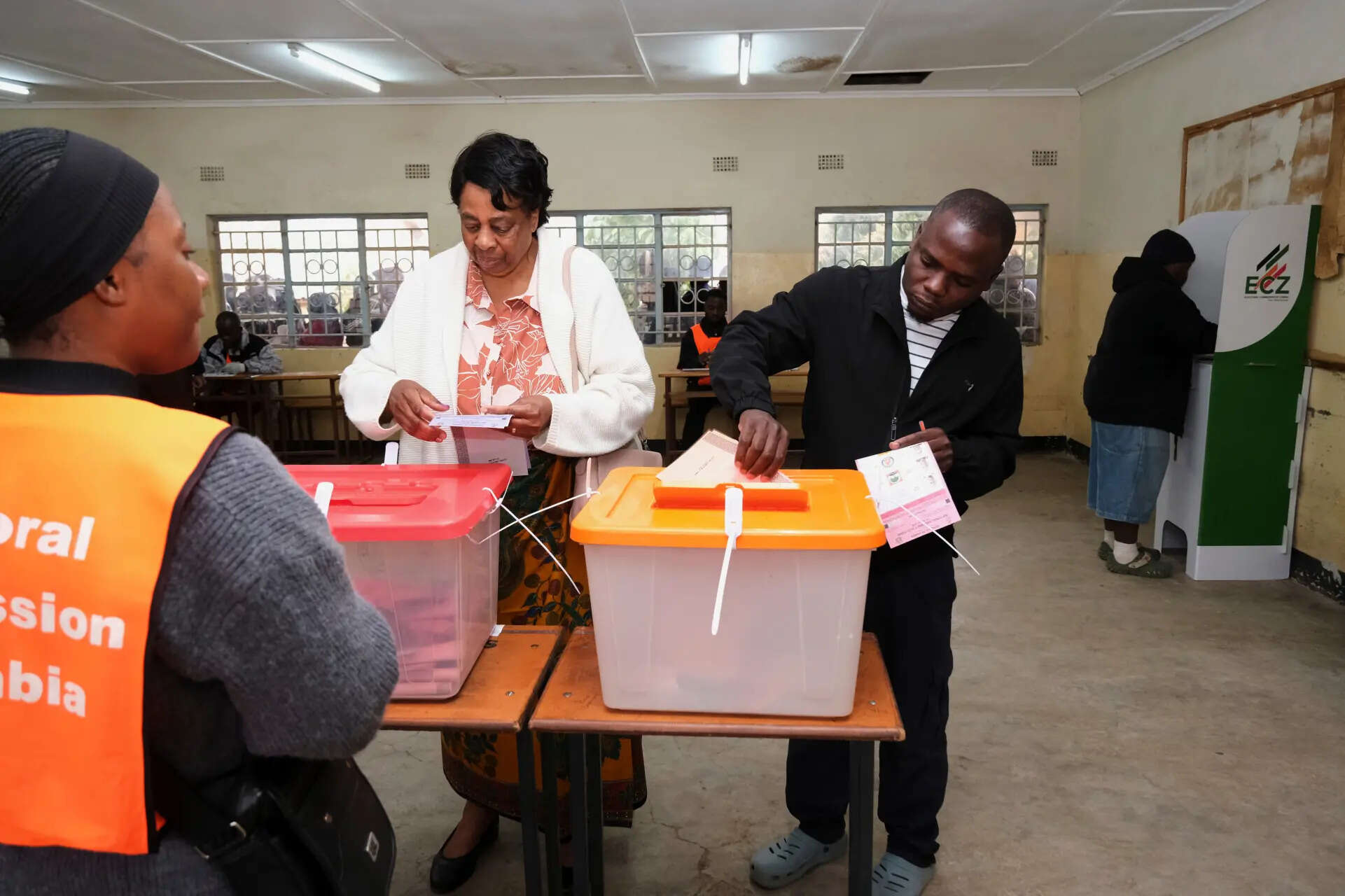
Zambia is awaiting the outcome of its presidential election after voters went to the polls on Thursday, with final results expected on Monday. The country saw a contest that could hand President Hakainde Hichilema a second five-year term and shape the future of one of the world's most important copper-producing nations.
Get breaking news anytime, anywhere. Download the TOI app now!
The election has drawn international attention because of Zambia's vast reserves of copper and cobalt, minerals that are critical for electronics, electric vehicles and other advanced technologies. China is already the country's largest foreign investor, particularly in the mining sector, while the United States has stepped up its interest in Zambia as part of President Donald Trump's push to secure supplies of critical minerals and reduce dependence on China.
Hichilema, who came to power in 2021, is seeking re-election after overseeing a major debt restructuring programme and efforts to stabilise the economy. His government has restructured more than $12 billion in debt, reduced inflation and improved the value of the Zambian kwacha. A central plank of his economic strategy is to more than triple copper production to 3 million metric tonnes annually by 2031.
Zambia's importance to global powers stems from its role in the supply chain for minerals used in renewable energy and technology industries. China has invested heavily in the country's copper and cobalt sectors, while Washington has pursued closer ties with Lusaka over access to critical minerals. Zambia has accused the US of linking mineral access to a proposed $2 billion health agreement, an allegation Washington has denied.
The election is being closely watched at home as well. Although inflation has eased and macroeconomic indicators have improved under Hichilema, many Zambians continue to struggle with high food and energy prices. The president has promised to build more schools, health facilities and roads, while tackling electricity shortages and the cost of living.
There are 14 presidential candidates, but analysts say Hichilema's strongest challenger is Brian Mundubile, the 55-year-old leader of the opposition Tonse Alliance. The alliance has accused the government of orchestrating a raid by a law enforcement agency on its offices days before the vote, during which vehicles and communication equipment were seized. The opposition claims the operation was politically motivated and intended to disrupt its campaign.
Hichilema has also faced criticism from opponents and civil society groups who argue that his administration has become less tolerant of dissent despite Zambia's reputation for largely peaceful elections.
The rivalry between Hichilema and his predecessor, the late former President Edgar Lungu, has remained one of the defining features of Zambian politics. Hichilema was imprisoned for four months on treason charges in 2017 during Lungu's presidency after a dispute involving their motorcades. Lungu later claimed he was effectively placed under house arrest during Hichilema's first term.
Lungu's death in South Africa in June 2025 triggered a prolonged dispute between his family and the Zambian government over his burial arrangements. The government sought to repatriate his body for a state funeral, while his family argued that he did not want a funeral presided over by Hichilema. South Africa's Supreme Court of Appeal ruled in favour of the family, although burial plans have yet to be announced.
Zambia, which gained independence from Britain in 1964 and has been a multi-party democracy since 1991, uses a 50 per cent plus one electoral system for presidential elections. If no candidate secures an outright majority, a second round of voting will be required. Around 8 million Zambians were registered to vote in Thursday's election, which also included parliamentary and local government contests.