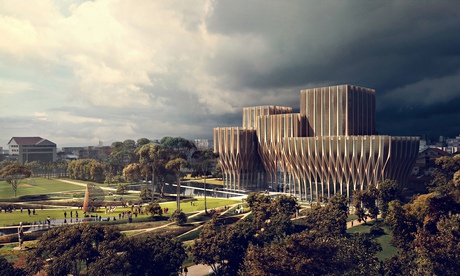
Looking like a futuristic descendant of Angkor Wat, with a cluster of chiselled forms poking above the trees, a genocide museum and research institute, designed by London-based Iraqi architect Zaha Hadid, is to be built in Cambodia.
Unveiled 35 years on from the brutal reign of the Khmer Rouge, the Sleuk Rith Institute will incorporate a museum, research centre, graduate school, document archives and research library, set in an expansive new park in the south of the capital, Phnom Penh.
The project is the vision of human rights activist Youk Chhang, 53, who has directed the Documentation Centre of Cambodia (DC-Cam) since 1995. He amassed a vast archive detailing the atrocities of the regime led by Pol Pot from 1975-1979, when 2 million Cambodians were slaughtered.
“We have to live with a long, dark shadow,” says Chhang, who lost his sister, aunts and uncles, to Pot’s reign of terror. “We cannot escape it, but we shouldn’t be enslaved by it. I want the institute to bring something new and hopeful, and get us out of the mindset of being victims.”
The complex will be a centre for genocide studies across Asia, with a strong educational and outreach component, and shares its site with a local high school – formerly home to a Khmer Rouge re-education camp.
The land has been donated by the Cambodian government and a $35m (£21m) fundraising campaign launched, with some funding already committed by USAid, sponsor of DC-Cam’s work.
Over the last two decades, Chhang and his team have compiled an archive of more than 1m documents, photographs, tapes and films, and mapped 200 prisons and 20,000 mass graves across the country.
From confidential reports describing conditions in the countryside, where a million people died of starvation, to confessions under torture of thousands of prisoners killed by the secret police, the archive provided essential evidence during the trial of two former Khmer Rouge leaders, Khieu Samphan, 83, and Nuon Chea, 88, who were convicted of crimes against humanity in August.
“The tribunal is one of the processes needed to lay the foundations for healing and reconciliation,” says Chhang. “But you can’t erase such a deep-cut memory.” He lifts a trouser leg to reveal a substantial scar running down his calf, the result of beatings at the forced labour camp where he was taken at the age of 14. His sister was to suffer a more gruesome fate: accused of stealing rice, the guards slashed her stomach open – to find it empty – and left her to die.
“It’s like a silent heart attack,” says Chhang. “You think you’re all right, but then it comes back. I want the institute to break the silence, but it must be optimistic and look to the future. So many of these memorial museums are depressing, and you leave with a sense of anger, not forgiveness. They are usually designed by men, so I thought maybe a woman could do it better.”
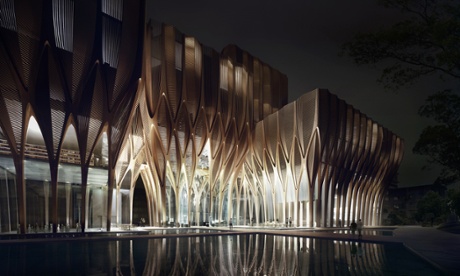
Hadid has brought her trademark sinuous lines, but she has eschewed some of her more violent geometries, making a building that promises to be unusually attuned to its context.
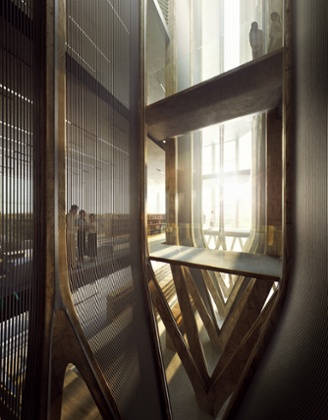
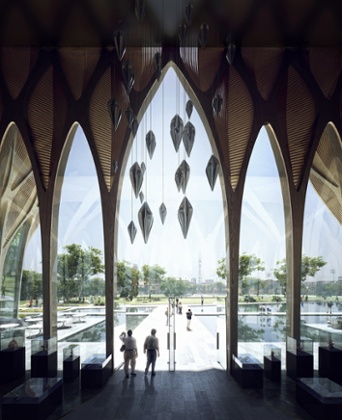
The five functions have been separated into a cluster of individual buildings, echoing the five towers of Angkor Wat, while their structures are formed from great timber columns that split and entwine, like the writhing roots that enlace the ancient stone temples.
“This is very different to our other projects,” says Hadid. “It is the first time we have used wood, to create a warmer, softer mood, and in time it will weather and take on a more a natural-looking feel.”
At first glance, the tapering forms recall some of her recent tower proposals, chopped off at the knees. But a closer look reveals the design of an intricate web of spaces and arcades formed by the intersection of the timber structures, surrounded by reflecting pools (which also drain rainwater to prevent floods) and threaded by a network of causeways and bridges.
“We were inspired by how the ancient temples make very intricate forms from simple geometries,” says project architect DaeWha Kang, describing the five-day “bootcamp” Chhang took them on around the country.