Afternoon summary
-
Kezia Dugdale, the deputy Scottish Labour leader, has said she will announce by the end of this week whether she is going to stand for the leadership following the resignation of Jim Murphy. Ken Macintosh, Labour’s justice spokesman at Holyrood, has also indicated that he is interested in standing.
That’s all from me for today.
Thanks for the comments.
Ed Miliband and Nick Clegg were standing together as they queued to take the oath in parliament.
Defeated leaders Miliband & Clegg make Commons small talk pic.twitter.com/rrM1XBFH6R
— Ross Hawkins (@rosschawkins) May 19, 2015
The New Statesman has published the text of an open letter Liz Kendall, the Labour leadership contender, has written to trade unionists. Here’s an excerpt.
Trade unions helped found the Labour Party, and if I am elected as leader that link will never be broken. On the contrary, I want to strengthen your relationship with the Labour Party so I will not tolerate those inside or outside our movement who want to put that relationship at risk.
My colleague Michael White has written an interesting blog about Ukip’s internal feuding. Here’s an excerpt.
Major parties are like well-built houses in an earthquake: they survive where weaker properties collapse. That is the test Labour now faces in its existential crisis. But it is noticeable that none of the candidates to succeed Ed (it does seem a long time ago, doesn’t it?) Miliband are attacking a rival in the way Ukip’s Patrick O’Flynn did Farage in the Times last week. Not since the damaging Gaitskellite v Bevanite spilt in the 1950s has Labour been so ravaged. Margaret Thatcher’s legacy is divisive, but never that bad within her party and she was a fastidious respecter of party procedures.
In the end the party matters more than individuals in the big league, which is why the Tories knifed her when they deemed their triple election winner a liability in 1990. Ditto Tony Blair in 2007. Big parties are not always right, but they are broad churches which have been around a long time and plan to stay around.
Only in faction-driven politics, sometimes accentuated by the proportional representation forms of voting that encourage multiple parties – it’s even happening again now in Germany – is the leader the cement that holds it together. Just look at Bibi Netanyahu’s destructive grip on Israel, a rare example of a populist capturing a democratic state.
Patrick O’Flynn was seen as a figurehead for the “red Ukip” faction in the party, not least because he once proposed a tax on luxury goods.
In a post on his blog written before O’Flynn’s resignation, the Ukip MP Douglas Carswell said he agreed with the idea that Ukip should try to displace Labour, but he rejected the idea that this amounted to a “‘red Ukip’ strategy”.
Labour today is a party of statism. The shape of the blue print envisaged for society might vary. To what ends the levers of state control should be tugged will be debated by different Labour leadership contenders. But Labour is hooked on the idea of top down control ...
Labour once stood up for ordinary people against the interests of the powerful. Today Labour sides with remote EU functionaries and well-renumerated Human Rights lawyers ...
Ukip believes in dispersing power. We want political reform to make government accountable to Parliament and Parliament answerable to the people. We don’t merely seek to return power from Brussels to Westminster, but to push control from Whitehall to the town hall.
Nigel Farage, the Ukip leader, says Patrick O’Flynn’s resignation has drawn a line under their row.
Farage on O'Flynn: "Bad things have been said but we now have drawn a line on this and it's all behind us" http://t.co/V3RtR9lc2o
— Nick Eardley (@nickeardley) May 19, 2015
In the House of Commons David Cameron has just taken the oath. This is something every MP has to do at the start of a parliament before they can take part in debates - and be paid.
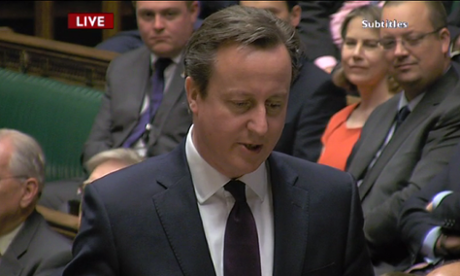
Here he is lining up to sign the register, behind Sir Gerald Kaufman, who took the oath before him, and in front of George Osborne.
There are another 640-odd MPs to go, and swearing in will carry on until next Tuesday.
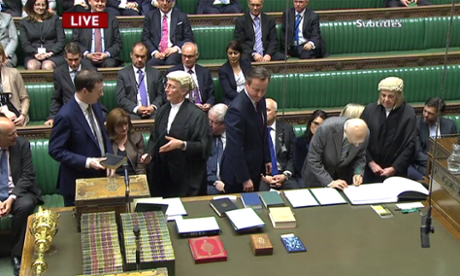
In the Commons the territorial warfare continues.
Pete wishart of snp fame sitting on labour front bench and refusing to move. Isn't it all just so grown up?
— ann treneman (@anntreneman) May 19, 2015
3 Labour MPs inc Dennis Skinner back on the opp front bench which SNP want.SNP source:"They are likely to become a feature on SNP benches"
— Tim Reid (@TimReidBBC) May 19, 2015
SNP now sitting on Labour front bench today.
— Torcuil Crichton (@Torcuil) May 19, 2015
MPs will shortly begin taking the oath.
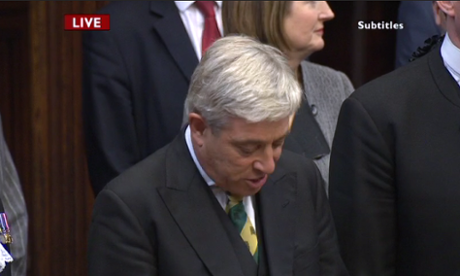
First, they had to troop up to the House of Lords again, to have John Bercow confirmed as Speaker.
Suzanne Evans, Ukip’s deputy chair, has put a statement on Facebook saying she is “very sorry” that he has resigned as economics spokesman. She says:
Patrick O’Flynn is one of UKIP’s hardest working MEPs. He has been an excellent economics spokesman and made valuable and professional contributions to our manifesto and our General Election campaign. I’m very sorry indeed to see him step down from his spokesman role.
Evans fronted many of Ukip’s election news conference with O’Flynn and it is thought she shared the concerns he raised about how Farage’s image changed under the influence of two combative advisers.

Here’s Darren McCaffrey, Sky’s election Ukip correspondent, on Patrick O’Flynn’s resignation. (Or perhaps that should be “resignation”.)
O'Flynn's "resignation" - Farage getting to grips with discipline within party. Also balances out losing two senior advisors last week.
— Darren McCaffrey (@DMcCaffreySKY) May 19, 2015
Having conceded ground last week to Carswell and O'Flynn. Farage spent past few days asserting his authority within @UKIP.
— Darren McCaffrey (@DMcCaffreySKY) May 19, 2015
Patrick O'Flynn resigns as Ukip's economics spokesman
Patrick O’Flynn MEP has resigned as Ukip’s economics spokesman, and apologised for the interview he gave last week describing Nigel Farage as “snarling, thin-skinned and aggressive”. He has just issued this statement.
I would like to express to colleagues my sincere regret at going public with my frustrations about the turn of events following polling day. And more than that, I would like to apologise directly to Nigel for the phrase ‘snarling, thin-skinned and aggressive’. This was a fragment of a wider passage about perceptions and is not what I think of him. Nonetheless, I should have known better than anyone what use would be made of phrases that were both unfair and unkind.
I am proud of what we achieved in the general election and am only sorry to have succumbed, as Roger [Helmer] put it with such impressive understatement, to public remarks that were ‘unhelpful’. I think it appropriate to stand down as economic spokesman, which I have done. I hope in the months ahead to be of use to the great campaign to persuade the British people to leave the EU, which is after all what brought me into politics in the first place.
Lunchtime summary
- Lord Mandelson has said that the Labour leadership contenders are too focused on the need for party unity. In an article in the New York Times, he suggested they were all avoiding the need to make “hard policy choices”. (See 1.36pm.)
- Robert Halfon, the new deputy chair of the Conservative party, has suggested that the party should change its name to the Workers’ party. (See 11.48am.) A spokesman for David Cameron said there were no plans to take up the idea.
-
Boris Johnson, the Conservative mayor of London, has said the living wage should be “massively expanded”. He made the call in an #askboris Q&A on Twitter.
The Living Wage should be massively expanded & be 1 of the great national ambitions with increasing productivity #askboris @adamclarke96
— Boris Johnson (@MayorofLondon) May 19, 2015
- The Electoral Commission has revealed that almost £14.4m was donated to political parties during the general election campaign - with the Conservatives and Labour both receiving around £6m. From March 30 until polling day on May 7, the Tories registered donations worth £6,100,588 and Labour £5,957,862. (See 12.33pm.)
Whilst Labour continue to tear themselves apart in the summer we can immediately hit the ground running after the summer break as a united party - that is absolutely essential in my view as we conduct our fightback.
-
Greg Hands, the new chief secretary to the Treasury, has revealed that there was some money left for him from Danny Alexander, his predecessor. In 2010 the outgoing chief secretary, Liam Byrne, famously left a note joking there was no money left. Hands did rather better.
Good news for me as Danny Alexander left £6.35 on his Treasury canteen card. Before anybody criticises, remember what Liam Byrne left us...
— Greg Hands (@GregHands) May 19, 2015
Mandelson says Labour leadership contenders putting too much emphasis on need for unity
Lord Mandelson, the Labour former business secretary, launched a withering attack on Ed Miliband’s leadership strategy on the Sunday after the general election. He has now written an article for the New York Times on Labour’s defeat, elaborating on his view that, although voters are concerned about inequality, they were not attracted by the solutions being offered by Miliband.
In the absence of any realistic program to reform the economy in a redistributive way, Labour fell back on a series of expensive financial offers to the public: capped energy prices and rail fares, controlled housing rents, a government-backed “living wage” and reduced tuition fees. Though welcome to many, these sounded implausible or unaffordable in straightened fiscal times ...
While people admire Labour and its commitment to social justice, they won’t sign up for what looks like an ideological vendetta, particularly if they fear becoming undeserving financial casualties of it. Voters are justly cautious.
But the most interesting line in the article is probably what Mandelson says about the leadership contest. Warning that Labour is “headed downwards”, Mandelson suggests none of the current leadership contenders has fully grasped the challenge the party faces because they are all putting too much emphasis on the need for unity.
The leadership contenders all fault Labour’s strategy under Mr. Miliband. They rightly talk about reconnecting with voters, but when they also talk about the need for party unity this sounds like continuity and an unwillingness to make hard policy choices. This is a luxury that is not open to them — not if they want to win.
-
Mandelson says Labour leadership contenders are putting too much emphasis on the need for unity.
Updated
Number 10 lobby briefing - Summary
I’m back from the Number 10 lobby briefing. Here are the key points.
- David Cameron and Theresa May, the home secretary, reaffirmed their commitment to getting net migration below 100,000 at today’s cabinet meeting, the prime minister’s spokesman indicated.
- Cabinet ministers received a briefing from the heads of MI5 and GCHQ. The spokesman would not elaborate on what they said.
- Downing Street rejected suggestions that the planned EU referendum was creating uncertainty for business. Asked about reports that Deutsche Bank is considering moving some of its operations out of Britain if there is a vote to leave the EU, the spokesman said Cameron was the one who was “providing certainty” over Britain’s relationship with the EU by allowing people to settle the issue with a vote.
- Cameron chaired a political cabinet before the main cabinet meeting was held. Boris Johnson attended the political cabinet, but not the main cabinet meeting.
-
Cameron has rejected a call from Steve Hilton, his former director of strategy, for bankers’ pay to be limited to that of top civil servants. Hilton made the proposal in an interview to promote his new book. Asked about the idea, the spokesman refused to endorse it, but instead highlighted other measures the government has taken to control bankers’ pay, such as limits on cash bonuses and the introduction of bonus claw-back provisions. The spokesman also indicated that Cameron did not agree with Hilton about Britain not being a proper democracy. Hilton has said:
Our democracies are increasingly captured by a ruling class that seeks to perpetuate its privileges ... Regardless of who’s in office, the same people are in power. It is a democracy in name only, operating on behalf of a tiny elite no matter the electoral outcome. I know because I was part of it.
Asked if Cameron agreed with Hiltion about the UK being a democracy in name only, the spokesman sidestepped the question, but said that Cameron was a strong believer in “spreading privilege” not “defending privilege”.
Political parties received £14m in donations during election campaign
The Press Association has this report on figures released by the Electoral Commission that show how much each political party received in donations from 30 March to 7 May this year.
Almost £14.4m was donated to political parties’ war chests during the general election campaign - with the Conservatives and Labour almost neck and neck, official declarations show.
The Electoral Commission said that from the start of the official race on 30 March through to polling day on 7 May, the Tories registered a total of £6,100,588 and Labour £5,957,862.
According to the watchdog’s data, Ukip registered £1,684,728, the Liberal Democrats £601,000, the Green party £18,400 and the Scottish National Party £10,000 during hostilities.
In the final few days before the country went to the polls, the Liberal Democrats reported £230,000 - only just short of the Conservatives’ £295,127 and well in front of Labour’s £10,000 and Ukip’s £60,000. The Eurosceptic party also registered a loan of £12,500.
As expected, Labour and the Conservatives received by far the most money. But perhaps most surprising is the SNP, which won all but two of the seats that it contested, received just £10,000 during the official campaign period. (The party may however still be flush from the millions given by lottery winners Chris and Colin Weir.)
Updated
Tory deputy chairman says party should consider changing name to become Workers party
Labour is debating how to rebuild as a party but, if an interview with Robert Halfon in the Sun is anything to go by, the Conservatives are quite serious about repositioning themselves too. Halfon is a long-standing advocate of what he describes as “blue collar Conservatism” and, in last week’s reshuffle, he was made Conservative deputy chairman. The interview suggests he is determined to shake things up. Here are the main points.
-
Halfon says the Conservatives should seriously consider changing the party’s name.
We are going to have a national conversation. The name is something we should look at. If we get the message right as well as the policies, we will de facto become the Workers’ party.
- He says the Conservatives should be the party for working people.
The prime minister wants me to spread the message that we are the party of working people now.
If he really wants to help the workers, Len McCluskey [the Unite general secretary] should join the Tories.
- He says he wants the Tories to attract more low-income candidates.
I’d like to see us have a special emphasis on getting candidates from low-income backgrounds - on £25,000 or £26,000 a year - and single-parent candidates.
- He says he would like the membership fee cut from £25 to £1 to encourage more blue-collar workers to join.
-
He says the Tories should show they are a party “with a moral mission”.
In a complimentary blog, Mark Wallace at ConservativeHome says Halfon is “out to build a new party” and that, although this is a difficult take, he is more than capable of succeeding.
Updated
The Morning Star has a scoop. It says Ed Miliband has returned from his holiday in Ibiza.
Our #milifandom Ibiza world exclusive pic.twitter.com/b0SmpNpFjY
— Morning Star (@M_Star_Online) May 19, 2015
Andy Burnham is the bookies’ favourite to win the Labour leadership contest.
But two Labour bloggers are arguing that a Burnham victory is not inevitable.
And, at Labour Uncut, Atul Hatwal suggests party members won’t vote for Burnham.
Andy Burnham is currently setting the pace for the the campaign. His team are briefing out a succession of prominent supporters from the PLP each week and will continue to generate momentum and decent media coverage.
But over summer, the campaign will move on from being a PLP popularity contest to focus on the substantive differences between the candidates. At this point, the decision on his candidacy will crystallise into two simple questions.
Do party members think that Andy Burnham, chief secretary to the Treasury in the Labour government on the eve of the crash, is best placed to overcome the Conservative onslaught and convince voters that Labour can now be trusted on the economy?
And do party members believe that Andy Burnham, secretary of state for health at the time of Mid Staffs, is the candidate most able to cut through Tory attacks and persuade voters that he, rather than David Cameron, or whoever replaces him, should be prime minister of Britain?
UPDATE: That post has prompted this exchange on Twitter.
@AndrewSparrow See you quoted @atulh & his lies re @andyburnhammp Will you point out that AB was NOT Health Sec when Mid Staffs happened pls
— kathy (@kb32904) May 19, 2015
@kb32904 @AndrewSparrow @andyburnhammp Oh please. Watch this from the elex. Now think, what will the Tories do? http://t.co/ZQMmlwfABK
— Atul Hatwal (@atulh) May 19, 2015
Updated
While we’re on the Labour leadership, I see that Andy Burnham has made the NME for sending out a tweet quoting The Courteeners.
But he has gone off The Smiths, says John Rentoul (citing a blog from last year).
Is the Labour Party really prepared to be led by someone who has gone off The Smiths? http://t.co/8JU42QOULZ pic.twitter.com/1ThX2D0xCJ
— John Rentoul (@JohnRentoul) May 19, 2015
Yvette Cooper on Woman's Hour - Summary
Yvette Cooper has just been on Woman’s Hour this morning. Here are the key lines.
-
Cooper said Labour should have been running a budget surplus after 2005.
UK budget should have been in surplus during third Labour term in Parliament, says Yvette Cooper
— Nick Eardley (@nickeardley) May 19, 2015
-
She suggested she no longer supports the mansion tax policy.
It was right at time but now there shd be a review of policy on Mansion tax - @YvetteCooperMP
— norman smith (@BBCNormanS) May 19, 2015
-
She said her husband, Ed Balls, was not thinking about a return to politics at the moment.
Ed Balls has to do "what's right for him", says Cooper (his wife). He's not think about return to politics at the moment, she suggests.
— Nick Eardley (@nickeardley) May 19, 2015
-
She said being one of the most experienced candidates should be an advantage.
There are advantages in having experiences and having learned lessons says @YvetteCooperMP
— norman smith (@BBCNormanS) May 19, 2015
-
She praised Ed Miliband.
I think Ed Miliband did a good job - @YvetteCooperMP
— norman smith (@BBCNormanS) May 19, 2015
In an editorial yesterday, the Guardian argued that Labour needed to work out what went wrong at the election first, and what to do next, before choosing the leader best placed to take the party back to power. Others who think the Labour leadership election is being rushed have said much the same.
In a bold column in the Financial Times today (subscription), Janan Ganesh argues that this is wrong, and that choosing the right leader needs to come first. That’s because what matters above all else is judgment, he argues.
Judgment, not intellect or hard work or even charisma, is the winning trait in politics. Judgment is why John Major became prime minister and his more luminous peers — Michael Heseltine, Michael Portillo, Ken Clarke — never did. And judgment is why the Conservatives have steered Britain for much of the past two centuries. They tend to read the national will acutely and know by instinct what a winner looks like ...
And still the waffle keeps coming, like so much guitar noodling. It is already customary among Labour MPs and activists to say that choosing a new leader matters less than mulling the larger questions. What is the point of the left when there is no money to spend? How can Labour simultaneously take on nationalism in Scotland, populism in northern England and conservatism in the south? Can Englishness ever be a left-leaning identity?
This gets it the wrong way around. As important as these questions are, the answers will emerge fitfully through tinkering, improvisation, trial and error. They always do. And new questions will turn up that we cannot even imagine now. They always do. The point is to have a leader in place with the right instincts. Labour’s job this summer is not to settle the big questions and then choose a leader. It must choose a leader who will then settle the big questions.
That might be Liz Kendall, Labour’s plain-speaking emissary to the Home Counties. Tristram Hunt, if he runs, will challenge her for possession of the centre ground. Then there is the puzzle of Andy Burnham, a potential star with volatile beliefs. If his mawkish leftwingery is just a passing gambit to win the race, he should worry the Tories more than he does. If he actually believes this stuff, they are right to pray for his victory. Yvette Cooper has all the virtues and vices of experience and Mary Creagh will struggle to make the cut.
Tessa Jowell launches bid to be Labour’s candidate for London mayor

Tessa Jowell, the former culture secretary, has launched her campaign to be Labour’s candidate for London mayor with a speech in Brixton. The full text is on her website.
Her key proposal is to get the London government building homes again for the first time since the GLC ere. She would do this through a Homes for Londoners agency. In her speech she said:
It’s not enough for the mayor to exhort others to build homes. We’ve tried that – it hasn’t worked.
The next mayor needs to take the lead, building thousands of homes that Londoners can afford on the vast swathes of land that the mayor owns.
On day one of my mayoralty, I will establish Homes for Londoners – a housing equivalent of Transport for London – led by a homes commissioner. Homes for Londoners will actively build homes as well as plan the development that London badly needs.
For the first time since the abolition of the GLC in 1986, City Hall will build homes again on public sector land – starting with the 5,700 acres of land in TfL’s property portfolio. Just this land alone may allow us to build an extra 2,000 affordable homes per year for the next 20 years.
Homes for Londoners would be a developer for homes built either with subsidy, or on public sector land. It would follow the “delivery partner” model used to build the Olympic Park. Its officials would make deals, matching under-used land to prospective housing developments.
In her speech, Jowell also argued that her record showed she could deliver.
So the question for this selection is clear: Who can deliver the change that London needs? Who can win, who has a plan, who can deliver?
Well let me tell you - we can win, all of us, together, not by talking to ourselves but by working with Londoners ...
I delivered Sure Start, helping hundreds thousands of young Londoners get a better start in life and in 2002 when the Prime Minister told me we couldn’t bring the Olympics to London I won him round. I won the cabinet round, and then the Olympic team got on planes and we won the world round too.
Updated
Inflation goes negative
Inflation has gone negative.
- The rate of consumer price index (CPI) inflation fell to minus 0.1% in April, from 0% in March.
- The rate of retail price index (RPI) inflation was unchanged at 0.9%.
The Office for National Statistics summary is here. And the ONS statistical bulletin, with the full details, is here (pdf).
My colleague Graeme Wearden will be covering the reaction to this on his business live blog.
Chris Mullin, the former Labour MP, is not impressed with Yvette Cooper’s pro-business stance.
Oh Yvette, must we really become the party of Wonga, Sports Direct, FTSE fat cats and buy-to-let landlords? And if so, what's the point?
— Chris Mullin (@chrismullinexmp) May 19, 2015
Mark Ferguson announced yesterday he was stepping down as editor of LabourList. This morning he has explained why.
Yesterday I left @LabourList Today I start working on @leicesterliz’s campaign for Labour leader And here’s why https://t.co/Xsx3ytWra6
— Mark Ferguson (@Markfergusonuk) May 19, 2015
And here’s an extract from his post.
Liz can put the Labour Party back together again, not by wielding power from the centre but by rebuilding our party – and our country – from the ground up. By working alongside the communities that built and sustain the Labour Party. By being that very rare kind of politician – the kind that wants to give power away rather than hoard it for themselves.
Now some people are going to want to stick labels on Liz – and the other candidates for the Labour leadership too. I’m not interested in doing that. That’s swimming in the shallow end of politics, and it’s utterly self defeating. But I’m sure of one thing – if I thought that Liz Kendall was the “Blairite” candidate for Labour leader, I wouldn’t have given up something I’d worked so hard for and cared about so much to support her candidacy.
At one point in the last parliament it was assumed that Yvette Cooper was the obvious successor to Ed Miliband. She is no longer the bookies’ favourite, but she is still a formidable candidate, and today she has made her first substantial contribution to the debate about Labour’s future.
The Labour leadership contest is the lead story at Westminster today and I will be covering it in detail. Here are the overnight developments.
- Yvette Cooper has said that Labour needs to reset its relationship with business, saying Ed Miliband’s divisional rhetoric of “predators and producers” was mistaken. Cooper is not making a speech today, but she has released a detailed briefing to the media which I will be covering in more detail. As the Financial Times reports, she is also saying Labour was seen as “anti-business, anti-growth and ultimately anti-worker for the many people employed by large companies in the UK”.
-
Dan Jarvis, the Labour MP tipped as a possible leader until he said he was not running for family reasons, has backed Andy Burnham. In an article in the Daily Mirror he wrote:
We need a unifying leader with the broad appeal to win those people back. That’s why I am supporting Andy Burnham and will be doing everything I can to ensure he is elected as Leader of the Labour Party.
I’ve served under many leaders in my life, and I never got to choose them when I served in the Army.
I’m choosing to support Andy because I’m convinced he has the strength, experience and character needed to bring our party together and restore Labour’s connection with the British people.
-
Lady Royall, the Labour leader in the Lords, has suggested the new leader should be elected on an understanding that he or she could be voted out of office in 2018. Labour are normally against job insecurity and short-term contracts, but Royall argued that in this case it could be appropriate. She told Newsnight:
I think it would be very good if whoever puts themselves forward were to say, ‘look in three years time it would be really good if you could reaffirm that I’m the right person to take us forward’. Why? Because we’re in a whole new landscape. We have a fixed term parliament for the first time. We know when the next election is going to be. We know that David Cameron is not going to be the leader of the Conservative party at that time…Also the tectonic plates of Great Britain are shifting. We’ve seen the results of the Scottish election, and now we’re going into an EU referendum, so let’s just make sure that we do have the right person with the right policies in place to take us forward to be the next government in 2020.
Here is the agenda for the day.
9.30am: Cabinet meets.
9.30am: Inflation figures are published.
12.30pm: Jeremy Paxman and Alastair Stewart discuss TV coverage of the election at a Royal Television Society event.
I will be focusing on the Labour leadership today, but as usual I will be covering the breaking political news as it happens, as well as bringing you the best reaction, comment and analysis from the web. I will post a summary at lunchtime and another in the afternoon.
If you want to follow me on Twitter, I’m on @AndrewSparrow