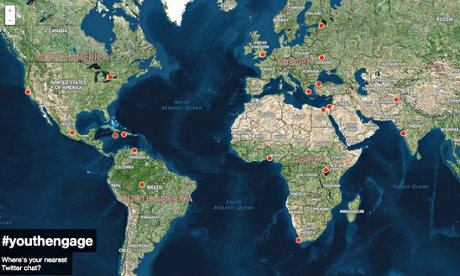
On October 24, young people and youth advocates hosted twitter chats as part of a global tweetathon on youth engagement – 24 hours, 24 countries and 24 discussions.
Francis Bobongie and Niumai Kovoa, Fiji
Our global tweetathon kicked off in Fiji where the need to educate all young people, who make up a high percentage of the population in the Pacific, was highlighted:
Education is the key Sometimes it is not affordable for everyone - solutions need to be thought of so that everyone has access #youthengage
— Dr. Francis Bobongie (@fbobongie) October 23, 2014
Issues around internet governance were also discussed. One tweeter urged youth to engage in discussions calling for a transparent and inclusive worldwide web:
Pacific Youths need to be more engaged in #APrIGF @apnicdg so they can raise their #Pacific #issues and concerns #IGF #YouthEngage
— SalaTamanikaiwaimaro (@SalanietaT) October 23, 2014
Stephen Yan and Catherine Church, Australia
In Australia, young people discussed the barriers to political and public engagement, particularly the legitimisation of youth voices:
Engaging youth in a genuine manner starts with mutual respect and believing they also have something to bring to the table. #youthengage
— kaiser (@corrosions) October 24, 2014
Participants suggested establishing connections with other organisations. “With plenty of youth groups fighting for a voice, they need to connect with the right partners and institutions to create long-term relationships, which can serve as avenues for action,” says Stephen Yan.
Lyn Garcia and Nash Tysmans, Philippines
Social media is one of the most available and powerful platforms for the Filipino youth but “engaging young people is more than just internet access”, said one tweet from the Philippines. Others pointed out that communication isn’t a one-way street:
@nashtysmans We have all channels like social media. What we need are adult listeners. It requires attitude change. #youthengage
— Fr. Jboy Gonzales SJ (@jboygonzalessj) October 24, 2014
Another tweeter pointed out the influential role of parents, as well as school, in encouraging youth engagement:
Education is important to engage #youth. However, in my opinion, every parent plays a larger role. #YouthEngage @nashtysmans
— Adriana Lemus (@vicexversa) October 24, 2014
Khrisnaresa Adytia, Indonesia
The discussion in Indonesia was around how young people can be informed about local and national politics, and pointed out that the government should also be listening to them:
To me #YouthEngage: Government should provide more platforms for youth to voice out their opinions! @OpenGovIndo @GuardianGDP
— Pras (@pstyd) October 24, 2014
Shrey Goyal and Saket Mani, India
In India, the role of media was cited as a key way to engage the youth:
@ShreyGoyal @KumaraGuru By adopting solutions journalism. Hardly any media outlet that covers positive changes in our society #youthengage
— Shweta Vitta (@ShwetaVitta) October 24, 2014
The possibility of a National Youth Council was also discussed:
@SaketMANI @ShreyGoyal @tabazeem @meeravijayann Yes, and perhaps NO. We have a fairly robust youth policy Can we socialise it? #youthengage
— DNV KumaraGuru (@KumaraGuru) October 24, 2014
Mohammad Farooq and Mehreen Omer, Pakistan and Afghanistan
Education formed a large part of the debate in Pakistan and Afghanistan, particularly the lack of government spending and variation in teaching.
@MohammadFarooq_ The current Education Spend to GDP ratio in #Pakistan is hardly 2%, which is one of the lowest in the world! #youthengage
— Mehreen Omer (@mehreen_omer) October 24, 2014
@Naardah @mehreen_omer It is significant to house an #openmindset encourage kids to think #Innovate from a young age. #youthengage
— M.Farooq (@MohammadFarooq_) October 24, 2014
“Free thinking has to be promoted,” says Mohammad Farooq. “Focus should be on developing the creativity and innovative skills of these youth to engage in something worthwhile.”
Kate Trofimova, Oleg Kucheryavenko and Victoria Stetsko, Russia
How the youth can help curb extreme inequality, specifically for women and rural communities, was the topic for the debate in Russia.
@kutcherson @GuardianGDP rural youth in Russia face salient inequalities in access to quality education due to lack of social infrastructure
— vickie s (@discosalmon) October 24, 2014
“It was encouraging to see fellow young experts and activists so hungry for answers on how to make youth voices against inequality and exclusion heard,” says Oleg Kucheryavenko. “We acknowledged the importance of having a space for young people to come together and speak out.”
Ariel Rubin and Fatma Hacioglu, Turkey
Issues of security, freedom, human rights, and political engagement all came up in Turkey but according to Ariel Rubin, the main theme was passion. “Young Turkish men and women are some of the most engaged I’ve ever seen. They aren’t afraid to speak their minds,” he says. The last tweet from @ornibara summed up the fervor of a country where the median age is 30 and the youth demographic is growing fast: “I am the youth,” she tweeted, “and this is my policy!”
Gençlik politikaları, gençlerin fikri alınarak değil, gençlerle gerçekleşebilir. Genç olan benim, bu politika benim! #youthengage #türkiye
— Dilan Kurt (@ornibara) October 24, 2014
Daria Bielinska, Ukraine
Following the the events of last winter, the relationship between young people and the government dominated the conversation from Ukraine:
@GuardianGDP #YouthEngage @AEGEE_Kyiv I want to say that adversity of this year rallied ppl in #Ukraine . It raises your self identification
— Dace (@Latenta23) October 24, 2014
The role of young people in elections, the transparency of government and governmental support of youth were all discussed, but it was agreed that young Ukranians are ready for change:
@Zheeene4ka @AEGEE_Kyiv our country now has another identity and we are ready for cahnges #YouthEngage @GuardianGDP
— Annie (@Anka_Smailikova) October 24, 2014
Sotiris Baratsas and Maria Kotari, Greece
The economic and democratic turmoil of recent years framed much of the discussion in Greece. The democratic deficit and lack of autonomy for young people was highlighted:
@youthnet_hellas @GuardianGDP sick of hearing Greek politicians in suits waxing poetically over youth uneployment @GuardianGDP #youthengage
— Elina (@ElinaMak) October 24, 2014
The lure of extremist views for desperate young people was also raised:
Unfortunately many young people in Greece adopt nationalist/racist ideologies as a way out. #youthengage @youthnet_hellas @GuardianGDP
— DimitrisMakrystathis (@makrystath) October 24, 2014
Layne Robinson, Minna Salami and June Eric-Udorie, UK
In the UK, frustration were expressed over the lack of efforts to end inequality:
@MsAfropolitan Worsening in that most people are too quick to deny any existence of racism/sexism/classism yet they're still pervasive
— Clemmie V-A (@superclemmie) October 24, 2014
Young Britons were concerned about the scarcity of job opportunities for young people, and felt disempowered by politicians:
Dear Politicians & social "leaders", dont ask what u can do FOR us youth, ask what u can do WITH us.Thats a game-changer. Thanx #youthengage
— John Loughton (@JohnLoughton) October 24, 2014
Zineb Belmkaddem and Jean-Patrick Ehouman, Morocco
The “rampant” unemployment kicked off the debate in Morocco, with people suggesting that career advice and more internships could improve the situation:
A simple thing like a career day in our elementary schools, would help youth have an idea about a wide range of career paths. #YouthEngage
— Badr Chaouai (@badrchaouai) October 24, 2014
@jpehouman They should be paid & have a clear structure, whereby the interns can be assessed & given feedback during their internship
— Sephora Ochou (@SephoraOchou) October 24, 2014
Better governance and transparency was suggested as a way to re-engage young people who have lost faith in politics and politicians:
@Onlyzineb Good governance and transparency in institutions &structures will motivate youth to engage and participate #youthengage #Morocco
— Hanane Zelouani Idri (@Lala_Fatna) October 24, 2014
Boniface Mwangi and Ruth Aine, Uganda
In Uganda and Kenya, young people were inspired to play a part in growth at a local, national and regional level:
@Ruthaine @jwhisperzz YES, large initiatives will have positive results in long run, but important to empower youth at a local level as well
— Arezoo (@ArezooNZ) October 24, 2014
Building a a future that finds the balance between parental duty, societal contribution and passion was also discussed. “There needs to be a connection between what parents want for their children, what our countries need and what the young people are passionate about,” says Boniface Mwangi.
Marlon Parker and Lulu Haangala, South Africa
For young people in South Africa, youth engagement is about empowerment and leadership development. Many of the youth believed that their voices are not being heard and there is a lack of guidance from leaders:
The youth is struggling because of a lack of career opportunities and guidance from those who have the ability to guide. #youthengage
— sweetu (@simone_rustin) October 24, 2014
There were also demands that the government prioritise job creation:
Our government needs to take a stronger stance and be more active in education, skills and leadership development. @GuardianGDP #YouthEngage
— Priya B (@Pr1ya_B) October 24, 2014
Fabiola Ortiz Rio and Marina Ribiero, Brazil
The engagement of young people in slum areas and other disadvantaged regions was highlighted in the Brazil chat. “In our country, we need to reduce state violence against citizens,” says Marina Ribiero. “Instead of public policies for the inclusion of young people, such as ensuring access to education and the protection of women and their children, the state governments act very violently.”
Ilana Milkes and Vanessa Siliezar, Venezuela
A central theme of the chat in Venezuela was frustrations at the lack of investment in building “future leaders”:
#youthengage they always say "you're the future leaders" but do they even pay attention to the 'future leaders'? @AIESECNigeria @GuardianGDP
— belle. (@deedeeAdeg) October 24, 2014
Tweeters also called for more action, not just words, with mentorships, internships, programmes, and youth panels:
@LetGirlsLead See youth as equal co-creators, changemakers, thinkers, doers, create avenues for youth to learn thru practice #youthengage
— Ashoka Changemakers (@changemakers) October 24, 2014
Emmanuel Asomba, Canada
The debate in Canada said that more community-level projects would engage the youth:
@MCFoundation @SaveChildrenCan @GuardianGDP @Emachi partner with the community center and work on more youth development programs
— IG (@Official_Thato) October 24, 2014
Malaika Brooks-Smith-Lowe, KizzyAnn Abraham and Safiya Sawney, Grenada
From Grenada, we gained insights into the current state of education, including the need for government scholarships to meet the economic needs of the country.
@Official_Thato the secondary schools are overly focused on testing vs. cultivating problem solvers, collaborators & visionaries generally.
— Groundation Grenada (@groundationgda) October 24, 2014
@ConTrekk yes! Youth need to get out of the classroom and into the field to be inspired and truly learn #YouthEngage
— Rewind N Come Again (@RACAblog) October 24, 2014
Denise Dunning and Kavelle Christie, USA
The final hour of the tweetathon discussed the themes of inclusivity, shared power and decision-making. The consensus that social media is a powerful platform for youth engagement:
@LetGirlsLead Platforms that allow youth to communicate through photos: FB, Twit, Instagram, Tumblr & snapchat, are among favs.
— Trisha Tahmasbi (@Trisha_Tahmasbi) October 24, 2014
Social media can help young people access to network they need not meet in person and can result in global collaboration #youthengage
— AIDemocracy (@AIDemocracy) October 24, 2014
And finally, thanks to our hosts from around the world.
Here are the pictures they sent during the tweetathon:
Read more stories like this:
• Top tweeters on youth empowerment in Africa
• Fighting for change: better from the boardroom or the street?
• ‘Youth unemployment is being fuelled by an education crisis’
• Advertisement feature: Global youth employment: hope in a bleak landscape
Join our community of development professionals and humanitarians. Follow @GuardianGDP on Twitter.