AHMEDABAD: As the famous adage goes, the left hand shouldn’t know what the right is doing — if the context is of charity or noble deeds, indicating its utmost private nature. But a study carried out by researchers at IIT Gandhinagar (IIT-Gn) claim that the left hand indeed knows what the right is doing!
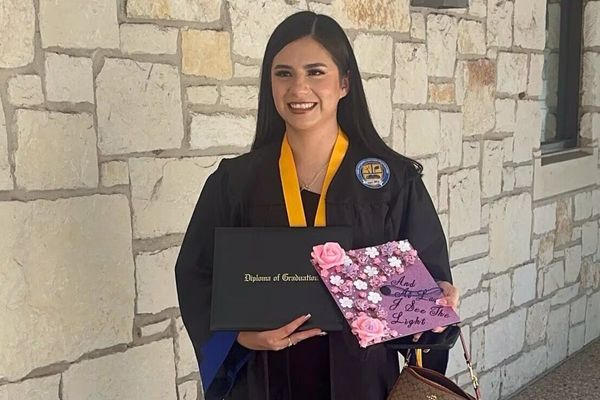
Goldy Yadav, who got her PhD degree from the institute during the recent convocation, got it in Cognitive Science discipline with title ‘Interlimb Generalization of Newly Learned Motor Skills’.
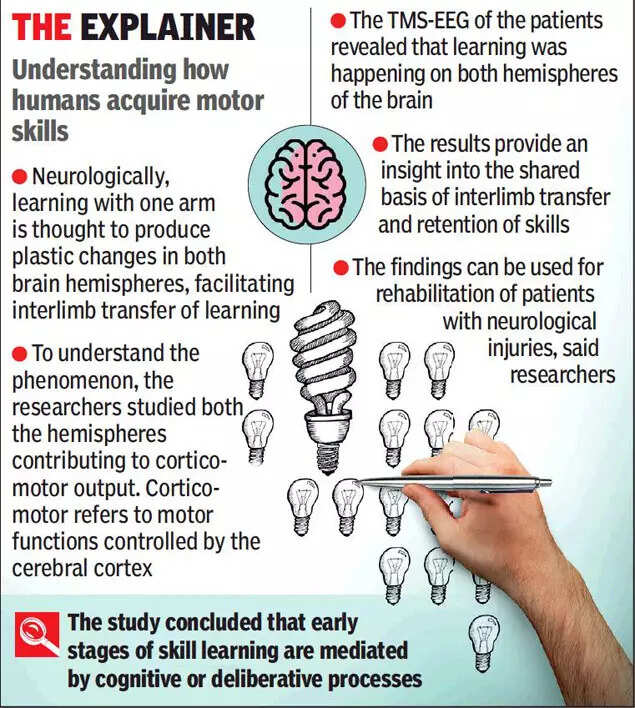
“My earlier work was focused on cognitive science and brain functions. My doctoral work expanded the scope to understand whether the skills learnt by one side of the body (only hands were tested) can be transferred to the other side,” said Yadav, who is now a post-doc research fellow in Belgium.
Skill acquisition, primarily motor skills, gives an insight into how the human brain functions, said Yadav. The study consisted of right-handed individuals who were taught new skills, like making highly accurate movements in a short amount of time on a computer-tablet setup.
“When we ask a right-handed person to do the task with left hand, it’s generally a speed and accuracy trade-off. But during our trials, we observed robust and symmetric inter-limb transfer across the arms in contrast to an asymmetry observed in a number of motor adaptation studies. Interestingly, neither the magnitude nor the directionality of transfer was affected by task level variability,” she said.
Prof Pratik Mutha, a senior faculty at IIT-Gn and Yadav’s research guide, said that the study has implications for stroke or paralysis patients who have lost control over one side of the body. “The conventional approach focuses more on the immobile limbs by stimulating it. But one can’t train it much. But if we apply the learning from the study, we can train the unaffected side and can improve the recovery rate,” he said, adding that an insight into how we learn these skills can also help in strategizing the rehabilitation programmes for those with locomotor issues.