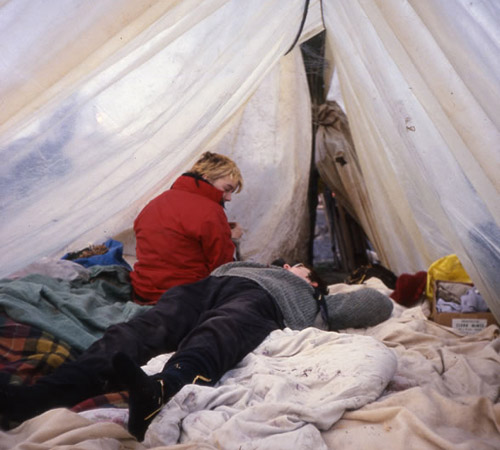
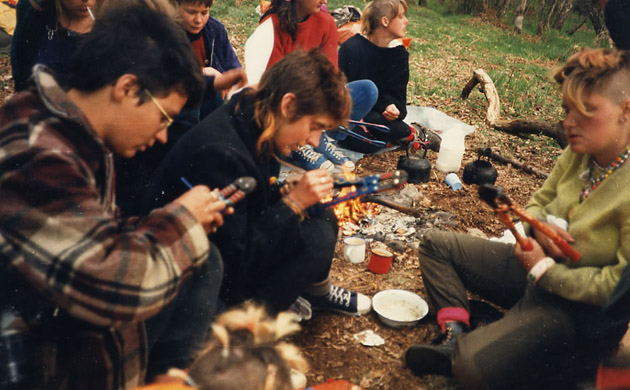
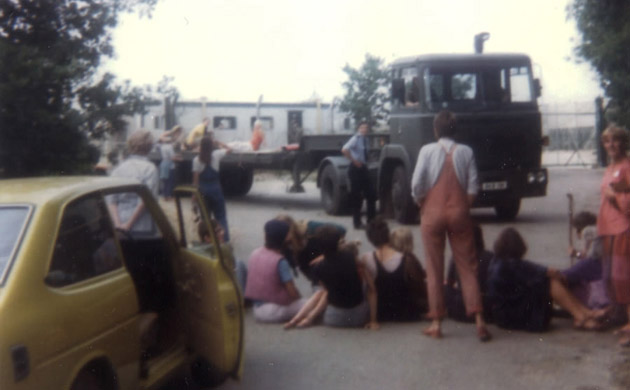
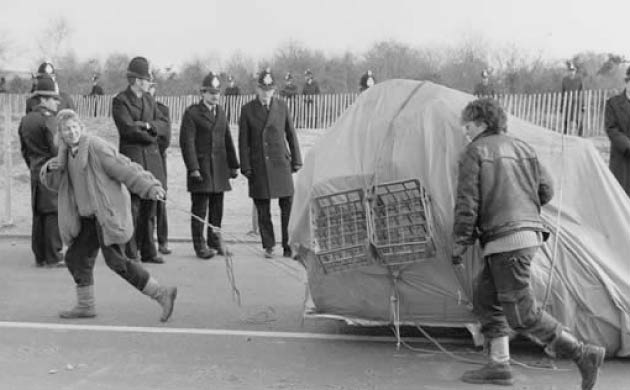
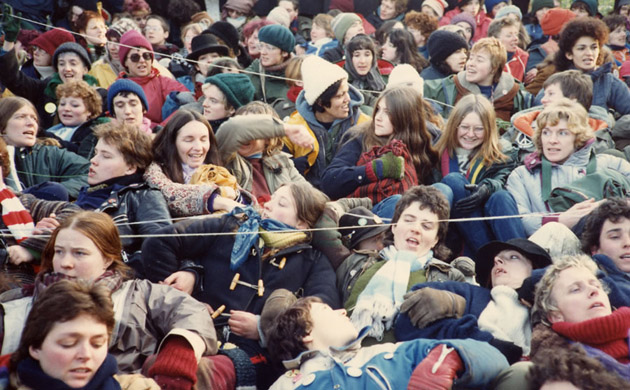
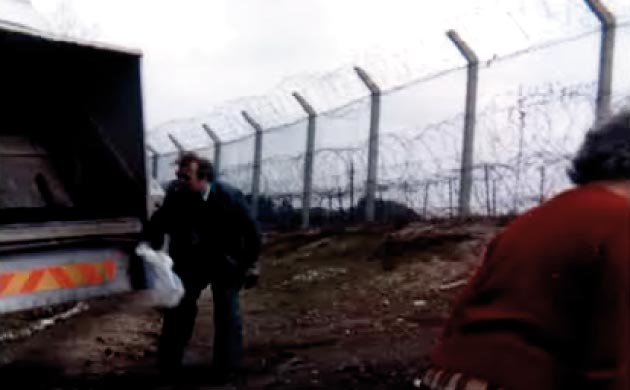
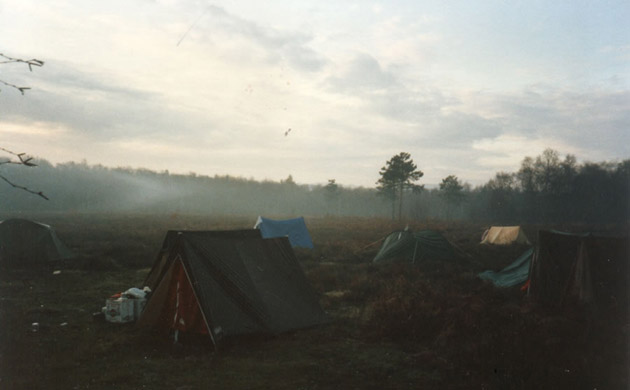
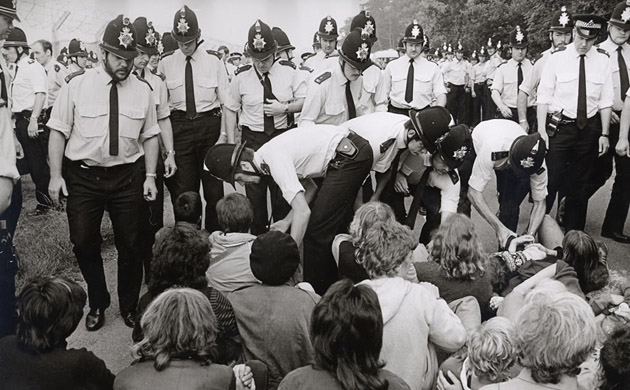
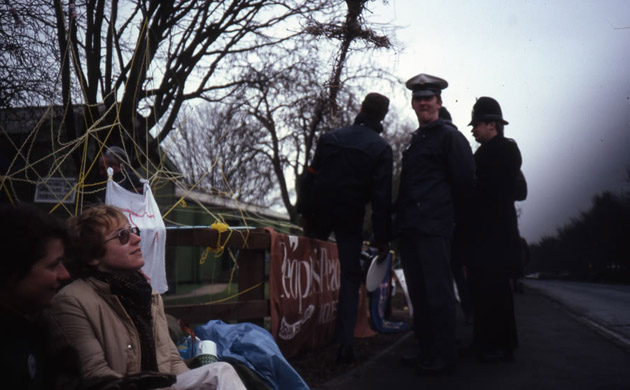
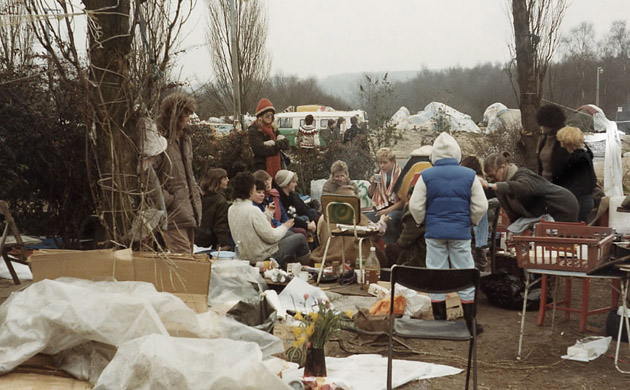
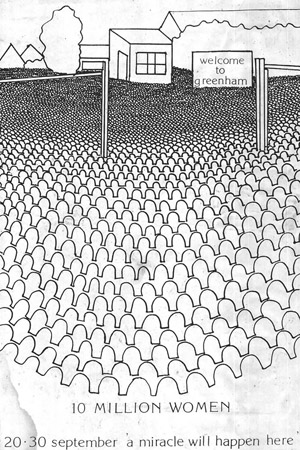
When the police banned tents, the women slept in benders. Benders are shelters made from branches that are bent, tied and stuck in the mud, then covered with plastic.Photograph: Public domainBlack cardigans - code word for 'bolt-cutters', which were used to cut down the perimeter fence.Photograph: Public domainBlocking the gates and disrupting traffic to upset the workings of the base, the women sat in the middle of the road, often being forcibly removed and/or arrested. This form of non-violent direct action attracted media attention.Photograph: Public domain
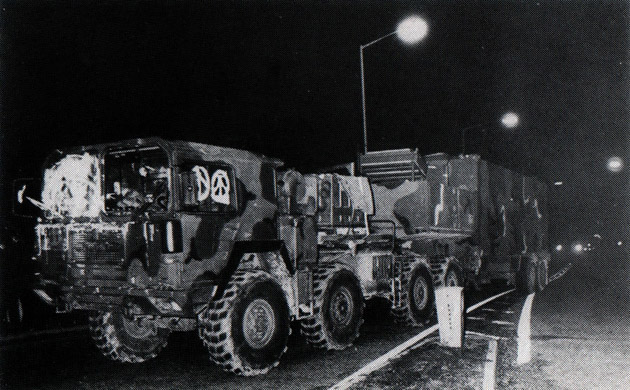
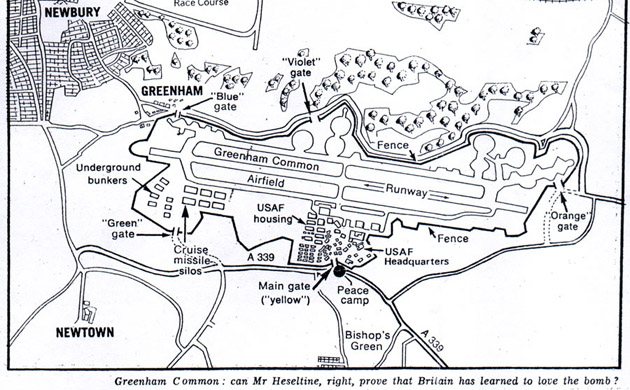
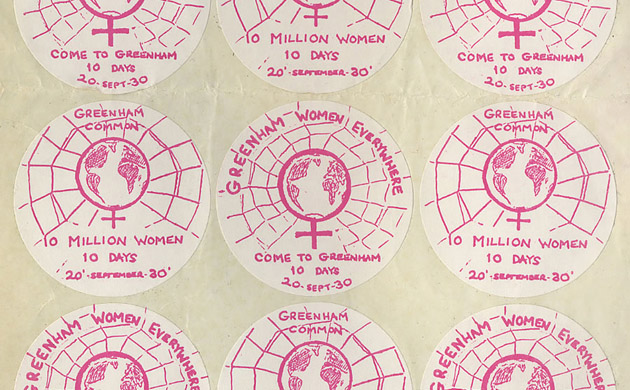
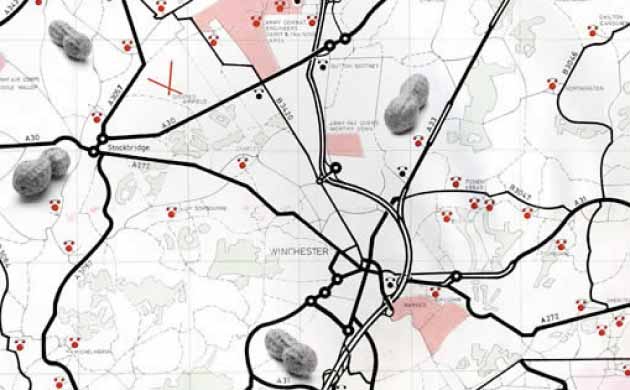
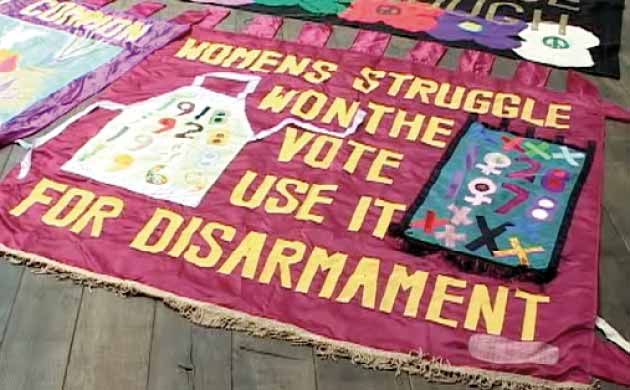
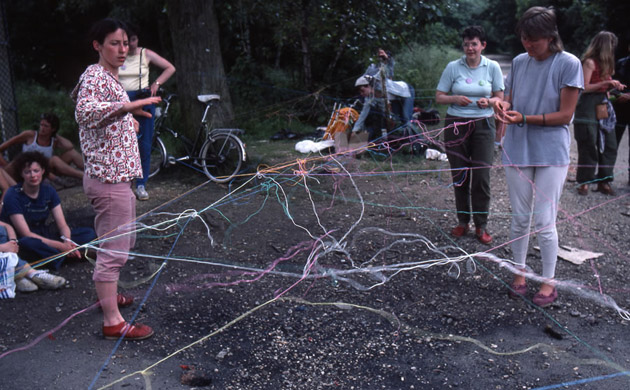
An organisation of both women and men who tracked the Cruise convoys whenever they left the base. No deployment from Greenham Common ever went unnoticed.Photograph: Public domainThe removal by court order of the Greenham Peace Camps by the bailiffs. Multiple landlords owned the Common Land on which the base was built; often the women moved their belongings no more than 100 yards to avoid the bailiffs.Photograph: Public domainThe camp itself was a collection of nine smaller camps, most stationed by a gate of the airbase and named after the colours of the rainbow. The first was Yellow Gate, which was established the month after the march reached the airbase. The rest followed throughout 1983. Green Gate, was nearest to the silos, and being furthest from the road was considered to be safest for children. Turquoise Gate was the next along towards Newbury, followed by Blue Gate - also known as the new age gate.Photograph: Public domainBanners using this slogan were seen all around the world, in the windows of the Houses of Parliament and on other protests of the time, including the Miners Strike. The slogan was a symbol of the ever increasing politicisation of the Greenham women and the groundswell of support.Photograph: Public domainKeening - to make a loud, long, sad sound, normally used when mourning a death. The Greenham women 'mourned' those who would die if there were a nuclear holocaust.Photograph: Public domainGreenham Common Women's Peace Camp was a leaderless organisation. This was a cause of great frustration to the media and other oppositional forces who found it difficult to articulate their opposition without a clear figurehead.Photograph: Public domainA rubbish truck used by evictors to remove, crush and destroy the encampment and possessions of the Greenham Women during evictions.Photograph: Public domainOften women who did not live full-time at the camp came and helped watch over the camps at night, guarding against vigilantes and watching for bailiffs.Photograph: Public domainNon-violent resistance/non-violent direct action relates to the practice of applying pressure to achieve socio-political goals through non-violent symbolic protests. Direct actions are often (but not always) a form of civil disobedience and are thus sometimes illegal. For example vandalism is illegal, while demonstrations are not illegal.Photograph: Public domainA 'peanut' was a lookout. One night in the early days of the Cruisewatch operation, the Cruisewatchers were waiting for the Cruise convoy with a map of the area, but no pen. They used a handful of peanuts to mark on the map the lookout positions. From this night forward Cruisewatchers were known as 'peanuts'.Photograph: Public domainSAS - a term used by police and soldiers to describe a Greenham woman who boosted the numbers by visiting the camp on Saturdays and Sundays.Photograph: Public domainSmellies - term used by the police and soldiers to describe a Greenham camper. Photograph: Public domainThe suffragettes who fought for the women's vote were a huge inspiration to many Greenham women. Political movement towards women's suffrage began during the first World War. The direct action employed by the suffragettes resulted in the British women achieving suffrage on the same terms as men in 1928.Photograph: Public domainTraditionally, the image of a spider's web symbolised the denial of established power within society. The image was used at Greenham to conjure up the power of a collective action.Photograph: Public domainMany Greenham Women reclaimed the word 'witches' as a symbol of powerful and independent women.Photograph: Public domainA slang definition used by Greenham Women to describe themselves. The change in spelling was symbolic as the Peace Camp was women only, thus they removed the 'men' from the word women.Photograph: Public domainFrom February 1982, only women were invited to join the camp. It was believed that in keeping the camp women only, it would be a space where women could express and assert their beliefs and politics in their own names and traditions.Photograph: Public domain
Sign up to read this article
Read news from 100’s of titles, curated specifically for you.