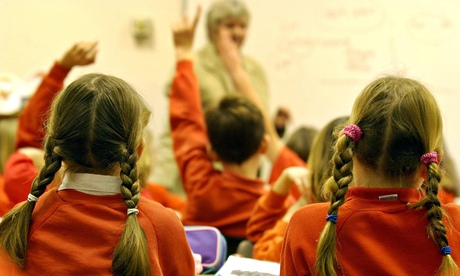
It is a fundamental principle of our democracy that every young person between five and 18 should have a school place. When in a locality there is a surge in the young population, new school places need to be created. This needs to be planned well in advance and new classrooms or new schools built. To expect this to be done, and done in time, by free school sponsors for every community in such need is ridiculous (Cameron to pledge 500 more free schools despite statistical doubts, 9 March). Planning for the provision of sufficient school places in every part of the country should be one of many proper functions of local government, yet, since the Education Act of 2011, local authorities can only create a new school if they have first sought proposals for a free school and no sponsors have come forward.
The antipathy of recent governments to local government is absurd. Local authorities do not “control” schools (as they are often accused) but should coordinate them in terms such as planning for sufficient places (which requires collecting local statistics), defining catchment areas and admissions policies, providing local inspectors and advisers, for smaller schools providing financial services, and organising training programmes for school governors. For these functions they should be properly funded by national government – not starved of resources as now.
Free schools with trained teachers will probably be found to be as good or not as local authority schools. What must be challenged is that they are taking state funding that should be shared across all communities, making a nonsense of any attempt to plan effectively for school places, and in some cases lacking the vital link between governors and local community.
Michael Bassey
Newark
• It would be expecting too much of the Tories for them to base their policies on empirical evidence, given Michael Gove’s examination reforms, but even the report by the Tory thinktank Policy Exchange, on which the party’s “500 more free schools” announcement is founded, admits its limitations. The fact that the report confesses its own “data cannot demonstrate conclusively” that any improvements in state schools have anything to do with being near a free school, beggars belief; they should have added, “despite what the prime minister will say”.
Sadly, news from Labour on the education front fares little better, despite its intention to “scrap” the free school scheme. Only last week we saw Tristram Hunt showing enthusiasm for another policy (Labour vow on gifted, 3 March). Of course, the country needs to “make the most of the talents of all our young people”, but how can that be achieved by identifying only a small proportion, the so-called gifted and talented, and giving them special treatment?
All children have talents and deserve an educational system that will stretch them to the limit, but designating some as worthy of a more expensive education, is unfair, and certainly should not be featuring in an education policy of any political party. Whatever happened to the idea of equality of opportunity?
Bernie Evans
Liverpool
• The claim by the thinktank Policy Exchange that free schools raise the standards of other state-funded schools is based on a flawed analysis. The number of schools involved is ridiculously small. In 2014 there were 92 primary free schools, just 0.55% of the national total, and 79 free school secondaries making up 2.4% of the total number. The “similar close” schools they were matched to were close only because they were in the same phase and not by any other characteristic. And because they had to be in the same local authority (LA) area as the free school they may well not have been the closest; it is obvious that in large urban areas the nearest school to another may well be in another local authority. It is possible, therefore that many of these “close” schools may have been some distance away from the free school claimed to have had influence.
The authors compare the schools by quartile of performance, but give no information about how many schools fall into each quartile. They claim the analysis shows that the lowest performing primary and secondary schools in areas where a free school opens improve by a greater amount than is seen nationally where a free school does not open. Conversely, the report acknowledges, the presence of a free school appears to show a decline in the improvement of the highest performing primary schools, and the secondary schools whose performance is above average. This pattern demonstrates a statistical phenomenon that used to be called regression to the mean and which is now referred to as regression to mediocrity. How apt.
John Gaskin
Driffield, East Riding of Yorkshire
• The paeans to Doug Lemov (Could this man transform your child’s education?, 11 March) are interesting, considering that all he has done is to encapsulate some well-known teaching theory into a list. So-called cold-calling for example was first mooted as “no-hands” by Black et al (2002) on the back of his collaborative work with Dylan Wiliam (1998); “wait time” in questioning was recommended by Mary Rowe in 1986. What his philosophy does do is to fly in the face of coalition policy on teacher training, especially the belief that teachers do not have to be trained but can learn “on the job”. Policy thus promotes schemes such as Teach First (based on Teach for America), other school-based routes and even the use of unqualified teachers – within a sterile and uncompromisingly rigid curriculum predicated on American ideas of a knowledge-based core (Hirsch 1996), which removes the need for teachers to be anything other than Gradgrinds.
If we characterise the process of Lemov’s list as one of theory-research-reflection, then popularisation and improved practice, then the keystone is the theory and research base. Removing or demeaning those teacher-training routes that provide the home for such a base means the entire process is undermined. Hence the crisis in teacher recruitment that leads Cameron offering monetary enticements (£15K for science students – but you must teach for 3 years, 11 March) instead of the necessary change in policy.
Dr Neil Denby
Denby Dale, West Yorkshire
• Education is not about the control of children, as Doug Lemov would have you think, but about engendering a genuine desire to learn. The problem with his approach is that it relegates teaching to a mechanistic act and ignores the wider context in which learning takes place.
If we cannot inspire children and young people with imaginative, interesting and relevant content that helps them to make sense of their world then they will switch off or vote with their feet, as far too many already do.
What is needed is an ongoing dialogue across the generations, across society and within each and every school about the purposes of education and how those purposes can best be achieved. In a week where the Guardian is focusing on the threat posed by climate change and growing inequity it is clear that such a dialogue is ever more urgent and that education has a role to play in responding to these challenges. If good teaching merely boils down to how fast the teacher walks around the classroom and the angle of her gaze then we are all lost.
Fiona Carnie
European Forum for Freedom in Education
• The poor deal for sixth formers (Cuts mean sixth-form students will get part-time education, 10 March) doesn’t just apply to those in school sixth forms, it also applies to young people in sixth-form colleges and further education colleges. However, schools can and do subsidise their sixth forms from the more generous funding available for the lower school – about £5,000 per pupil against the £4,000 for post-16 study. Sixth-form colleges cannot cross-subsidise because in general all they have is their sixth-form provision; and while FE colleges could in theory raid their adult budget to protect young people, they can’t in practice because funding for adults has been savagely cut at the same time as school funding has been protected. Furthermore, those institutions with large numbers of 18-year-old students, usually those who need a little more time than average to achieve their potential, have had an extra cut of 17.5% – a cut that hits the disadvantaged hardest - and the FE colleges that serve them. All our young people get a poor deal but some get a poorer deal than others.
Dr Lynne Sedgmore
Executive director, 157 Group
• I agree with Francis Gilbert (Should the free schools programme be extended? 12 March) that the closure of the Al-Madinah free school, for being “chaotic, dysfunctional and inadequate”, raises concerns that the free school movement is nurturing religious and social segregation. The price paid by the victims of this misguided experiment in educational engineering – the children, was high indeed. The last thing we need at a time of heightened religious tension is yet more divisive faith-based free schools.
Stan Labovitch
Windsor
• This wouldn’t, by any chance, be the same Conservative party that, in the early 1970s, strove to shut down Dr Eric Midwinter’s pioneering free school in Toxteth?
GodfreyHolmes
Withernsea, East Riding
• You report (11 March) that Mr Cameron is to announce “a £67m package to increase the number of maths and physics teachers by 2500”. Isn’t the problem more urgent than that?
John Rayneau
Witney, Oxfordshire