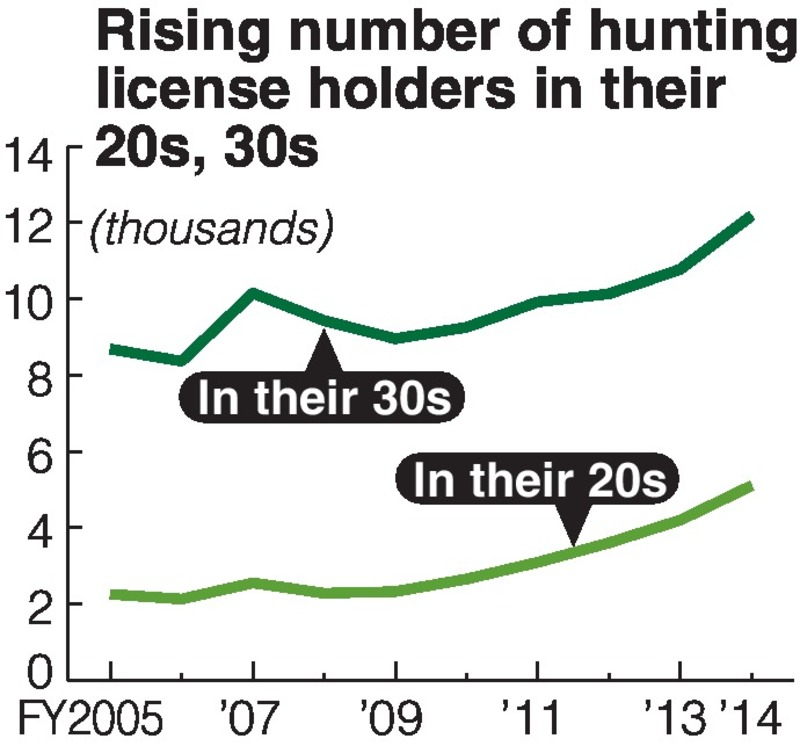
A growing number of young people in their 20s and 30s have obtained hunting licenses (see below), amid continuing agricultural damage by wild animals such as boar and deer.
Some people appear to have found social meaning in preserving their local forest environment, while others feel close to nature through hunting.
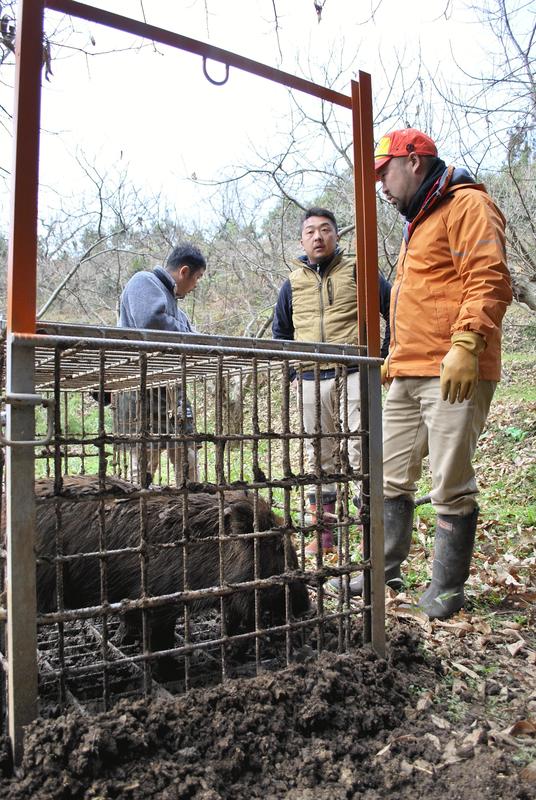
"We've caught two," 39-year-old farmer Tatsuya Inaba said in late January. Inaba had set up a cage-shaped trap in a chestnut forest in Uki, Kumamoto Prefecture -- animals are lured into the cage by food, with the door closing when they enter it -- and caught two boars in it.
Inaba is a member of Kumamoto Farmer Hunter, a group of hunters comprising young farmers. The group was established in the wake of damage to the farm products produced by his mother, Emiko, in February 2016. Boars ate dekopon citrus fruits a day before his mother planned to harvest them.
As similar damage was widespread in nearby areas, Inaba decided to form a group to protect farming fields from wild animals. He consulted with Masahito Miyagawa, 39, who now serves as the co-representative of the group.
Currently, 80 men and women participate in the group, and about 30 have obtained hunting licenses.
"We want to utilize the boars we catch for meat and fertilizer," Miyagawa said.
According to the Environment Ministry, the estimated number of deer in 2015 was about 3.04 million, excluding those in Hokkaido, or 10 times the number 25 years ago. The number of boars tripled during the same period, and was estimated to be about 940,000 in 2015.
Wild animals cause about 20 billion yen in damage to agriculture every year, and there is concern about the adverse effects on ecosystems.
Fifty years ago, about 500,000 people had hunting licenses. In recent years, that number has fallen to between about 180,000 and 200,000, and many of the hunters are getting old.
Among young people, the number of license holders hit bottom around 2006, but it has been increasing since then. A surprising number of people living in urban areas are said to have obtained licenses.
A way of life
Chiemi Konno, 30, of Fujisato, Akita Prefecture, obtained her hunting license when she was participating in the activities of the government's Community-Reactivating Cooperator Squad.
She was prompted to get a license when she was invited to a gathering of a local hunting club. She said she was shocked because "they were all elderly men." At the same time, Konno said, "I got interested in hunting because they looked cool when they talked about hunting."
She also knew that an increasing number of deer had been spotted in the Shirakami-Sanchi mountain area, a World Natural Heritage site. She then decided to obtain a hunting license.
Konno is the youngest and only female member of the local hunting club. She took part in hunting twice this season, but has not had any success on her own. But she was upbeat, saying, "Next season, I want to catch one myself."
A university hunting group called Karyudo no Kai (Hunters' club) was established in 2016 by Yoshinobu Kobayashi, 21, a second-year student at the University of Tokyo.
Members learn about hunting while also helping hunters. On some occasions, they sell goods made of tanned leather and bones of hunted animals during campus festivals.
The group now has more than 30 members, with various reasons for why they joined. Members have said things like "I enjoy outdoor activities," "I'm interested in the lifestyles of the Jomon period [an archaeological period in Japan; from 10,000 B.C. to 300 B.C.]" and "I was prompted by a video game that focuses on hunting."
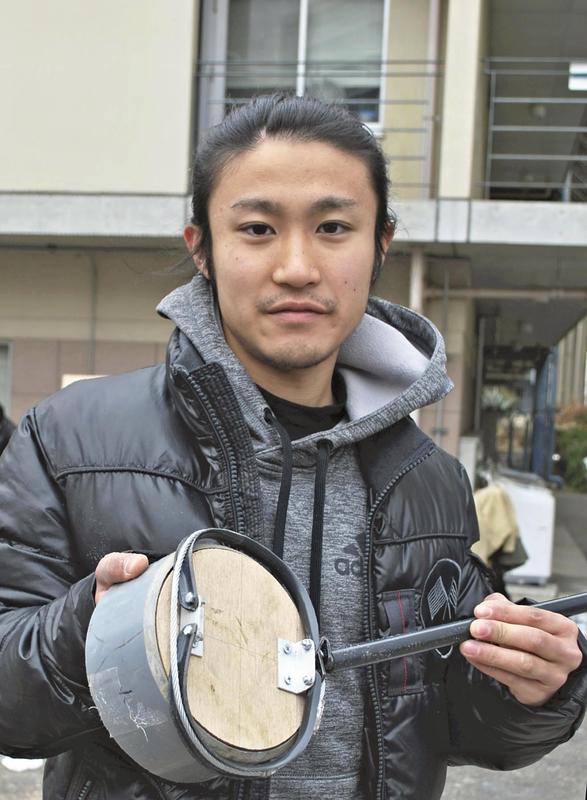
Kobayashi also has a hunting license. He makes handmade traps called kukuriwana, which instantly tie up the legs of boars and other wild animals with wires. He set the traps in cooperation with farmers in Chiba Prefecture.
"The reality of wild animals is not well known to the public. I want to promote it by cooperating with other universities," he said.
In March last year, The Whole Earth Publications Co. created the magazine Shuryo Seikatsu (Hunting life), which explains such things as how to obtain a hunting license and how to process animals that are caught.
As to why an increasing number of young people are obtaining hunting licenses, editor in chief Yukinari Suzuki said, "I believe more and more young people have come to desire the simple practice of eating what they hunt, and want to coexist with nature."
-- Hunting license
There are four categories of hunting licenses: shotgun/rifle; air gun; trap; and nets. A license is given if an applicant passes an examination comprising a paper test, qualification check and skill test. By registering with prefectural governments, license holders are allowed to hunt 48 kinds of birds and animals. A license is renewed every three years. In fiscal 2014, a total of 193,762 people held a hunting license.
Read more from The Japan News at https://japannews.yomiuri.co.jp/