2015 is proving to be a critical year for England’s youngest grandmasters, Gawain Jones, 27, and David Howell, 24. The pair are both established above a 2640 rating, equal to a place in the world top 100 grandmasters, and have set their sights on the 2700 elite yardstick, the level of the world top 40-50, which gives chances of a place in invitation tournaments.
Beyond 2700 is the UK No1, Michael Adams, securely established in the top 20 and who at 43 still has a steady rating around 2740, close to his all-time best mark. Adams rarely plays a bad tournament and it could be at least three to five years before Jones or Howell can hope to challenge him.
Statistics show that the majority of GMs reach 2700 in their teens or early 20s, and it becomes progressively harder after that age to make the necessary improvement. Still, Howell has a real chance. Since leaving university and becoming a full-time professional he has advanced about 50 points and is approaching 2680. Last month he scored his best result yet when he finished runner-up to the US No1, Hikaru Nakamura, at Tradewise Gibraltar and collected a £15,000 prize, the largest of his career and ensuring a financial base for an attempt at 2700.
This month’s European championship in Jerusalem was a setback, as Howell tied for the lead on 5.5/7 four rounds from the end but tailed off with 1/4, so missing out on a qualifying place in the lucrative 2015 World Cup knockout. There was extra pressure because he was the only Englishman in a powerful field dominated by east Europeans and ex-Soviets. Although he finished 54th overall, he was as high as fifth among the west Europeans.
Jones reached his rating peak at 2671 early this year, then had a setback at Tradewise Gibraltar, and this week was joint second at Reykjavik with a round to go before a bad final game spoilt that, too. The Yorkshire GM’s strength in the past has been his imaginative opening novelties and it could be that he needs a break to recharge his creative ideas.
This week’s game from Reykjavik is a rerun of one of the best-known shocks in chess history, Garry Kasparov’s 1997 loss to the super-computer IBM Deep Blue. The Peruvian’s 8...fxe6 is much better than the fatalistic 8...Qe7? chosen by Kasparov, and White soon lost the thread. 12 Rxe6 and 14 Be3 are possible improvements, since as played White was soon a piece down for nothing.
Hannes Stefansson v Julio Granda Zúñiga
1 e4 c6 2 d4 d5 3 Nd2 dxe4 4 Nxe4 Nd7 5 Ng5 e6 6 Bd3 Ngf6 7 N1f3 h6 8 Nxe6 fxe6! 9 Bg6+ Ke7 10 0-0 Qc7 11 Re1 Kd8 12 Ne5?! Nxe5 13 dxe5+ Nd7 14 Bf7? Bc5 15 Be3 Qxe5 16 Qd2 Qd6 17 Qe2 Bxe3 18 Qxe3 e5 0-1
Free and live online chess this weekend features the women’s world championship at Sochi, now in its round of 32. The reigning champion, Hou Yifan, is absent as a protest against the two-game knockout format, but will play a title match against the winner.
Games begin on Saturday at midday, when Edinburgh’s Keti Arakhamia-Grant, 46, whose CV includes the male GM title and the Scottish title against men, will be in action. Arakhamia-Grant knocked out a higher rated Hungarian in round one and now faces the No11 seed and fellow veteran Sweden’s Pia Cramling, 51. Their first game on Friday was drawn, and if they halve again on Saturday it will go to speed tie‑breaks on Sunday.
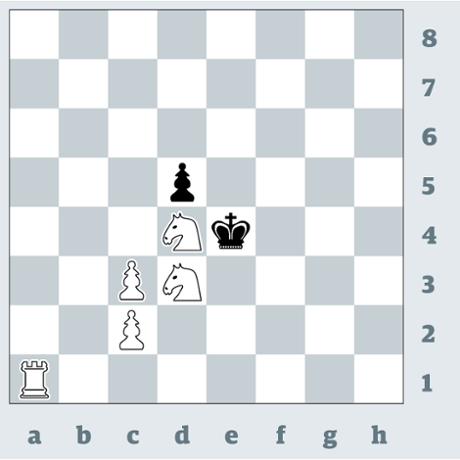
3382 One and three quarter moves, wrote Purdy. The white king is off the board so must be in White’s hand en route to 1 0-0-0 Ke3 2 Re1 mate. Castling is half a king move, half a rook move, hence White is a quarter of the way through the process. But arguably Purdy is wrong, and the answer should be 1.51 moves, with the king on the point of touchdown at c1.