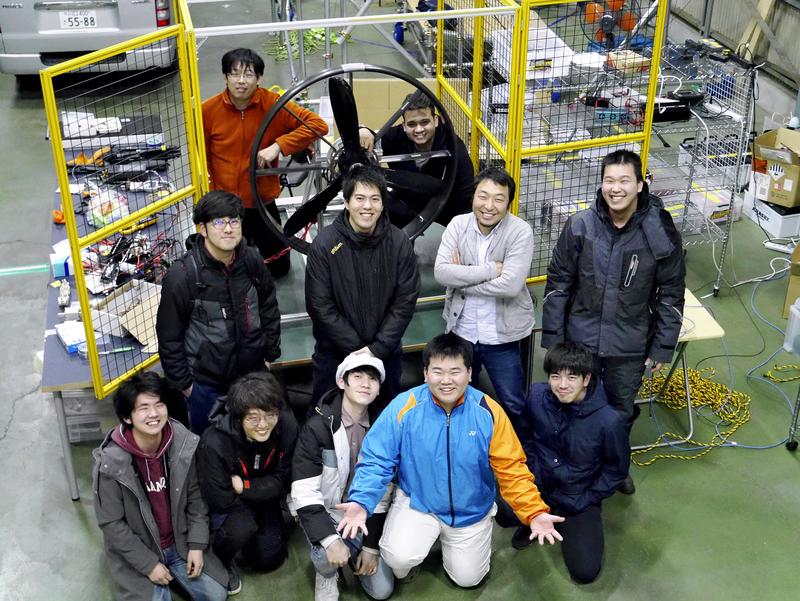
A team led by a University of Tokyo graduate student will compete in the GoFly Final Fly-Off, the final stage of a global competition to create personal aircraft, to be held in the United States in February.
"Our dream is to fly over Japan with our own aircraft. We want to win the finals and gain momentum for practical application," said team leader Tasuku Nakai, a graduate student at the University of Tokyo specializing in mechanical engineering.
The GoFly competition tests the skill of innovators as they develop next-generation manned flying cars and is sponsored by U.S. companies including Boeing Co. The final round will take place at a National Aeronautics and Space Administration airfield in California, with 2 million dollars in total prize money for the winners.
Among 854 teams of engineers and students from more than 100 countries, 31 teams who have successfully passed an evaluation of documents, including an explanation of their methods and goals, and a further evaluation involving a working prototype, will compete with their completed devices in the finals in February.
Nakai, 28, leads a team called teTra, formed two years ago with four other Japanese competitors, including aviation and communications engineers, who decided to enter GoFly as a team. The teTra team spent 100 days in preparation for the first stage of evaluations and reached the top 10, winning 20,000 dollars in funding.
The team started its own company with capital of 1 million yen in June 2018 and raised 50 million yen in total from enterprises and financiers to build their current machine. The one-manned flyer is 1.65 meter tall, 2.2 meters wide and 2 meters long. A passenger boards the dronelike flyer in the same posture as someone riding a motorbike. The device is designed to fly at an altitude of 30 meters at 100 kph.
The competition will evaluate the aircraft's performance in a variety of aspects including safety, low noise and its potential as a business model.
"With cooperation from all over the country to pursue our dreams, our flyer has turned out to be a good one," Nakai said. "The design encourages unity between the device and the passenger, so they can enjoy flying in the sky. We want to win the finals and commercialize it in 2025."
Read more from The Japan News at https://japannews.yomiuri.co.jp/