Here are the reviews from Queen Mary’s High School in the West Midlands, which took the runners up prize in our young critics competition 2015.
Guruleen Kahlo, 12: review of Cece Bell’s El Deafo
Weird. Childish. Creepy; those were the thoughts that came to my mind when I first saw El Deafo. Boy, was I wrong!
El Deafo is a heart-warming graphic novel about a girl who gets meningitis which makes her go deaf. She is confident at kindergarten as everyone in her class wears a hearing aid and they all have some kind of deafness. But when she moves house and school everything changes…
She had to wear a bigger hearing aid called the “Phonic Ear” and was the only deaf child. She was patronised. She was lonely. She was strange…
This book reached out to me and now has a place in my heart. This book made me feel as if I wasn’t alone. I had a struggle to make friends myself when I first started secondary school. Cece was different and she was patronised. People thought she was odd because of the contraption she had to wear for hearing; the ‘Phonic Ear’. But she wasn’t strange, in my opinion. She was brave and she was strong. She had meningitis at four and went deaf but she fought through it all. She was lonely and was labelled ‘weird’, ‘strange’, ‘deaf girl’. Cece said she felt like she was in a bubble.
But Cece decided to break out of this bubble. At first she was friends with a girl called Laura but she was bossy and controlling. As Cece began to fade back into her bubble a girl named Ginny tossed her a rope of friendship to pull her out. But Ginny’s patronising tone soon severed that rope. It seemed like the bubble had a switch that kept bringing Cece in and out of the bubble. But her new friend Martha fought through and they were soon best friends. They had one fight in which Martha didn’t speak to Cece but like the best friends they are, they made up. The bubble had finally evaporated.
When I found out this was an autobiography the book reached deeper into my heart. How could a real, living person go through this pain?!
Soon enough though, I found the answer. Cece has a superhero inside her (‘El Deafo’). But as I read on I realised…
We all go through this pain and the thing that gets us through are the super heroes inside us…
Note: Use the superhero inside you to read this heart-warming and witty tale.
Meg Wilkinson,14: review of Jennifer Niven’s All the Bright Places
This book was amazing; this book was heartbreaking; this book was absolutely beautiful.
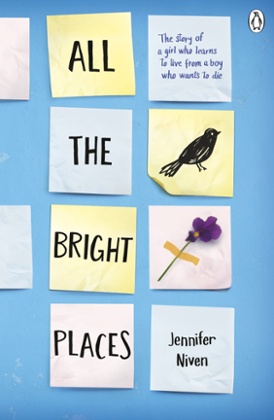
All the Bright Places was for the most part beautiful and uplifting, and the relationship between Violet and Finch was so lovely and it touched my heart. I loved how they started off as not really friends but then throughout the book their relationship blossomed into something special.
I really felt for Violet as having to deal with the death of someone close to you, must be extremely hard. I could not imagine a life without my little sister and this really made me feel grateful for our relationship. I love that as the book progressed, with the help of Finch, she started to feel better about herself and started to actually live her life and make the most of it.
Finch was my favourite character due to his craziness and quirkiness. He was just a bundle of joy to me and I just wanted to reach through the pages and give him a big hug. As we get to see from Finch’s perspective you see that although he puts on a bold front, inside he’s actually dealing with many problems, and is suffering from depression and bipolar. This made me think about how in real life some people, who seem to have a happy life and seem content, could actually be feeling something that they cannot talk about and show the world. As well as making me contemplate what is behind the face people show to the world, I think Finch’s character would make other readers, especially younger ones, more aware of mental illnesses and show that anyone could be dealing with it.
The bond between Violet and Finch was magical, and it made me feel jubilant. They showed a relationship that was not perfect but still worked. The love they shared for each other and the fact that they both put each other’s need before their own, shows what a good, strong relationship should be based on.
The end of the book was devastating for me as I had become so attached to the characters. I have to admit that upon reading the ending at 1:00AM, I was rocking back and forth, my head in my pillow, sobbing hysterically. Yes, I was that emotionally moved. For a long time I could not bring myself to think about the death of Finch, as it hurt my heart. However, upon reflecting back on the incident, I realised that it showed an important message; that you need to appreciate your life and make the most out of it. The fact that Finch, even after he committed suicide, still thought about Violet and his last message to her was that she needed to be happy and live her life, I think is an inspiring message. In life you need to make the most of every opportunity and take some risks, just so you do not miss out on anything. Thank you Jennifer Niven for this inspiring, thought-provoking book.
Symran Wedge, 15: review of David Almond’s A Song for Ella Grey
I approached this book truly hoping to enjoy it, but by around a quarter of the way in, I came to the conclusion that I will never take pleasure from reading David Almond’s books.
The book did have many positives that should be praised. I enjoyed one of the characters he was able to bring to life through his novel. Claire was a well written character and it was interesting for the reader to see her become so possessive of her friend. I also agreed with her that Ella and Orpheus’ was just puppy love. Another positive was the friendship explored between Ella and Claire which would have been intriguing if it had not been in a book that I thought was about Greek mythology. Never the less it was an interestingly shown friendship that was often strange, but still well written.
This brings me onto the negatives. Firstly, I disliked the characters of both Ella and Orpheus. I did not buy into the ‘love story’ shown in this book as it felt both rushed and forced. I believed that Claire and Ella were more in love than Orpheus and Ella. Also I did not feel that the characters reflected the ones from the traditional myth well, which for me was an utter disappointment. This brings me onto my main issue; I expected to read a version of the Greek story of Orpheus and Eurydice with a few twists and changes to modernise it. I did not get that from it. It steered away from the myth too far for my liking and weakened the characters, which may be an issue due to the fact it was marketed more to be like the myth than it was.
The plot did not interest me after I had read a few pages. I found it boring and slow and that it focused far too much on the friendship relationship rather than the romantic one.
As well as this, the way he writes his books to many is considered to be ‘lyrically beautiful’. I understand this opinion, but when you are writing in a lyrical manner, it is important to still be able to make sense. I feel he focuses too much on making his books sound beautiful, yes making it nice to hear, but then he sacrifices clarity and well driven, exciting plots.
The book just was not everything I wanted it to be and I am sorry for that. Yes it had many good points and if there was an award for the most beautifully written book, he would win. Also if you enjoy David Almond books then you will too enjoy this book. However when I read I do not just want it to sound good, it needs to have characters I enjoy and a thrilling plot, this book for me just did not have that.
Victoria Wallace, 15: review of Kate Saunders’ Five Children on the Western Front
Once upon a time, there was a girl called Victoria, who lived in a dream land. She had many fairy tale neighbours, who sprang up from books that were close to her heart: Harry Potter lived nearby, and Katniss Everdeen had a small house a few streets away. Winnie the Pooh lived just opposite. Her dream land was a utopia. One day, a new neighbour moved in, and she came and introduced herself as Kate Saunders.
Now it just so happened that at the time Kate came to call Victoria was drinking tea and eating cake with Edith Nesbit, a very good friend of hers who lived down the road. Victoria invited Kate to join them and so the three girls ended up bonding over afternoon tea. Kate, it turned out, was a prolific writer who was on the lookout for information on some old friends of hers, the Pembertons. The Pembertons were a large family she had known when she was young, and were made up of: Anthea, Cyril, Robert, Jane, Hillary (The Lamb) and Edie. At this point, Edith Nesbit sprang into the air with surprise and exclaimed that she had known the family too, and how she had known of another member of their family; the Psammead, a wise old Sand fairy that the children had found in the Gravel Pit near the house when they were young.
Kate nodded and explained that the Psammead had appeared once again in the gravel pit and been discovered by Edie and The Lamb. He was striving to get back home, and yet found himself unable to return. It turned out that the Psammead, whilst being old and dignified, had in the past committed many sins for which he felt no regret for, and it was this lack of regret that prevented him from returning. The children convinced him that his only way back was repentance. Meanwhile, the children were growing up. Anthea had fallen in love, Bobs had gone to Cambridge University and Jane had developed a great desire to become a doctor. The biggest change of all, however, was that Cyril had joined the army and had gone to fight in the First World War.
Here Kate swallowed hard. She said she never had found out what had happened to Cyril and the others. She had listened, awestruck, to the children’s stories about travelling into the future, and now Kate, living their future as her present, looked back at the memory with great fondness. Victoria enjoyed hearing about the family, thinking the story was beautiful, creative and reminiscent of good days. She thought how cleverly crafted the story was, and how perfectly it had been told. “Maybe it’s your job to find out what happened to them, and tell the story, Kate,” Victoria said; Kate opened her notebook. She scratched a title at the top of the page and flipped the book round to show the other two: ‘Five Children on the Western Front’. The quest had begun.

Jenna Stanton, 15: review of Jennifer Niven’s All the Bright Places
If you like books that are funny, adorable but also filled with heart breaking scenes then this is the book for you. ‘All the Bright Places’ is a book about love, finding yourself and it shows the impact a person can have on your life.
The book is about Finch and Violet and how their lives entwine when they meet each other on the top of a bell tower.
My first thought after finishing this book was ‘don’t worry Jennifer Niven, I didn’t need my heart anyway!’ as she completely destroyed it with this book. It is emotionally damaging and has a massive impact on the reader. I think that the ups and downs of Finch’s life shows that someone can be depressed or have a mental illness but no one really notices it until it is too late. This really had an impact because it made me realise that this happens a lot in today’s society and that it should be changed. Finch also got bullied which added to his depression and I thought that this shows that something has to be done about the issue of bullying, as it can make a big difference to someone’s life. I also think that by having someone popular like Violet, and portraying them as depressed, shows that people can act in a completely different way to what they are actually feeling.
The characters in this book were amazing; I loved them so much! Finch was a funny, unique, exciting character that made you question everything and Violet was an unpredictable, relatable character who progressed so much through the book. Putting these characters together was a perfect combination as you could see how much they helped each other (even though you wouldn’t expect them to even speak to each other in normal circumstances.) This meant there was a lot of character development which made the book, and characters, much more interesting to read about.
I think the fact that the book was narrated by the characters made it so much more enjoyable to read and also meant that, as a reader, I felt like I had a much stronger connection to them. As the book went on, I became so emotionally attached, that I felt utterly heartbroken by the end.
The book was set over all of Indiana as Violet and Finch visited different places for their project. I thought this was a really nice idea because as they moved to more places, the closer they became, which meant that all of the places held special memories for them, meaning that they also felt special to the reader. They were also really unique settings; for example, the site of the biggest paint ball in the world - amazing!
Overall I think that this book is one of the best I have read and should be read by everyone as it is one of the most eye opening and amazing books in the world and would have such a massive impact on todays’ society.
Anya Koprivica-Adams, 12, review of Cece Bell’s El Deafo
I really loved El Deafo because even though I have never been deaf myself, I know how it feels to be suddenly whisked off to a new school and feel like an intruder as you come into other friendship groups.
The way that the people are portrayed as rabbits is quite sad as it adds context to such a really devastating situation by adding a bit of irony, as rabbits have super-sonic hearing. It has a very very cute sense of humour with El Deafo the superhero breaking through every bad situation! But the cuteness cuts through you as it has such a true meaning; whatever your situation, if you have a superhero inside you, you can do anything!
Congratulations to Queen Mary’s High School in the West Midlands for winning the runner up prize in the groups category of the Young Critics award 2015.
Queen Marys High School
Review 7
El Deafo
El deafo is a coming of age comedy that warms the heart. The main character Cece loses her hearing to meningitis at a young age and has to deal with the everyday struggles of not being able to hear. She firstly attends an all deaf school where she learns to lip read but soon moves away after the first year. This means she must attend a hearing school at the small age at 4.She deals with friendships issues, having to learn sign language, and later having a first crush. The book is called el deafo as Cece believes that she is a superhero, as during silent maths she can hear her teacher in the bathroom due to the fact she wears a microphone to enable to hear her more clearly. She gains a sidekick and Cece, and the reader, realise that being deaf is not always a bad thing.
I personally felt a connection to the book as many disabilities are not represented in books very often so it is nice to see this written from an actual deaf person’s perspective. So we know these feelings are all real things people go through for example when she gets told the “rules” of lip reading for example ‘sherry, jerry or cherry’ shows us how similar words can look to outsiders and how grateful we should be for our hearing. The adorable drawings and writing makes even the most serious of moments look fun and enjoyable.
Many of the parts are very stylised this gives it perspective from Cece’s opinion. One of my favourite parts is when her hearing aids run out of power and the words start disappearing from the page. This really hit hard as many people think if they speak loud enough the deaf person may be able to hear them however, if they are profoundly or severely deaf, this is not the case. The other well known saying ‘Deaf and Dumb’ is also represented in the book as Cece’s best friend at the beginning says ‘Hey I didn’t know you’d still be able to talk’. This book may help younger children accept people for who they and help them realise that no-one is perfect, but that is ok.
Maddie Fisher, 14
Queen Marys High School
Review 8
El Deafo
El Deafo follows the story of Cece, a nursery child with a hearing disability. The story follows her everyday life with a phonic hearing aid and her struggles. Cece uses a hearing aid, which allows her friends to communicate with her without having to learn sign language. Throughout the book, Cece imagines herself as the super hero,El Deafo, with a supernatural sense of hearing. Cece comes up with the persona of El Deafo at school. At her school, all teachers (apart from the PE teacher, with his horrible memory) wear microphones so that Cece can hear them. However, these teachers tend to be forgetful and don’t always take their microphones off when leaving the room. This allows Cece to hear things the others in the room can’t, such as talking in the staff room and going to the bathroom.
The book is cute and comical, as well as providing great representation for deaf children and a relatable story for them to read. I liked seeing a book written from a HoH person’s point of view as, although I know a few people that have hearing disabilities, I wasn’t as aware of the daily struggles of someone with a hearing aid and it is nice to be able to finally understand some of the issues that effect them.
I thought the art style was adorable and I loved the fluidity to the lining and the melding of the colours. I also liked the style because it resembled the typical style of a nursery book, which added to the emmersion factor of the book.
Overall, I enjoyed the book and would recommend it to children so that they can be more open and better understand the people around them and erase any prejudice children may have towards deaf people.
Mia Harris, 14