Down among the beige houses of southern Johnson County, Kan., is a man who has lived anything but a beige life.
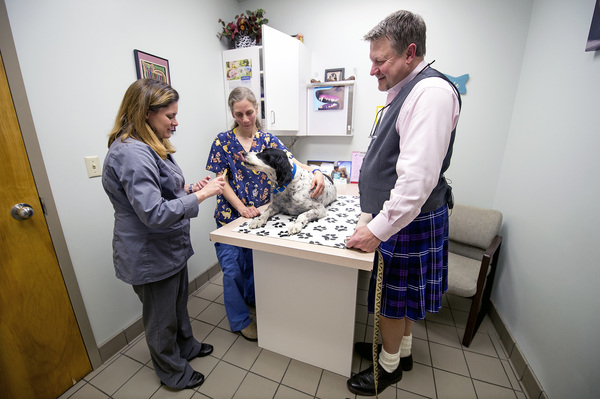
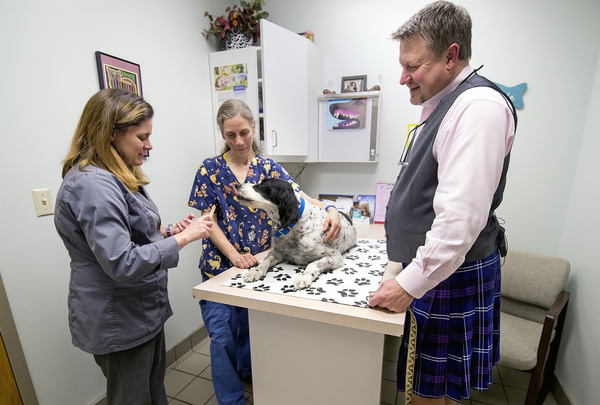
"I haven't worn a pair of pants since 2013," said Ken Babb, 51, a former executive engineer at IBM who is perhaps best known when he steps outside his home as the guy in the kilt.
Yet Babb, who wears the kilt often _ without the long socks _ is not of Scottish heritage.
He doesn't play the bagpipe.
Nor does the blue tartan he wears have any personal significance for the native of Hutchinson, Kan., other than that his father-in-law recommended it.
Frankly, if Babb had his druthers, he happily would give up his kilt forever for the trousers he once wore as a globe-trotting executive.
"I can't," Babb said.
The reason goes to a story of twisting fate and twisting pain that involves a trip to China and an almost 14-hour return flight with a crushed and swollen right leg.
Later would come the therapies, the opioid prescription, the addiction and recovery, as well as a slew of doctors including one, William Corporon, who in April 2014 was gunned down along with his grandson, Reat Underwood, as part of a hate crime outside the Jewish Community Center in Overland Park, Kan. Terri LaManno, an occupational therapist visiting her mother at the Village Shalom care center nearby, also was killed that day.
"When he was killed," Babb said of his doctor, "it was like losing a close ally."
In the end, Babb wears a kilt because of a chronic nerve condition known as complex regional pain syndrome. The tenderest touch of fabric against his lower right leg will ignite waves of dizzying pain.
Whether he's wearing a kilt or shorts, even the slightest breeze sparks pain. "The wind is my enemy always," he said. "Any moving air hurts."
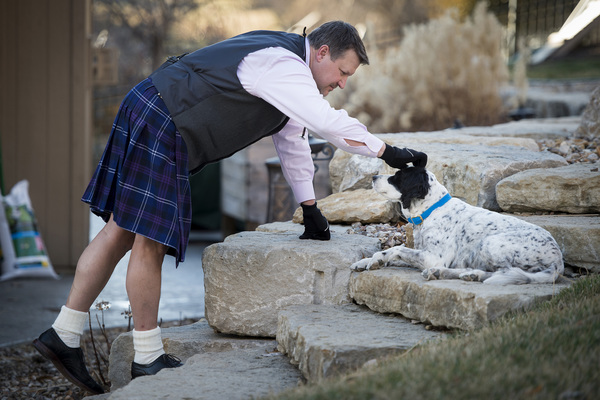
"Imagine," Babb said, "taking a nerve _ an open, exposed nerve _ and hitting it with a blowtorch. It is a deep, deep burning pain that you cannot get away from. And there is nothing you can do about it."
Long pants? Long socks? They are the equivalent of stabbing the front of his right leg with a flaming butcher's knife. It would hardly be appropriate to wear short pants in winter or to formal dinners or events, so he opted for the Scottish tartan.
"Last year," said Babb, who at 6-foot-4 was a southpaw pitcher in college, "I wore my kilt to (the president's suite at) NASCAR. You can't imagine how hard it is to walk into a NASCAR event when you're a big, burly guy wearing a kilt."
The condition has spread to his hands and can leave them extremely hot or cold, so Babb sometimes wears battery-heated gloves.
He agreed to share his story not merely to explain his kilt; he has been doing that with friends, neighbors and curious strangers for years. Instead, it is part of a stepped-up effort, led in Kansas City by the Center for Practical Bioethics, to bring attention to the treatment of chronic pain and to change what is viewed as the negative narrative of those who suffer.
The National Center for Complementary and Integrative Health, part of the National Institutes of Health, estimates that more than 25 million adults suffer chronic pain.
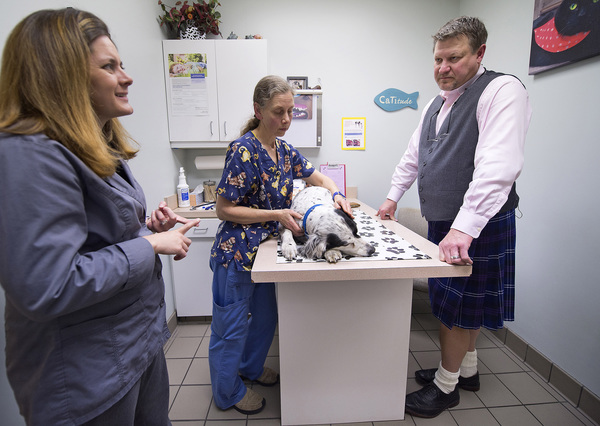
"People who live with chronic pain have been terribly stigmatized and stereotyped," said Myra Christopher, a former president of the center who is director of what is known as its PAINS Project. "The common perception is that they are weak in body or mind. Or that they are malingerers; they are faking to collect disability. Or, with the opioid epidemic, they have become seen as drug seekers, which they are not."
Christopher said the PAINS Project's goals include not only destigmatizing chronic pain sufferers and disassociating chronic pain from the opioid abuse epidemic, but also promoting approaches (beyond pain medications) to treat it.
"I'm talking about having clinics where people can go where they can get multidisciplinary care _ where they can get their medications, get physical therapy, get occupational therapy, they can get acupuncture," said physician Richard Payne, a neurologist and professor of medicine and divinity at Duke University who also holds a chair in ethics at the bioethics center.
"We don't have that now. There are organizations that call themselves pain clinics where either they mostly just dispense medications or they give people nerve blocks. It is not coordinated. It is not comprehensive."
Chronic pain, he said, should be classified not just as a symptom of other illnesses or injuries, but also as a distinct, chronic illness like diabetes that requires various treatments.
"No one would say that you treat diabetes with just insulin anymore," Payne said. "Insulin is part of a total management process _ (along with) changes in diet and activities and a whole range of things."
Chronic pain strategies beyond pain medications, he said, need to be treated in the same fashion and, likewise, covered by insurers; many are not.
Babb, the married father of a daughter and stepdaughter, is eager for others to understand the nuanced truth of chronic pain and, equally important, to know that there are strategies aside from addictive pain medications to help manage pain as opposed to control it.
"I don't use the word 'control' anymore," Babb said.