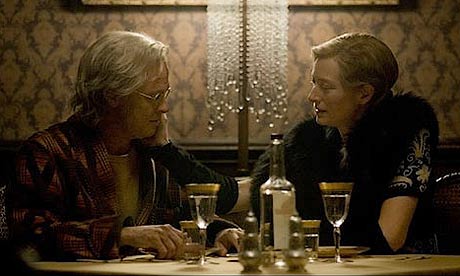
The critics are divided over David Fincher's epic romance. While some see it as an inventive piece of film-making offering much insight into the nature of death and ageing, others wonder whether The Curious Case of Benjamin Button says anything particular about anything much at all. Will this unusual combination of cutting edge techniques and old-fashioned, century-spanning storytelling be seen in years to come as one of 2009's most notable movies? Or is any pretence at greatness undermined by its twee premise and contrived air of antiquity?
Benjamin Button is the tale of a man who lives his life backwards. Born at the tale end of the great war in New Orleans, young Benjamin starts out life as a baby stricken with all the ailments of an 80-year-old man. He is not expected to live longer than a few months, but slowly begins to realise that he is growing younger every day, a condition which eventually allows him to start to enjoy some of the advantages of adult existence. He learns to drink, starts work on a boat, and tentatively begins liaisons with the opposite sex. His life starts to approach some semblance of normality, and yet the great love of his life, Daisy, who he first met when she was a young girl and he a wrinkly five-year-old, is ageing in the opposite direction.
"What an incredible shaggy-puppy of a movie, a cobweb-construction patched together with CGI, prosthetics, gibberish and warm tears," writes our own Peter Bradshaw in the midst of a one-star review. "And, at two hours and 40 minutes, it really does go on for an incredibly long time."
He adds: "The idea of Button getting younger and younger is not imbued with any great comic or tragic insight. Or any insight at all. He is not like Dracula or Dorian Gray. He is just bland-faced Benjamin Button, who eventually, in his youthful pomp, riding his motorcycle or sailing his yacht, has all the interest of a model in a Gap advert. Apart from his remarkable physical quirk, which never attracts any medical or media attention, Benjamin really is very boring indeed."
Roger Ebert of the Chicago Sun-Times is similarly scathing. While admitting that the cast is excellent and the film itself "well made", he complains: "Given the resources and talent here, quite a movie might have resulted," he writes. "But it's so hard to care about this story. There is no lesson to be learned. No catharsis is possible. "
Others disagree. "Nominated for 13 Oscars this year, it's a drama, rich in ironies both funny and bitter, about the inevitability and indignity of aging, as well as the gulf that exists between how old we feel and how old we actually are," writes The Telegraph's Sukhdev Sandhu. "It's also the anti-Slumdog Millionaire: a film that's stately, tasteful and genteelly melancholic rather than fevered, rollicking and euphoric. It's a film about time that seems almost out of time."
"Fincher and his team's technical achievement in integrating the digital make-up within a lush but grounded reality is considerable. The actors do interesting work with their characters at different points in their respective lives," writes Channel 4 Film's Matthew De Abaitua. "Around Brad Pitt's still, emotionally simple Benjamin, Cate Blanchett, Tilda Swinton and Taraji P Henson bring layered, inspiring, intriguing performances. [This is] an unusual conceit brilliantly executed. A moving work of golden fantasy poised just above the dark waters of our own mortality."
For me, Benjamin Button is the most obvious example of Oscar bait to hit cinemas in quite some time. The panoramic view of 20th century history, the hokumy New Orleans setting, the fable-like storyline; they're all the kind of hooks which less cynical (or more muggish?) reviewers have a habit of hanging words like "warm-hearted" and "life-affirming" upon. And yet this is also a brave undertaking: the technical achievement of morphing Pitt's head onto the bodies of three differently-sized, differently aged body actors, while retaining his ability to properly play the part cannot be underestimated. And performances are strong across the board, from Blanchett's firey Daisy to Henson's Queenie, the retirement home manager who takes Benjamin in after his father abandons him at birth. It's a hugely-engrossing spectacle, albeit one which sometimes seems a little insipid, given the grand scale of its ambition.
What did you think of The Curious Case of Benjamin Button? Did Fincher's film have you wishing you could live your own life backwards, if only for the two hours necessary to wipe it from your memory, or do you suspect Button will eventually find a place in the pantheon of great films from the early 21st century?