Get all your news in one place.
100’s of premium titles.
One app.
Start reading
Reuters
Reuters
Entertainment
Darren Whiteside

'You look so beautiful!': Indonesians celebrate the dead in ancient ritual

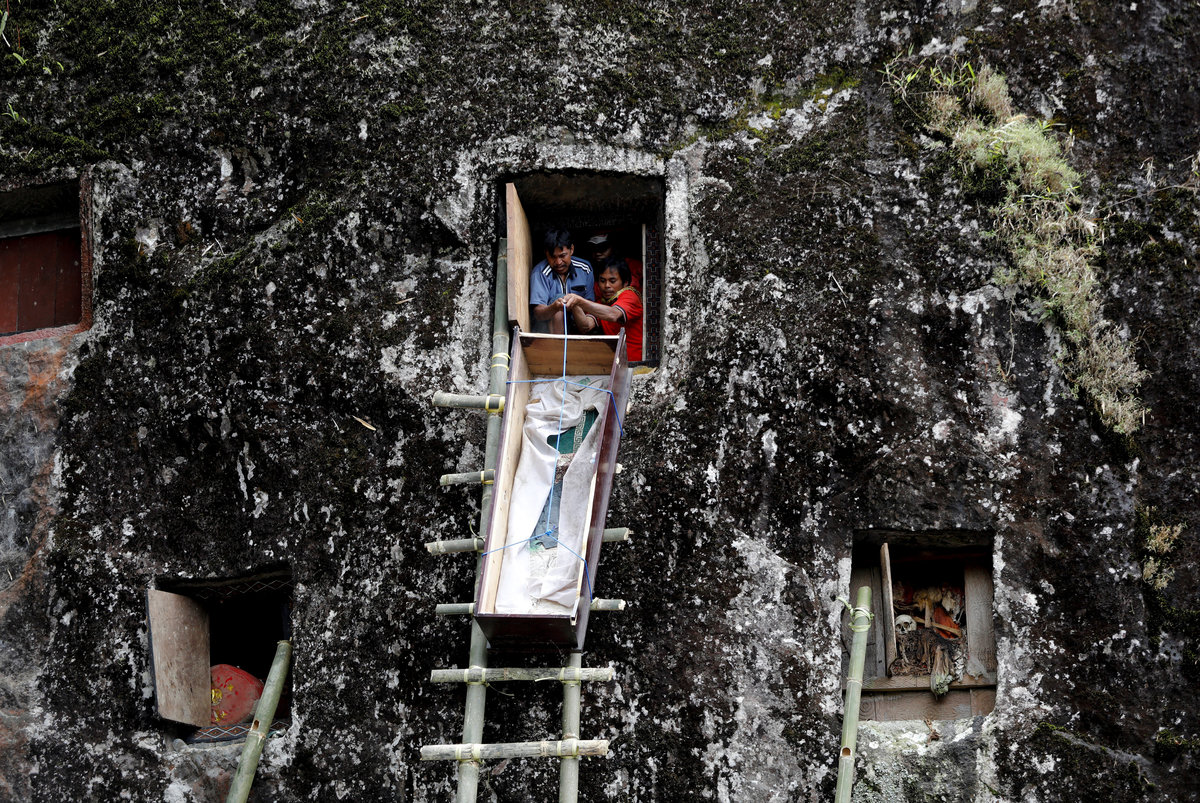
Men lower part of a coffin down from a burial chamber cut into a massive boulder of Loko'mata, a traditional Toraja burial site, during an ancient Torajan ritual known as "Ma'nene", near Rantepao, North Toraja, South Sulawesi, Indonesia, September 14, 2017. REUTERS/Darren Whiteside

TORAJA, Indonesia (Reuters) - Yosefina Tumanan, a resident of the remote Toraja region of Indonesia's island of Sulawesi, was thrilled to see her sister-in-law.

"You look so beautiful!" Tumanan told the skeletal remains of her relative who has been dead for six years.

Men use bamboo ladders to open doors to burial chambers cut into a massive boulder of Loko'mata, a traditional Toraja burial site, during an ancient Torajan ritual known as "Ma'nene", near Rantepao, North Toraja, South Sulawesi, Indonesia September 11, 2017. REUTERS/Darren Whiteside

The scene is part of an ancient Torajan ritual known as "Ma'nene", in which clans visit the tombs of deceased family members, clean their remains and replenish the coffins with personal belongings.

"Even though she's not here physically, we still have a connection," Tumanan told Reuters as several families gathered at Loko'mata, a massive boulder in a misty, rice-terraced valley that houses the remains of dozens of people.  

"It's a chance for the whole family to visit and express our love," she said, adding that the ritual was like a family reunion every few years.

Traditional Toraja houses are seen in a forest near Rantepao, North Toraja, South Sulawesi, Indonesia, September 13, 2017. REUTERS/Darren Whiteside

The people of Tana Toraja, or "the land of Toraja", are mostly Christian, but adhere to old traditions whose roots trace back to animistic beliefs.

This is common in Indonesia, a predominantly Muslim country of 250 million people that is also home to minority groups which espouse Hinduism, Buddhism, and traditional beliefs.

Unlike some other cultures, death is barely a parting for those in Toraja.

A man stands next to a burial chamber containing the bodies of his relatives at Loko'mata, a traditional Toraja burial site, during an ancient Torajan ritual known as "Ma'nene", near Rantepao, NorthToraja, South Sulawesi, Indonesia, September 12, 2017. REUTERS/Darren Whiteside

The deceased are mummified and housed in ornate, colorful coffins and spend several months or even years in their own homes before receiving a funeral and burial.

Relatives talk to the deceased, offer them food and drink, and involve them in family gatherings, as if they are still alive.

Once sufficient family members can attend and money is available to pay for sacrificial buffaloes and pigs, a funeral ceremony, known as 'Rambu Solo', is held, with the whole village usually invited to a feast celebrating communal ties. 

Men remove a coffin from a burial chamber cut into a massive boulder of Loko'mata, a traditional Toraja burial site, during an ancient Torajan ritual known as "Ma'nene", near Rantepao, North Toraja, South Sulawesi, Indonesia, September 11, 2017. REUTERS/Darren Whiteside

Family members shed tears for their dead as the coffin is carried in a chaotic funeral procession to the burial site.  

The coffins - painted in bright reds and ochres - are stuffed with clothes and personal effects and placed in narrow tombs carved into monolithic rocks that pepper the mountainous region.

The boulders can be as high as a three-storey building and each tomb can take between three to six months to carve.

A village elder distributes freshly slaughtered pork for friends and relatives during a funeral ceremony, known as 'Rambu Solo', for a deceased man from the village near Rantepao, North Toraja, South Sulawesi, Indonesia, September 12, 2017. REUTERS/Darren Whiteside

Keeping the tradition alive for future generations is an important responsibility, said Renolt Patrian, a 21-year-old studying to be a mining engineer.

"When I have a job and earn money, I will not give up the tradition," he said after visiting his great-grandmother who died last month in the family home.

Villagers and family carry the body of Ne' Ponno, an elderly woman who died more than a year ago, during a funeral ceremony, known as 'Rambu Solo', to the deceased's final resting place in a tomb cut out of a large rock in Batu Busa, North Toraja, South Sulawesi, Indonesia, September 13, 2017. REUTERS/Darren Whiteside

(Writing by Kanupriya Kapoor; Editing by Clarence Fernandez)

Relatives grieve at the coffin containing the body of an elderly woman, Ne' Ponno, who died more than a year ago, during a funeral ceremony, known as 'Rambu Solo', in Batu Busa, North Toraja, South Sulawesi, Indonesia, September 13, 2017. REUTERS/Darren Whiteside
A visitor sits outside a burial chamber cut into a massive boulder of Loko'mata, a traditional Toraja burial site, during an ancient Torajan ritual known as "Ma'nene", near Rantepao, North Toraja, South Sulawesi, Indonesia, September 11, 2017. REUTERS/Darren Whiteside
Sign up to read this article
Read news from 100’s of titles, curated specifically for you.
Already a member? Sign in here
Related Stories
Top stories on inkl right now
One subscription that gives you access to news from hundreds of sites
Already a member? Sign in here
Our Picks
Fourteen days free
Download the app
One app. One membership.
100+ trusted global sources.