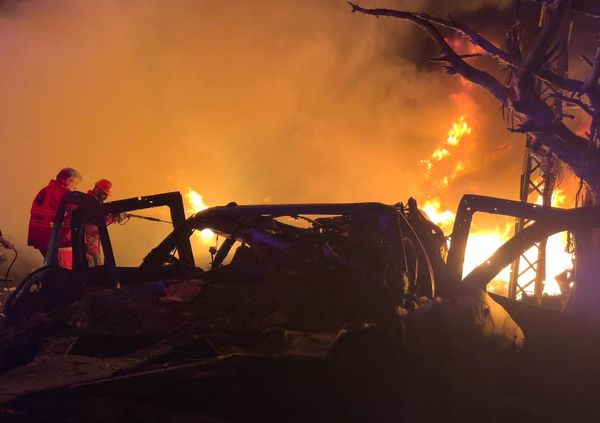
Student paramedics are helping save the lives of a family rescued by firefighters from a blazing house only a few minutes’ drive from their university campus.
They give immediate medical care to two young children and their parents, who are badly injured, on the pavement outside their burning home, before riding with them in the back of an ambulance to hospital.
But the drama unfolding in front of them is not real life. Instead, it’s a simulated training exercise designed to bring home the real adrenaline-fuelled challenges of working on the NHS frontline.
“These students may never get a call to a house fire in their whole career, or it could be the first call they get once qualified,” explains Emily Browne, senior lecturer in patient safety and simulation at Staffordshire University.
“As much as we can talk to students in the classroom about how it will be, it’s not the same as actually being handed a baby out of a burning building by a firefighter – you can’t explain that. It’s all about how you act in that moment and the reality of working under pressure.”
For many paramedic students the simulated event, run in conjunction with local trainee firefighters at their station training centre in Stafford, will be the first opportunity they have of being in control of an emergency response.

“Typically on a practice placement a student paramedic will be the third person in the ambulance,” explains Browne. “They can end up being an observer, as it’s a challenging environment and the qualified paramedics are there to get the job done.”
In any staged event, Staffordshire University recruits volunteer clinical staff from local trusts to play themselves rather than rely on professional actors, in order to add authenticity. Sometimes volunteers from the local army reserves are brought in to play patients while the university will also use state-of-the art mannequins – which have the technology to talk – when necessary.
Simulated training experiences – covering routine house calls to major critical events – are offered to all undergraduate paramedics, nurses, midwives and operating department practitioners throughout their degree at Staffordshire University.
Sam Clark-Smith, who is due to qualify as a nurse in 2020, took part in a mock event earlier this year. The exercise was designed to follow the patient journey from an emergency house call attended by student paramedics to hospital, where care was picked up by student nurses in an emergency department or medical ward.
He says the final-year experience has boosted his confidence of working in the real world. “The biggest challenge is being thrown into the situation but it’s obviously the biggest benefit, because that is how it would be in practice,” he says. “You aren’t going to know what’s coming and you have to think on your feet.”
Newly qualified paramedic, May Malcolm, who also took part in the event before she graduated, says it helped her “think for myself”.
The benefits to students before they join the NHS frontline are multiple, according to Browne: “I think this way of training gives them confidence,” she says. “But what it also does is make them think about areas that they need to work on. You don’t get that in a classroom lecture or on placement.”
Staffordshire University now plans to break new ground by offering students on its professional social work and health and care degrees the same exposure to simulated events. A mock home visit and taking a phone call from a provocative service user are already in the planning pipeline.
The move is all part of Staffordshire University’s ambition to become a centre of excellence for professional health and social care simulated training and research, putting patient safety at the heart of the student experience.
Each of its three campuses already has its own simulated training suite alongside skills labs – a hybrid between a classroom and a real-life clinical space such as a ward.
A new simulated training centre on its Stafford campus is due to open in the summer of 2021.

And this summer the university unveiled the first of a possible three immersive simulation suites. A scene can be projected onto the suite’s walls, and sounds and smells can be added to make the experience more life-like. The idea is to deliver world-class learning opportunities by providing immersive environments for students.
Images available include a range of home and public environments, including a police custody suite, a wood and a beach. The university can add its own material and is currently in discussion with the RAF to use its training footage of a plane crash.
Browne, a former member of the RAF reserves, who served as a nurse in Afghanistan, is almost evangelical about the potential of simulated training, routinely used in the military, to boost patient safety in the NHS.
“I think the reason I am a good nurse has a lot to do with my military training,” she says. “In the military, simulated practice is there [to help prepare you] before you go into the field. This approach helps you to deliver the best possible care, whether you’re in an aircraft, an ambulance or a field hospital under fire.
“It’s the same with medical training – it gives you an arsenal of ability to deal with whatever is thrown at you. And I want to bring that into the way that we educate our students in health and social care.”