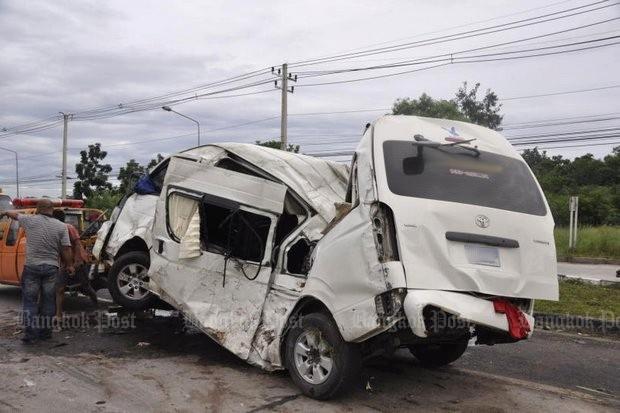
The numbers never lie; the state's efforts to tackle road fatalities have paid off. According to the Road Safety Group Thailand, the country's ranking improved from No.2 in the world, with 36.2 traffic-related deaths per 100,000 people, to No.9, with the deaths being reduced to 34:100,000.
Yes, it's better but not good enough.
The agency, which released its report this month, said Thailand still tops the motorcycle deaths category. It also pointed out that most of those who lost their lives in this category are youngsters and working people. Motorcycle crashes leave 6,000-7,000 people disabled each year, it said.

Ploenpote Atthakor is editorial pages editor, Bangkok Post.
As the festive New Year season with long holidays now just days away, we have started to pray while state authorities have begun rolling up their sleeves and putting in place extra traffic measures to boost safety.
But the road to safety in Thailand is a long one given the lack of a safety-oriented culture.
I say this because some motorists are allowed to play the traffic roulette game. Take, for example, the reckless motorist who illegally cruised down the expressway hard shoulder and rammed into a stalled car in September. A woman standing next to the vehicle was hit, plunged from the elevated highway and was pronounced dead on the spot.
This month, a similar crash took place, with two deaths, though the driver, a 72-year-old car owner, disputed the media report, denying she intentionally used the hard shoulder and caused the fatal crash. Instead, Surang Supornsuk blamed it on a sudden illness. The claim has yet to be proven.
Driving on hard shoulders is not allowed here, so why do some motorists still take the liberty of breaking the law? How many get off scot-free when they and others are lucky enough that no crashes have taken place?
In European countries, those driving on hard shoulders face harsh penalties. Their drivers are also disciplined enough not to break the law. In the Netherlands, passengers of broken-down vehicles are required to stay in the vehicle for their own safety. This is not the rule here.
Closer to home, Japan is one of the countries in Asia with low traffic fatalities.
When I was in Tokyo in 2017, I knew right away why the city -- or the country -- has lower traffic-related accidents and fatalities. It's all about the culture of safety that prompts everyone concerned to react properly to traffic-related incidents.
One afternoon, as my vehicle was on the Tokyo highway, there was a spot where transport officials were repairing the surface.
Japanese authorities were considerate enough, or perhaps required by law, to put up a tall warning sign, with a revolving light that allowed motorists to know beforehand that the repair work lay ahead of them.
The sign could be seen many metres before the spot and this was enough to prevent a crash as all drivers could see the situation. Well, I should also perhaps mention the good driving etiquette of Japanese motorists.
In Thailand, we would be delighted if transport authorities and traffic police posted any kind of useful warnings when road repairs are under way, or if there is a broken-down vehicle.
It's normal for a driver to put a tree branch half a metre or so behind his or her broken-down vehicle. This is not very helpful as other motorists see the branch only when they get too close.
Even if the authorities try to be considerate and place orange cones on the roads, it turns out that most cones are in a sorry state anyway. The cones' colours are so faded that we hardly notice them.
And the authorities do not care much about prevention as they just place the cones at the trouble spots, not metres away so motorists can prepare for the situation, relying on the skill of drivers to survive on the road.
Besides this, there are many confusing traffic signs and bad road designs that make roads unsafe.
Such warning signs like the ones on Japanese highways and stiffer law enforcement against reckless drivers might prevent crashes and save lives here.
For Ms Surang, she may have suddenly fallen ill as claimed. In that case, it's high time the Land Transport Department considers harsher regulations regarding driving licences for aged motorists. Perhaps a medical check-up as a prerequisite for licence renewal should be made on an annual basis?
Road safety is about discipline on the part of the motorists and law enforcement on the part of the authorities. We cannot depend on luck.