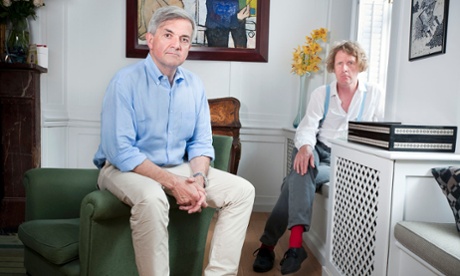
Last Wednesday, on Channel 4’s Who Are You? programme, Chris Huhne, former government minister and ex-offender, appeared on the nation’s television screens in a new role: artist’s model. Grayson Perry – potter, husband, dad, transvestite with a preference for rouged cheeks, hacked bob and baby-doll frilly frocks – was tackling the issue of identity. He operated with humour, understanding and compassion as “part psychologist, part detective”; to question 14 individuals and capture something of each of them for an exhibition now running at the National Portrait Gallery in London. “One single image is all you get,” he explained. “If you get it right, it tells you something.” He was so right.
Huhne, described by Perry earlier this month in an article for the New Statesman as typical “default man”: 60, Westminster, PPE Magdalen, self-destructively heterosexual”, displayed little insight into his compulsion to lie, his fall from grace and his experience of jail. Perry, exasperated, finally said: “Turn off the politician and try to be vulnerable for a second.”
For “default men”: white, male and middle class, who believe that their world is the norm, and all else is “other”, that is an impossible task. Self-deception is the medication for the traditional male; Huhne, in his own eyes is, therefore, invincible. But Perry was gloriously on his case.
He was on a personal mission to show that the weirdness of gender, the impositions of conditioning and what it does to the psyche, isn’t just for the girls; it’s troubling men too, even if some don’t know it. It’s not a new area, but it’s lacked a male champion with Perry’s populist tendencies, his sense of ease with all sides of himself, and the obvious evidence that he is a family man. What’s more, what Perry sees in others he captures in his art, even if some are still too blind to see it.
At the turn of the 20th century, the eminent American neurologist Charles L Dana declared with great professional authority that the female spinal cord was a little on the light side for politics. He also predicted that if women, with their “unstable precocity”, persisted in their intention of breaking out of the gilded cage of “natural” femininity, to “achieve the feministic ideal of living as men do”, they would “incur the risk of 25% more insanity than they have now”. The message had force: to want something different was to give up the essence of being a “normal” woman and become mad, bad and sad.
In 1970, in The Female Eunuch, the redoubtable Germaine Greer chucked out all such gender tosh, excoriating women for lacking a sense of vigilance in understanding what was being done to them and in which they were heavily complicit (echoes of today?). She challenged them to shape up to a different kind of future, one that was definitely not to every woman’s taste. Perry is her modern-day male compatriot.
Seeing the iron bars of conditioning, never mind rattling the cage, doesn’t come easy, especially when it appears to require nothing but loss. Men in the developed world have been stripped of their role as cannon fodder in war, breadwinner and sole rulers of the heavy industries and white-collar middle management. They have been told that the battle between the sexes can achieve a truce only if they give up even more and forfeit power and control, because everything that’s masculine is dangerous and damaging. A vacant lot exists when it comes to what’s positive about male change.
In Feminism and Men, Nikki van der Gaag makes the case for a different, more affirmative approach, drawing on international research.
She quotes Todd Minerson from the White Ribbon campaign, a group run by men dedicated to ending violence against women, who says: “When you’re from the dominant group, you don’t have the history of struggle and analysis that comes from the non-dominant group’s perspective.”
But analysis gets you where, precisely? In Wednesday’s programme, in addition to Huhne, Perry talked to Celebrity Big Brother winner, model and singer Rylan Clark, who said, poignantly: “I don’t think I’ll ever be happy. It’s all fake.”
Another of Perry’s interviewees was “Jazz”, aged 24, now called Alexander, who was transitioning from female to male. In an extraordinarily moving scene, he talked to a class in his former school.
One teenager raised the issue of conformity and becoming girly with cosmetics and false nails. “If everyone else is doing it, you succumb to pressure.” A boy said he hadn’t had sex and he didn’t want to yet. “I don’t need to have sex to prove I’m a man.” Nobody sniggered.
Perry, otherwise loud celebrity male, listened quietly. It was as if an awareness of how gender and conditioning undermine a genuine sense of identity, causing enormous pain and dislocation in the process, was taking place among the young people as we watched.
In a now famous 2008 essay, Men Explain Things to Me, Rebecca Solnit refers to (some) men who wrongly assume they know things and wrongly assume women don’t and why women allow themselves to be silenced. Perry isn’t a “new man” in his capacity to know when to shut up. What he understands is that being a man today – or a woman – is organic, not fixed, an ongoing fragile building of identity, ever more difficult in the onslaught from the commercial market. Perhaps such insight comes from his experience as a working-class boy, who liked to wear girls’ clothes and still hold on to his sanity and his “maleness”.
Perry, in last week’s film, turned the sketch of Chris Huhne into a large vase. On it were identical repeating patterns (“symbolising vanity”) of a penis, Huhne’s customised number plate and his face. Perry had smashed it with a hammer but, unlike Humpty Dumpty after his great fall, the fragments had been stuck together again.
Huhne was filmed viewing for the first time this artistic symbol of his masculine identity as interpreted by Perry. Without irony, he loved it. He showed little interest in the meaning of the golden cracks.