Hello and welcome to another edition of Free Agent! Be careful where you jump a fence this week, or you might face federal charges.
So a country with a bad government is in the World Cup. Should you root for them, stay away, or maybe it's not that simple? We'll dive into the situation with Iran's men's soccer team, then move on to what might be the worst new thing about this World Cup (not hydration breaks, sorry!), and close with five thoughts about golf's U.S. Open.
Locker Room Links
- Congratulations to Giannis Antetokounmpo on going from Wisconsin's 7.65 percent income tax rate (10th-worst in the nation!) to Florida's 0.0 percent. This is going to save him at least $4 million a year.
- The PGA Tour has announced a major shake-up to its schedule and format .
- The caddies at Pebble Beach voted to unionize —possibly because their employer moved them from contractor status to full-time employees. "It is believed that this is the first time that elite caddies at a major golf destination have voted to unionize."
- After (wisely!) rejecting a big subsidy for the Chicago Bears, Mayor Brandon Johnson wants to spend a $425 million subsidy on infrastructure for the Chicago Fire's stadium.
- NASCAR's race weekend on Naval Base Coronado in San Diego involved " no federal spending ," according to documents seen by The Athletic thanks to a FOIA request. The Navy got to keep all the money from alcohol sales.
- The MLB proposed a draft overhaul that would raise the age floor (two years past high school graduation for American players), shorten the draft, create a separate international draft, and make picks tradeable. The players union was not happy about it . College baseball fans should be! For better or for worse, I also think a higher age floor will make the draft a more effective way to rebuild.
- The Protect College Sports Act, which I covered before here , passed a Senate committee vote and could get a full Senate vote soon . The bill now restricts the Big 12 and ACC from conference expansion (the bill originally intended this only for the Big 10 and SEC). It also tries to close a loophole that may have unintentionally allowed for a super league. The NFL and NBA players unions , and the NFL itself, support the bill. The SEC and Big 10 are still opposed. Sen. Tommy Tuberville (R–Auburn), a former college football coach, suddenly withdrew his support .
- Elsewhere in Reason , the sports takeover continues. On the Giants Pride Night controversy, we have " Major League Baseball Teams Have the Right To Offer Pride Uniforms. Should They? " by Billy Binion ( update here ). On the World Cup, we have " England Fans Warned Not To Chant 'Keir Starmer's a Wanker' at World Cup ," by our favorite English/Moroccan/Egyptian staffer, Reem Ibrahim.
-
This is why no one outside of New York was rooting for the Knicks.
The Knicks overcame the odds and won the NBA championship.
We can also overcome the odds, beat the oligarchs and create an economy that works for all, not just the few. https://t.co/BrIly7rb9r
— Bernie Sanders (@BernieSanders) June 18, 2026
The Case for Rooting for Iran
If you love freedom, you wouldn't root for the North Korean soccer team to win the World Cup, would you? (Perhaps you'd root for them to at least qualify, so a few players could courageously defect.) You wouldn't root for the Soviet Union to win at Lake Placid in 1980. You'd probably never root for China, even if they paid you millions of dollars to do it.
So why should you root for Iran to succeed in a World Cup on U.S. soil?
It's a nasty regime, after all. Dissent is brutally and murderously repressed. Rights are hard to come by. Even simple daily freedoms—like, say, going to a soccer match as a woman—are heavily restricted. The regime and sports in Iran are deeply intertwined. "In the Islamic Republic, sports are too serious to be left to the athletes," as Kambiz Foroohar wrote for the Middle East Institute in 2021. "Over the past two decades, most sports clubs and related bodies have been taken over by political or security-military organizations, with former Revolutionary Guards holding the top positions."
In theory, Iranian victories at the World Cup are a vindication of the regime. But somehow they have an opposite effect: Major victories by the men's soccer team have often been the spark of anti-regime demonstrations.
When the men's team qualified for the 1998 World Cup, thousands of young women went to the main stadium in Tehran to celebrate, even though the media called on them to stay home. Soon after, Iran won a World Cup match for the first time—against the United States. The New York Times' report on the celebrations mentions some anti-American sentiment, but plenty of exuberance that surely went beyond what the religiously conservative regime would have appreciated: "The young woman flung her head scarf off and hung out the window of the blue Volkswagen, her long red hair flying wild in the wind….A man and a woman sat halfway out of their car windows and swayed to the American rock music that blared from their car."
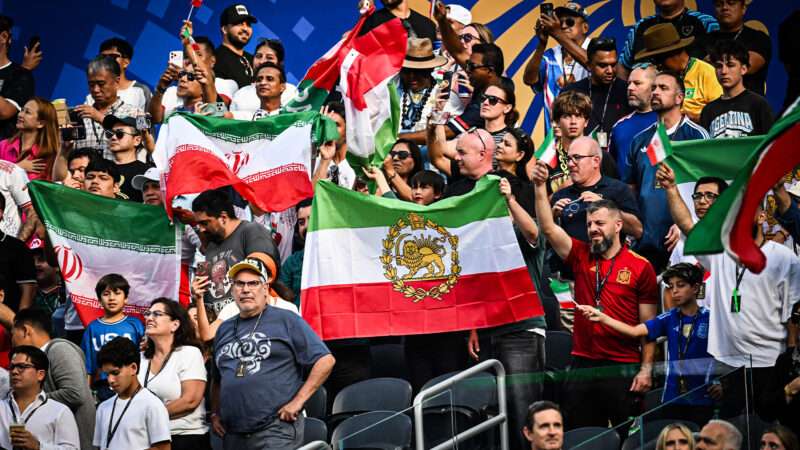
This "support the team, not the regime" sentiment was on full display at Iran's first World Cup match on June 15, against New Zealand. The stadium in Los Angeles was overwhelmingly full of local Iranian supporters—who booed the regime's national anthem, snuck the prerevolutionary Iranian flag past security, and steadfastly supported the team that technically represents the regime anyway (because of travel restrictions, it's not like current Iranian residents were making the trip). The match was an exciting 2–2 draw.
My friend, the freelance journalist Natalie Fertig, was at the match and said the Iranian fans largely separated their support for the team from their negative view of the Iranian regime. She saw several flags that even blended together the American stars and stripes with the prerevolutionary Iran flag, and one "Make Iran Great Again" hat. The non-Iranians in attendance, whether American or European, generally seemed supportive of the Iranian team too. (A scuffle broke out in her section toward the end of the game over a flag, though it was unclear to her which flag and who felt aggrieved by it.)
Overall, she described a family atmosphere. Iranian-Americans brought their kids, greeted each other, and were proud to support the soccer team representing the country of their heritage, even if they don't support those in government power (something even some Americans need to learn). "A lot of people want an excuse to love their country, even if they don't agree with everything that its government does," Natalie tells me. "That was really the sense that I got from the Iranian fans that I was around, was that they were so excited for this moment to support their identity and their culture, even if they were going to take the moment during the anthem to show opposition to the current government."
So even if Iran makes it out of their group, or even wins a knockout game or two, don't expect it to be used by the regime to tighten their tenuous stranglehold on the country. Iranians, at home and abroad, don't seem to view the team as an extension of their government. The World Cup is a place for the team and their global fans to represent Iran (much like regular Americans should be the "face of America," not whoever is president).
"That's the World Cup, right? It's people finding ways to separate what governments do from who people are," Natalie says. "And that oftentimes, people no matter where they live, want the same things out of life."
As it turns out, people can have nuanced opinions on the Iran regime, the Iran soccer team, and the Iran war all at the same time. Maybe America's geopolitical enemies don't always have to be our sporting enemies, too.
The Worst Rule at the World Cup?
It's great that FIFA is trying to crack down on racist abuse against players, whether it's coming from the stands or from the other team. But this rule is giving me major "if you're not doing anything wrong, you have nothing to worry about!" vibes.
HISTORIC SENDING-OFF 🟥
Paraguay's Miguel Almirón becomes the first player at the 2026 World Cup given a red card under the new rules barring players from covering their mouths to conceal discriminatory behavior. pic.twitter.com/mE4PnzZ3oe
— Men in Blazers (@MenInBlazers) June 20, 2026
The theory, I guess, is that if players are about to say something racist or insulting, they'll cover their mouths so that the lipreaders in the peanut gallery can't turn them in. But banning mouth-covering is a bit like banning guns or banning VPNs—it assumes there are no legitimate uses and anyone who wants to use this or do that must have nefarious reasons for it.
But in the sporting context, as any (American) football coach can tell you, there are very important reasons to cover your mouth when speaking in the middle of a game. The rule does specify that it's supposed to involve "a confrontational situation with an opponent," but it still seems likely that an overzealous referee might punish a player for an innocent action or inoffensive language.
If someone facepalms or wipes their face while talking to an opponent, is that deserving of a red? We'll find out!
Especially since covering your mouth doesn't affect gameplay, the punishment being a straight red card (thus kicking the player out of the game and his team can't replace him) instead of a yellow card seems harsh. If a player says something racist, give them a red card—but don't kick them out for something that maybe, you're not sure, could have been done to conceal saying something racist.
That said, I'm sorry that I can't get worked up about the hydration breaks that soccer purists are mad about. Maybe I'm just used to commercial breaks as an American, or used to seeing Arsenal use an injury break to take a drink and get some coaching. The breaks seem to change up momentum a little bit, and I'm fine with that. If you were FOX, you'd gladly use them to make $250 million (or more) too.
The Worst Golfer, Par None
Since I invested a lot of time and energy into consuming U.S. Open content this week, here are some quick thoughts:
- I really do not like Wyndham Clark. There are a lot of golfers I like, there are some I'm ambivalent about, and some I don't care for. I don't think I hate any of them, but Clark comes close. Even the LIV Golf defectors have (mostly) only given me one reason to not like them, and I at least understand why they defected. Clark has given me several reasons to not like him.
- Thankfully, sports are better when there's a villain to root against, and golf is desperately in need of one as the power of the LIV Golf defectors fades away.
- I'd still rather live in the universe where this putt on the 18th hole drops and we get to see a playoff instead. Putting is based more on randomness and luck than you'd think!
- The U.S. Open is run by the United States Golf Association, who governs golf for pretty much everyone in the country who isn't a professional player—your weekend hackers, your regular Joes, and even your played-in-college-but-not-Tour-material players. (It does decide rules of play and equipment standards for professionals, too). As such, I think they should only have the U.S. Open at public courses that everyone has access to (everyone who can afford them, anyway). They don't have to be municipal courses (like Bethpage), but this would still include many iconic courses like Pebble Beach, Pinehurst, Torrey Pines, etc. Leave the fancy, exclusive country club courses for the PGA Championship. The point of the U.S. Open's site selection should be "You could play here too!"
-
I'm not related to Miles Russell, but I'd like to be. This is
awesome stuff
.
🥹
Miles Russell's father, Joe, took over as caddie for his son's final walk up 18.
What a Father's Day gift! pic.twitter.com/7tfHKSrjyx
— U.S. Open (@usopengolf) June 21, 2026
Replay of the Week
The best soccer teams always know how to utilize the sport's most secret weapon: the own goal.
1-0! GOOOOAL FOR USA! 🇺🇸
Flo Balogun charges in and the @USMNT finds the back of the net on the own goal pic.twitter.com/GdivDaeNt9
— FOX Sports (@FOXSports) June 19, 2026
That's all for this week. Enjoy watching the real event of the weekend, pickleball's 2026 APP Vlasic Classic Cincinnati (we need more pickle sponsorships in sports).
The post You Can Root for Iran at the World Cup Without Rooting for the Iranian Regime appeared first on Reason.com.