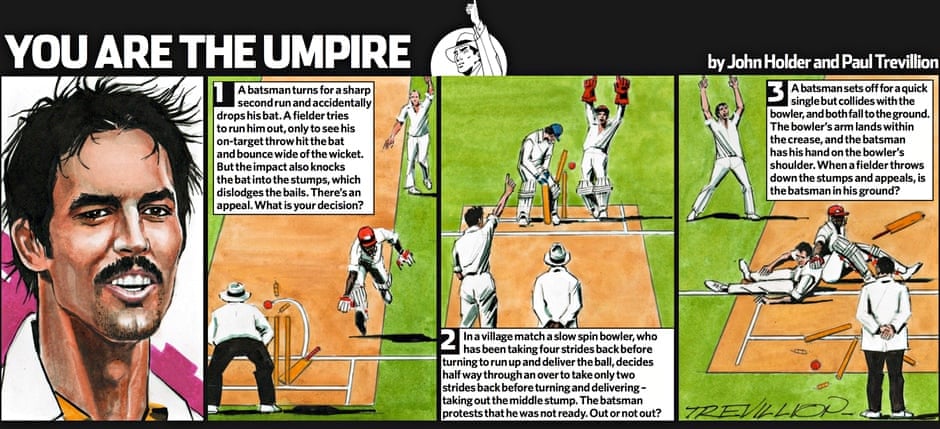
Click to enlarge, and debate the strip below the line.
John Holder's verdict
1) Not out. He cannot be run out like this – the wicket has to be broken by the ball having been thrown, or by the hand or arm holding the ball. And for hit-wicket, it must be put down by the striker in the act of playing a stroke, avoiding being hit by a delivery, or setting off for a run. Thanks to Peter Grant.
2) In this situation the batsman should not attempt to play the ball, and should pull away – at which point you can call and signal dead ball. There is no dismissal here – it's a clear case of gamesmanship by the bowler and is unfair. Yes, the striker should always be ready when the bowler is about to deliver, but this is clearly a deliberate ploy to catch him unawares. Warn the bowler's captain that this unfair play will be reported. Lewis Stowe wins the shirt.
3) The batsman is run out on appeal. No part of his bat or person was grounded behind the popping crease when the wicket was thrown down. There are no other issues to deal with here: the collision between him and the bowler was accidental, and the bowler did not deliberately fall under the batsman. If it had been clear that either striker or bowler had been injured in the collision, though, you would call and signal dead ball to prevent any further development, such as runs, wickets or controversy. Thanks to Alex Durie.
Competition: win a T-shirt of your choice

For a chance to win a sporting T-shirt of your choice from the Guardian range send us your questions for You are the Umpire to you.are.the.umpire@observer.co.uk. The best scenario used in each new strip wins a T-shirt; Terms apply. For more on You are the Ref's history, click here.