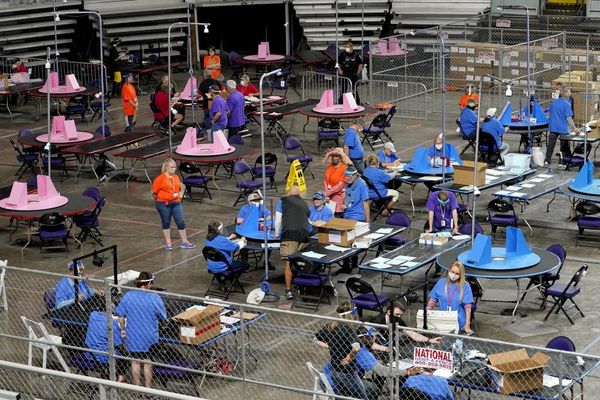
Yorkshire demolished Kent 11-5 with the loss of only one game last weekend as the northern county, who beat Middlesex 11.5-4.5 a year ago, continued their recent domination of the English counties championship.
The team has a solid pool of seasoned club experts rated in the 200s and 190s but its spearhead is a talented student group from the University of York, led by James Adair, aged 20 and with two grandmaster norms, who won smoothly on top board as he emerged with extra pawns in a rook endgame.
Only a few counties can realistically hope to be champions. Yorkshire and Lancashire have frightened away the opposition in the north, so that their head-to-head match – noted for its poor playing conditions – decides little as both teams qualify for the national quarter-finals. The real battle is in the south where Essex, Kent, Middlesex and Surrey are all contenders so that the outcome changes from year to year. Middlesex are strongest on paper but many of their stars avoid county chess. Surrey do well by placing juniors, including England’s best girl player Akshaya Kalaiyalahan, 14, on high boards while Essex and Kent have highly efficient organisers who have built strength in depth. The inter-county events included graded championships for weaker players, and Kent teams reached the under-140, 120 and 100 finals as well as the open.
Could the inter-county championships be improved? Of course. The artificial northern duopoly could be challenged and made more competitive if Manchester was allowed, as it wishes, to switch from the Midlands. That this does not happen is down to an ancient feud dating back 40 years to when Greater Manchester, as it was, split from Lancashire.
Below, Adair’s strategy homed in on his opponent’s unambitious opening followed by the dubious 12 Qd4? (exposed queen) and 16 a4? (pawn weakness). White was already worse when 23 Qc3? (Kg2 is necessary) set up the tactic 24…Nfxe4! leading to a won endgame for Black.
Andrew Mayhew v James Adair
1 d4 Nf6 2 Nc3 d5 3 Bf4 e6 4 e3 Bb4 5 Bd3 c5 6 dxc5 Nbd7 7 Nf3 Nxc5 8 0-0 Bxc3 9 bxc3 h6 10 c4 0-0 11 Be2 b6 12 Qd4? Ba6 13 Rfd1 Qe7 14 Ne5 Rac8 15 Bf3 Bb7 16 a4? Rfd8 17 Qb2 dxc4 18 Nxc4 Bxf3 19 Rxd8+ Qxd8 20 gxf3 Qd5 21 Nd6 Rd8 22 e4 Qh5 23 Qc3? Qg6+ 24 Kh1 Nfxe4! 25 fxe4 Nxe4 26 Qxd4 Nxd6 27 Bxd6 e5 28 Qxe5 Qxd6 29 Qxd6 Rxd6 30 Kg2 Rc6 31 Rd1 g6 32 Rd7 a5 33 Rb7 Rxc2 34 Rxb6 Rc4 35 Kg3 Rxa4 36 h4 Rb4 37 Ra6 Rb5 38 f3 Rf5 39 Kg4 h5+ 40 Kg3 Kf8 41 Ra7 Ke8 0-1
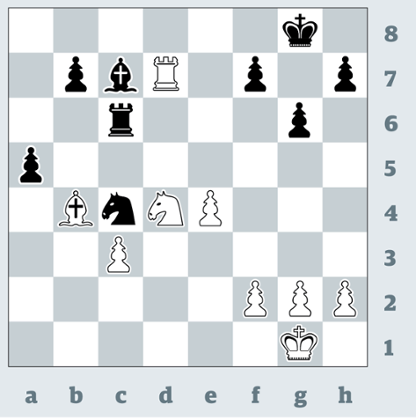
3398 1…axb4! 2 Nxc6 b3! 3 Rxc7 Nd6! and White resigned as the pawn queens. No better were 3 Nb4 b2 4 Rd1 Nd2! or 3 Na7 b2 4 Rd1 Bf4! 5 Rb1 Bc1 and Nd2 wins the rook.