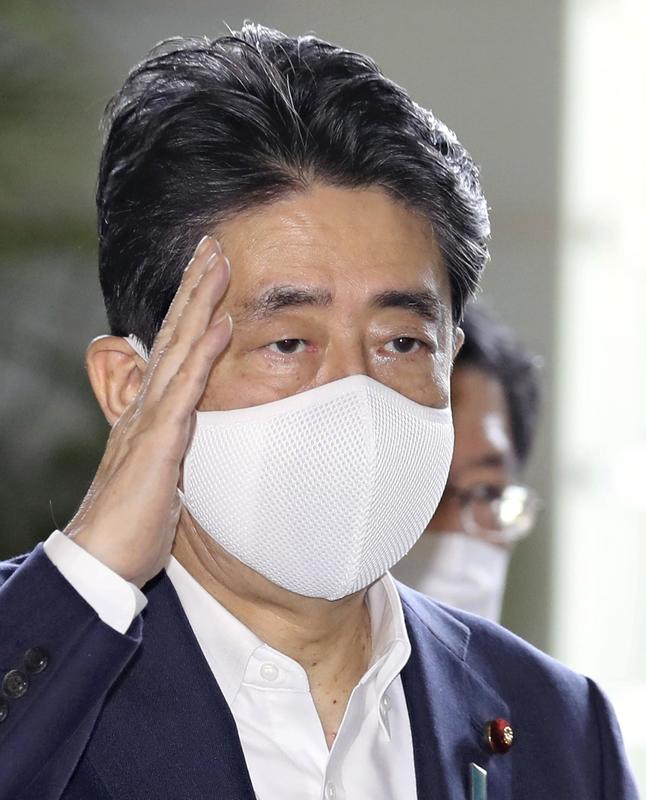
The disapproval rate for Prime Minister Shinzo Abe's Cabinet was 54%, the highest since the inauguration of Abe's second Cabinet in December 2012, according to a nationwide opinion poll conducted by The Yomiuri Shimbum from Friday to Sunday. The figure is two percentage points higher than the previous poll of 52% recorded from July 3 to July 5.
Meanwhile, the approval rate for the Cabinet was at 37%, almost unchanged from 39% in the prior poll. It is the fifth consecutive poll since April that disapproval exceeded approval.
On the government's response to the novel coronavirus, the answer "do not approve" rose to 66% from July's survery of 48%, the highest figure of the six surveys conducted since February, when The Yomiuri Shimbun began asking the same question. "Approve" ranked lowest at 27%, compared to July's 45%. Seventy-eight percent of people thought Abe was not taking leadership in dealing with the novel coronavirus.
Opinions were divided on whether or not the government should declare a state of emergency. Forty-nine percent answered "should be declared immediately to protect people's health" (47% in July), while 48% said "should be prudently considered while taking into account the economic impact" (49% in July).
Regarding favorability, former Liberal Democratic Party Secretary General Shigeru Ishiba was the most favored LDP politician as the next suitable prime minister, taking a 24% slice of the poll, down from 26% in a June survey, followed by Environment Minister Shinjiro Koizumi with 16% (15% in June), Defense Minister Taro Kono with 13% (8% in June) and Prime Minister Shinzo Abe with 12% (15% in June).
The support rate for political parties was 33% for the LDP (32% in July), 5% for the Constitutional Democratic Party of Japan (5% in July), and those who have no party to support was unchanged from July at 46%.
Asked about thoughts on returning to hometowns during this year's obon holiday in mid-August, 76% of the respondents said they "should refrain from it due to fears over spreading infections," far more than the 22% who said they see "no problem as long as infection prevention measures are thoroughly taken."
By region, Hokkaido and Tohoku had the highest percentage of the "should refrain" answer at 87%, while the Kinki region had the lowest at 67%. The figure stood at 75% in the Kanto region and 67% in Tokyo.
Regarding the government's launch in July of the "Go To Travel" campaign to support tourism by offering discounts on travel expenses, 85% of the respondents said "It wasn't appropriate," while 10% said "It was appropriate." The campaign started in 46 of 47 prefectures, as Tokyo was exempted, but the percentage of people who answered "It wasn't appropriate" varied little by city size or region.
The percentage of people who were worried they might become seriously ill after being infected with the novel coronavirus was at 73%, with 20% worried "a lot" and 53% "somewhat." Twenty seven percent were not worried, with 21% "not very" worried and 6% "not at all." By age group, the percentage of worried people was higher for the elderly: 80% for those aged 60 or over; 72% from 40-59, and 62% from 18-39.
The Yomiuri Shimbun used computers to randomly choose landline and mobile phone numbers of those with voting rights at 18 or older across the nation to make calls. It acquired 1,083 valid answers from 533 landline phones and 550 mobile phones.
Read more from The Japan News at https://japannews.yomiuri.co.jp/