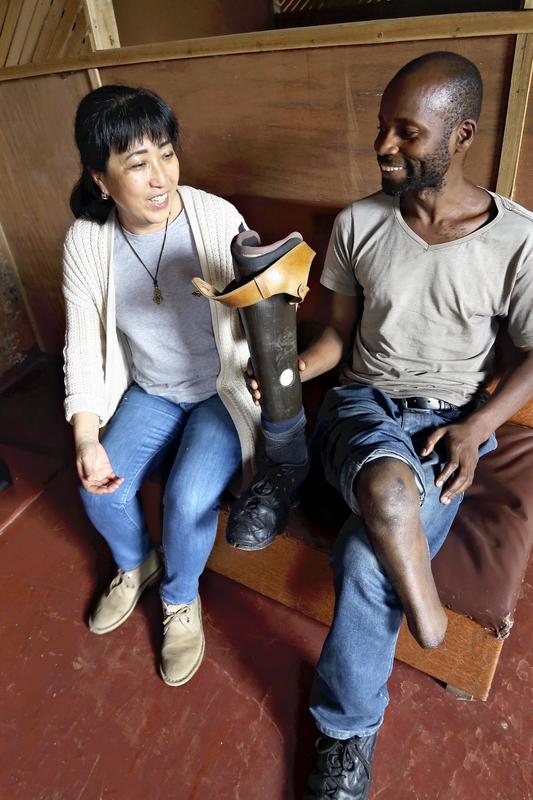
Mami Rudasingwa, the recipient of the 25th Yomiuri International Cooperation Prize, has made and distributed free artificial limbs for thousands of people, including men and women who lost arms and legs in the Rwandan genocide (see below). For about 20 years, this 55-year-old Japanese woman has unstintingly devoted herself to supporting disabled people in Africa, helping to fulfill their wish to walk again on their own legs. This page presents her activities as reported by Yomiuri Shimbun Correspondent Tatsuya Kimura.
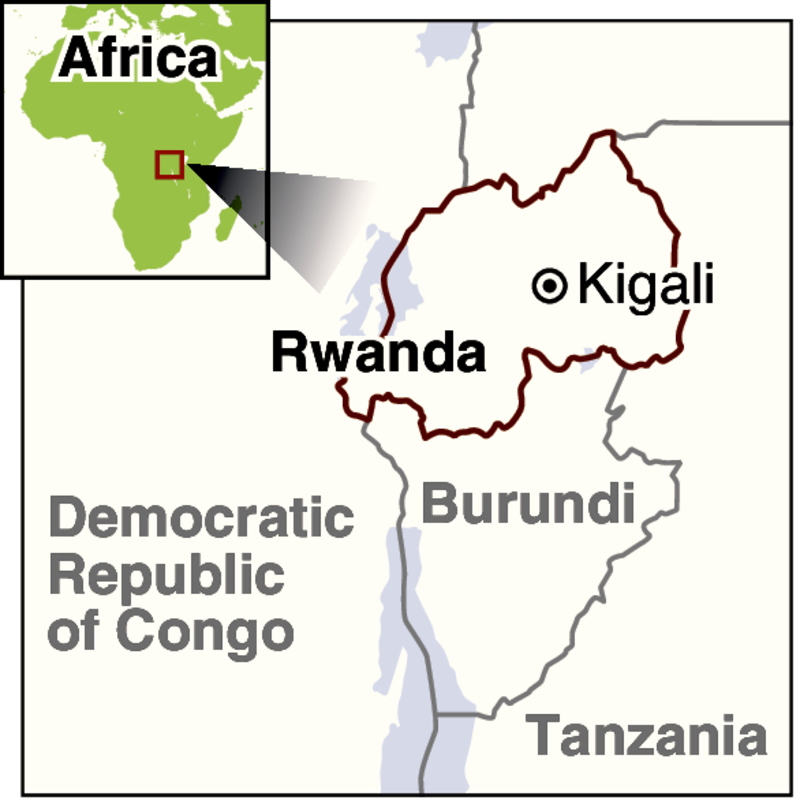
KIGALI -- The tree-lined streets of Kigali are bright in the sunlight. In a lushly green corner of a clean urban area stands One Love Land. This complex is the headquarters of Mulindi / Japan One Love Project (see below), the nongovernmental organization run by Mami Rudasingwa.
Inside its brick workshop for prosthetic limbs, a variety of tools are lined up against the wall, and there is a low hum of machinery for shaping the tips of canes.
"It makes me happy to make an artificial leg and see a disabled person become able to walk," said technician Assier Nyirinkwaya, 33, with a smile. Nyirinkwaya has worked at the factory for 11 years.
Mulindi / Japan One Love Project was launched in 1997. It has provided artificial arms and legs free of charge to disabled people who lost limbs due to the Rwandan genocide that occurred in 1994, as well as people who were disabled due to illness and other causes. More than 8,600 people are said to have received items such as artificial legs and canes, including people in the neighboring country of Burundi, helping them to live more independent lives.
At the workshop's reception area are files on people who have received prosthetic legs, containing their words of thanks.
"I wasn't used to it at first, but I want to practice so I can walk to school with everybody else," wrote an 8-year-old girl. A 47-year-old woman wrote: "I was often teased as a child because I didn't have a leg, but now I'm very happy that I could get an artificial leg. I want to go to lots of different places."
After asking recipients about how they lost their leg and other information, the workshop makes a cast of the remaining part of their leg with bandages covered with plaster and creates the prosthetic.
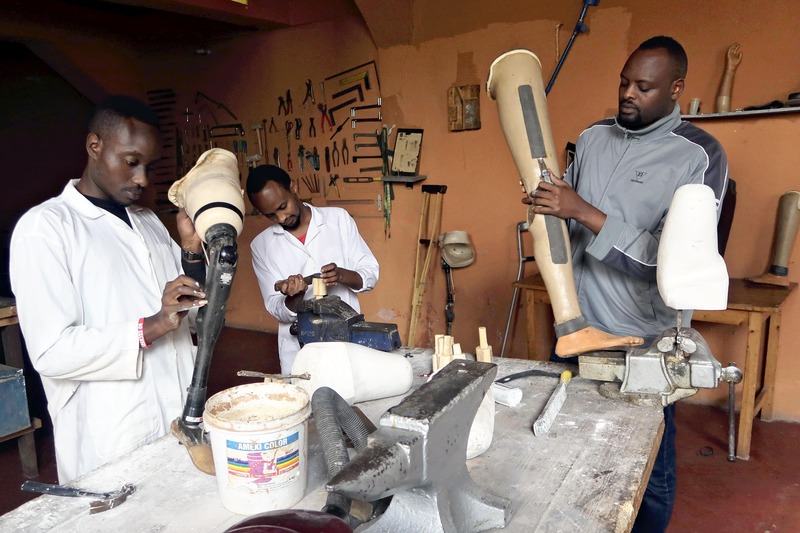
Expensive materials, machinery and other items used to make prosthetics in Japan are not available in Rwanda. However, the NGO uses its knowledge and various measures to overcome these obstacles: For example, it utilizes inexpensive materials such as plastic pipes, and uses a vacuum cleaner instead of a vacuum pump to remove air from the cast.
Despite these limitations, Mulindi / Japan One Love Project works to create prosthetic legs tailored to each person's situation, including size, skin color and individual lifestyle.
Electrician Evode Habimana, 42, received a new artificial leg from the workshop in August. Habimana lost his right leg from the shin down in 1994, as a result of being shot during the genocide. He was able to work thanks to an artificial leg he received after that, but it did not match the length of his left leg, forcing him to bend his body as he walked.
"They asked about my wants, including adjusting the length, so now I can walk with my body straight," said Habimana as he rubbed his brand-new leg.
Bringing workshop to Rwanda
Mulindi / Japan One Love Project has been the joint work of Rudasingwa and her husband, Gatera, 63. Due to improper treatment of an illness he suffered as a child, Gatera became disabled in his right leg and was brought up away from his parents, in a support facility for disabled persons.
"As thanks for the help that I was given, I want to give back by supporting my countrymen and women in the same position," Gatera said.
Wanting to make equipment for Gatera's leg, as well as acquire a technical skill, Rudasingwa spent five years from 1992 studying at a prosthetics workshop in Totsuka Ward, Yokohama. It was during this period that the Rwandan genocide occurred.
She realized that the many people who were disabled in the violence would need artificial legs and that she had the ability to create them. She had already decided to go to Rwanda, and now she had a new purpose in helping the victims of the attacks.
In 1997, the couple opened their workshop in a small converted restaurant in Kigali. While operating there, they also obtained about 1.5 hectares of land through negotiations with the Rwandan government. They cleared the land and made bricks for its structures by hand, building up their headquarters complex from nothing.
In 2000, they moved to their current premises, which also contain such facilities as guesthouses and restaurants. About 30 employees work there.
Donations needed
About 10 percent of Rwandans are said to have some kind of handicap. Therefore, to help people who cannot afford to travel to Kigali, Mulindi / Japan One Love Project travels around the nation to examine people. They also provide job training for disabled people, and have so far dispatched 10 technicians to Japan to study techniques for making artificial limbs. Some of these trainees have opened their own workshop for making prosthetic legs.
However, there have been endless difficulties as well.
"Our biggest concern is financing difficulties," Rudasingwa said. The guesthouses and other endeavors bring in revenue, but about 70 percent of the NGO's operational expenses are covered by donations from Japan and elsewhere.
There is serious damage from repeated flooding, with heavy rain causing the river on the grounds to overflow. Items such as materials and tools for making artificial legs have been ruined by flooding.
Nevertheless, "I'm happy when I see the smiling face of a disabled person who can walk after putting on their artificial leg," Rudasingwa said with a smile. Her valuable work in Africa of fostering hope through artificial legs will continue.
-- Rwandan genocide
In 1994, a plane carrying Rwandan President Juvenal Habyarimana, a Hutu, was shot down. Hutu hard-liners subsequently began indiscriminately murdering Tutsis and Hutu moderates. More than 800,000 people are believed to have been killed in only three months. The ethnic conflict stemmed from Belgium's policy of favoring the Tutsis when it colonized the area.
-- Mulindi / Japan One Love Project
Launched in 1997, this private organization has provided disabled people with such needed items as prosthetic legs and canes free of charge in Rwanda for more than 20 years. Mulindi is the name of a northern village in that nation where Gatera Rudasingwa pledged before many Rwandans in 1993 to provide free artificial legs. "One Love" represents the desire to overcome such ethnic strife as the Rwandan genocide and love each other as one.
Supporting para-sports for Rwandan people
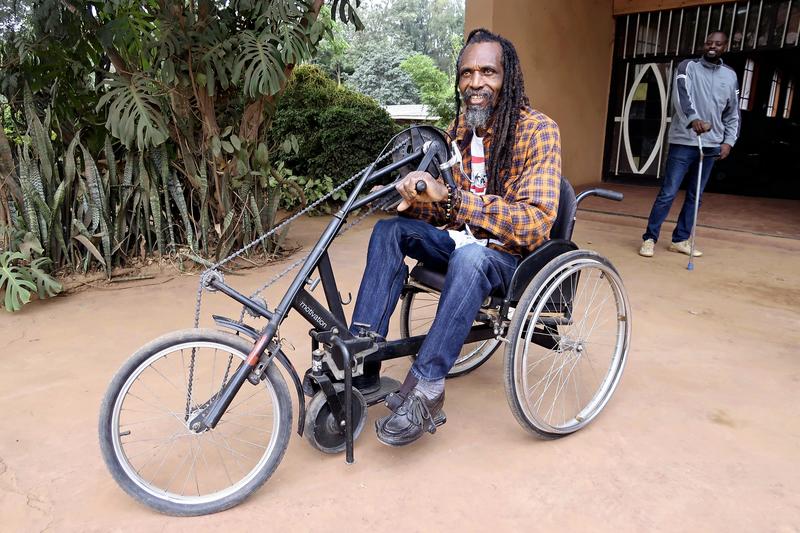
Mami Rudasingwa and other members of the project are making efforts to promote sports for the disabled as well as offering prosthetic limbs.
She wants disabled people to know that "even if they are disabled, there are many things they can do, and they also can find something new."
During the 2000 Sydney Paralympics, a Rwandan man who was a prosthetist in the workshop participated as the first Paralympian swimmer from Rwanda. Rudasingwa also walked with Rwandan athletes during the opening ceremony.
After those Paralympics, the Federation Rwandaise Handisport was formed. It has since changed its name to the National Paralympic Committee of Rwanda and is run by the people of Rwanda, which has continued to participate in the Paralympic Games.
Gatera, Rudasingwa's husband, aims to compete in a wheelchair marathon at the 2020 Tokyo Paralympics.
"I'm not young, but my body can endure the race as long as I have the desire," Gatera said. "I hope I become a role model for other disabled people."
Husband spurs quest for artificial limbs
"I am so appreciative," Mami Rudasingwa said. "I'd like to buy materials with the prize money to make prosthetic limbs."
Her husband, Gatera, has motivated her to devote herself to the project. They met in Nairobi in 1989. Rudasingwa, from Chigasaki, Kanagawa Prefecture, had worked as an office clerk among other jobs in Japan after graduating from a school specializing in the English language.
When she was 26, she "became sick and tired of a monotonous daily life" and went to Kenya to take a Swahili language course she happened to find. Then she met Gatera, a refugee from Rwanda, working as a vendor of folk arts and crafts.
They had been drawn to each other while they were exchanging letters even after Rudasingwa went back to Japan. She had learned to make prosthetic limbs through her affection for Gatera, who has a leg disability. In the wake of the genocide in Rwanda, the number of impaired people who need support rapidly increased. More than 20 years have passed since she started the workshop.
"I have been told, 'You are amazing,' but I just want a place to make use of my skills," Rudasingwa said. She feels that an emotional barrier would emerge if she consciously wanted to help disabled people.
She has been concerned about having a successor for her project.
"I want this project to continue even after we die. However, I cannot find someone who has the will to do it," she said. "Sometimes, I felt I wanted to quit the project, but I cannot get away as I have gotten deeply involved with it, so I'll stick with it."
From zero to steady path
The following is a statement from Yukio Sato, chairman of the YICP Selection Committee
For more than 20 years, Ms. Mami Rudasingwa has steadily been working for humanitarian support to produce and offer prosthetic limbs for free to people who lost their arms and legs in the Rwandan genocide.
She has executed every operation from scratch, including soliciting donations and building an on-site base. Her sincere activities to continue to present prosthetic limbs to victims of ethnic dispute, which makes them harbor hope to become self-reliant, can be said to be an international contribution that Japan can be proud of in the world. Ahead of the 2020 Tokyo Paralympics, another contribution that she has made to the spread and promotion of sports for disabled people in the developing country also deserves special mention.
Yomiuri International Cooperation Prize
The Yomiuri International Cooperation Prize was established in 1994 to commemorate the 120th anniversary of the launch of The Yomiuri Shimbun. The prize is awarded to individuals or groups recognized for their outstanding achievements in the field of international cooperation.
YICP Selection Committee members:
Yukio Sato -- Councilor of the Japan Institute of International Affairs
Ritsuko Nagao -- Honorary president of the Japan National Council of Social Welfare
Kenzo Oshima -- Former Japanese ambassador to the United Nations
Ken Sato -- Adviser of Nakasone Peace Institute
Shoichi Oikawa -- Executive adviser and senior deputy editor-in-chief of The Yomiuri Shimbun Holdings, editor in chief of The Japan News
Read more from The Japan News at https://japannews.yomiuri.co.jp/