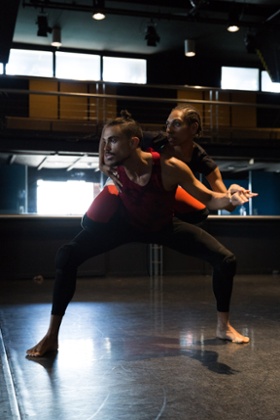
Sustaining and developing the 40,000 year old Indigenous arts culture means keeping it alive with new talent. Bangarra, the highly acclaimed contemporary dance company, recently announced Yolanda Lowatta, a Geide woman from the Torres Strait Islands, had won a place in the ensemble supported by the Russell Page fellowship. Lowatt has been doing traditional dance since she was a toddler and graduated from Brisbane’s Aboriginal Centre for the Performing Arts. She’s currently appearing in her first Bangarra production, Lore, a double bill of dance works I.B.I.S and Sheoak, playing at Sydney Opera House.
What are the two dance works in Bangarra’s show Lore about and what do they mean to you?
Ibis is a community shop in the Torres Straits. It’s the only shop they have, and the [dance] work is about the day of a Torres Strait islander. The different sections of the Ibis become different sections of the piece. I think Ibis connects with me more because I am Torres Strait. I can relate to the whole story and how, for most Torres Strait Islanders, that is a big part of their life. Although they can hunt and gather outside of the shop, it’s a place where they can pay bills and buy electricity cards. Most of my life revolves around Ibis when I’m home. I find myself in there on a daily basis because it’s so hot, and so you go in there for the air conditioning.
Sheoak is about the tree, and what it symbolises to us, in that it carries law and the old generation, and that knowledge. There is a section in it about the toxicness of the people around me, how they are affected by society today and how they take it on. It’s a very deep and heavy piece, I can really relate [as I] have been in that kind of environment.
What do you wish people knew about the Torres Straits?
How much beauty is up there. Not just the water, sand, sun and the reef, but the people and the community and how they are so family-oriented. It’s really beautiful up there, [it’s] something they respect and follow.
What did it mean to you to be awarded Bangarra’s Russell Page fellowship?
When it happened, it was very exciting and an eye opener. It made me feel really humbled to be a part of that legacy and be a part of the company. It was something I had aimed for, so it was a very big goal met.
Do you remember the moment you decided to make dancing your career?
Yes, at college, the Aboriginal Centre for the Performing Arts in Brisbane. I had to make a decision about what I wanted to do [in my final year] and I didn’t know if I should pick dance. At the time it was a hobby I really liked doing, that made me feel amazing. It gave me the ability to be someone else and not be myself. To express the way I feel or portray something and not have that pressure.
Did you work with [former resident artistic director] Leah Purcell at the college?
Yes, she is an amazing woman. I came into the college without discipline. I knew I wanted to act or sing or dance but I didn’t really have drive. That’s where I got it from. She’s very tough but in a good way.
What is the college like?
It’s a really good place for young Indigenous people coming out of communities and places where you don’t get the opportunity to attend a fancy dance or acting school. It’s taking that step from community to mainstream arts. You get a lot of kids that come in and they are not really disciplined and that’s a good place to start. [Also] it is very close, it’s like a family there because it’s all the same people coming from different places, doing the same thing, and working for it.
Sounds similar to Bangarra?
It’s very much the same. I think it’s the culture that brings us all very close, and we have similarities although we come from different places.
Are you a passionate supporter of Indigenous issues?
I’m passionate about a lot of things but I think it’s more about equality, despite colour or race or age or size or whatever else. The one thing I’m really passionate about is equality.
What would you like to see for the future of Indigenous arts?
If it keeps going the way it is going, and gets a chance to be sustained and viewed by different people, not just the same people, [it will] bring awareness to that culture.
-
Bangarra’s Lore is on at the Sydney Opera House until 4 July, then tours Canberra, Wollongong, Brisbane, Melbourne and regional areas