
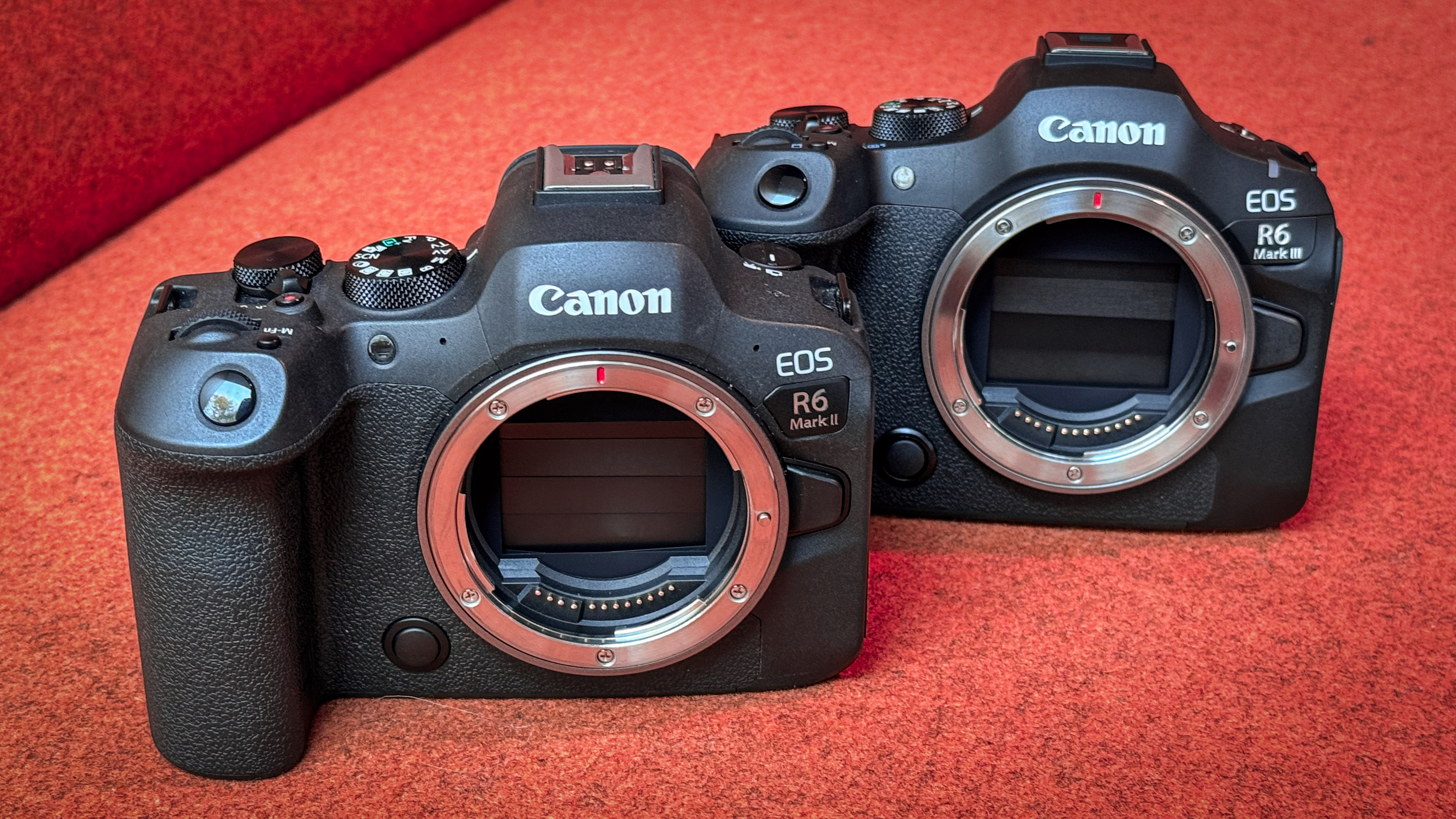
There's a reason that the Canon EOS R6 Mark II is one of the company's best-selling products: it's an almost perfectly-pitched hybrid camera.
Of course, we live in a world of "bigger, better, more" – and the Canon EOS R6 Mark II, launched at the end of 2022, has been replaced by the R6 Mark III. But while the III is undoubtedly the better camera, the II might actually be the better one for you.
Let me explain.
I love the R6 Mark III – so much that I briefly considered buying one over the R5 Mark II. But it's a horsepower camera. Its key features – 32.5MP stills and 7K video (including open gate) – are geared towards power users.
Crucially, this means that it's also geared towards power users with lots of storage. And today, of course, we live in a world of "fewer, rarer, more expensive" when it comes to memory.
This is one of the reasons why I think the Canon EOS R6 Mark II could actually be the smarter buy for most users.
Why the Canon EOS R6 Mark II in 2026?
Again, I want to stress how much I enjoy using the Mark III. It's a newer, faster, beefier and just plain better camera. But better specs don't always make for a better buy.
I recently shot a live event in 7K 30p open gate – a flagship feature of the III. And while it was useful for a very specific purpose, the sheer size (over 100GB) makes it utterly impractical – and, in terms of storage, unaffordable – for most jobs.
People forget that the Canon EOS R6 Mark II can shoot 6K 60p (including RAW, externally), which is still more than enough resolution when you actually need it. But 90% of the time, you probably don't.
Ditto the 24.4MP stills resolution. Are you going to be shooting archival prints on it? Probably not – but that's not what the Canon EOS R6 Mark II is for. It's a crossover camera for hybrid stills and video shooters – and 90% of the time, 24.4MP is probably enough.

In almost all other respects, the Canon EOS R6 Mark II and Mark III are neck-and-neck in terms of specs, from stabilization (8 stops and 8.5, respectively) to burst rate (12fps mechanically / 40fps electronically on both).
The R6 Mark III does boast better autofocus for wildlife, a higher ISO ceiling (a native 64,000 compared to 25,600 on its predecessor), a faster second memory card slot (albeit more expensive, being a CFexpress B) and the addition of Canon Log 2.
But again, these are all very specific features aimed very specifically at power users. Do you truly, honestly need them for what you shoot?
The Canon EOS R6 Mark II is available right now for $1,799 / £1,829 / AU$ 2,408, whereas the Mark III is selling for $2,799 / £2,370 / AU$3,499. And, again, it's worth every penny – but make sure to ask yourself, are those pennies that you really need to spend?
You might also like…
Here's my Canon EOS R6 Mark II vs R6 Mark III comparison with a head-to-head look at the key differences. You can also check out the best lenses for the Canon EOS R6 Mark II along with the best lenses for the Canon EOS R6 Mark III.